
Federal Reserve Policy and Its Catalytic Role in the 2025 Crypto Bull Run


 Aime Summary
The 2025 crypto bull run is not a product of speculative frenzy alone but a convergence of macroeconomic tailwinds, institutional-grade infrastructure, and blockchain innovation. At the heart of this dynamic lies the Federal Reserve’s dovish pivot, which has redefined capital allocation strategies and amplified the appeal of digital assets as a hedge against monetary devaluation. As rate cuts loom on the horizon, BitcoinBTC--, EthereumETH--, and SolanaSOL-- are emerging as linchpins of a maturing crypto ecosystem, supported by institutional inflows and protocol-level upgrades that address scalability and utility.
Fed Rate Cuts: A Catalyst for Institutional Capital Reallocation
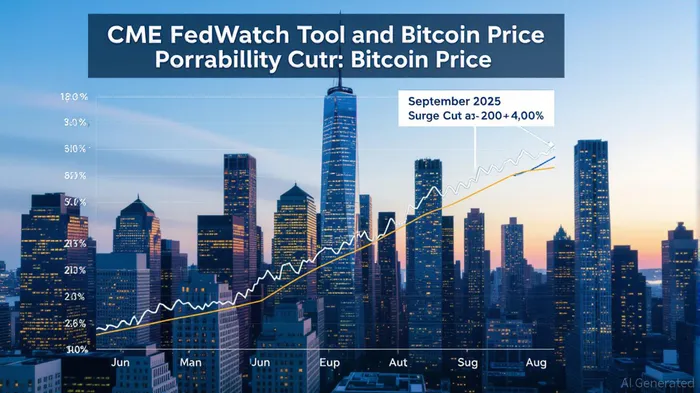
The Federal Reserve’s anticipated 2025 rate cuts—projected at 100 basis points across three meetings—have already triggered a shift in institutional investor behavior. With the CME FedWatch Tool indicating a 91% probability of a September 2025 cut, capital is flowing into crypto as a non-correlated asset class. Bitcoin surged 10% to $117,300, while Ethereum gained 11.51% in a single day, reflecting renewed speculative and hedging demand [1]. The Crypto Fear & Greed Index, oscillating between 44 and 60, has become a contrarian tool for institutions to time entries, with “Fear” readings prompting accumulation and “Greed” peaks triggering hedging via derivatives [1].
Institutional strategies are also adapting to the Fed’s signals. A 5–10% allocation to Bitcoin and Ethereum is now recommended to hedge against dollar depreciation, while regulatory clarity—such as the CLARITY Act—has streamlined access via ETFs and staking mechanisms. Ethereum ETFs, for instance, delivered 9.5% annualized returns, and the ETH/BTC ratio rose from 0.03 to 0.05 by August 2025, signaling a shift in institutional preference toward utility-driven assets [2].
Blockchain Upgrades: Enabling Institutional Adoption
While macroeconomic factors set the stage, blockchain upgrades have provided the infrastructure for sustained growth. Ethereum’s Dencun and Pectra hard forks reduced gas fees by 53%, making it a scalable platform for tokenized real-world assets (RWAs) and DeFi protocols. With $223 billion in TVL, Ethereum’s dominance in on-chain finance is reinforced by its proof-of-stake model, offering 3–6% staking yields and a deflationary supply mechanism [4].
Solana, meanwhile, has leveraged its Alpenglow upgrade to process 10,000 TPS at $0.00025 per transaction, outpacing Ethereum’s 15 TPS and higher fees. This efficiency has attracted $1.72 billion in corporate treasury holdings, with institutions favoring Solana for high-frequency DeFi and cross-border transactions [3]. Bitcoin’s institutional adoption has also accelerated, driven by the U.S. CLARITY Act and SEC-approved ETFs like BlackRock’s IBITIBIT--, which unlocked $132.5 billion in capital. The 2024 halving event further solidified Bitcoin’s scarcity model, pushing prices toward $124,000 [1].
Strategic Entry Points: Dollar-Cost Averaging in a Maturing Market
The interplay of Fed policy and blockchain innovation creates a compelling case for dollar-cost averaging (DCA) into Bitcoin, Ethereum, and Solana. Institutions are increasingly viewing these assets as foundational infrastructure rather than speculative gambles. For example, 59% of institutional investors allocated at least 10% of their portfolios to Bitcoin by Q2 2025, while Ethereum’s ETF inflows outpaced Bitcoin’s due to its utility-driven advantages [2].
DCA mitigates volatility risks, particularly in a market where derivatives metrics like the Deribit put-to-call ratio (1.31) and $3.8 billion in notional value expiring in August 2025 signal active hedging [1]. By systematically investing in these assets, investors align with long-term trends: Bitcoin’s role as a strategic reserve, Ethereum’s dominance in tokenized finance, and Solana’s efficiency in institutional-grade transactions.
Conclusion
The 2025 crypto bull run is a testament to the maturation of digital assets as a legitimate asset class. Federal Reserve rate cuts have catalyzed institutional inflows, while blockchain upgrades have addressed scalability and utility. For investors, dollar-cost averaging into Bitcoin, Ethereum, and Solana offers exposure to a resilient market underpinned by macroeconomic tailwinds, regulatory clarity, and technological innovation. As the Fed’s dovish pivot continues to reshape capital flows, the crypto ecosystem is not just surviving—it is thriving.
**Source:[1] Crypto Market Sentiment and the Fed's Rate Cut Outlook [https://www.ainvest.com/news/crypto-market-sentiment-fed-rate-cut-outlook-navigating-contrarian-opportunities-2508][2] How Fed Rate Cuts and Regulatory Tailwinds Could Spark ... [https://www.ainvest.com/news/fed-rate-cuts-regulatory-tailwinds-spark-record-altcoin-season-2025-2508][3] Solana's Institutional Adoption and the Future of Blockchain [https://www.bitget.com/news/detail/12560604936720][4] Ethereum ETFs Surpassing Bitcoin in Institutional Inflows [https://www.bitget.com/news/detail/12560604937306]

Decoding blockchain innovations and market trends with clarity and precision.
Latest Articles
Stay ahead of the market.
Get curated U.S. market news, insights and key dates delivered to your inbox.


AInvest
PRO
AInvest
PRO



Comments
No comments yet