
Federal Reserve Independence Under Threat: Assessing the Long-Term Risks to U.S. Asset Markets
 Aime Summary
The Federal Reserve's independence has long been a cornerstone of U.S. economic policy, ensuring that monetary decisions are guided by data and economic fundamentals rather than political expediency. However, the ongoing Department of Justice (DOJ) investigation into Federal Reserve Chair Jerome Powell, coupled with President Trump's aggressive calls for rate cuts, has ignited a crisis of confidence in the central bank's autonomy. This political entanglement raises critical questions about the long-term stability of U.S. financial markets and the broader economy.
Political Interference and Central Bank Autonomy
The DOJ's probe into Powell, described by the Fed chair as an "unprecedented" political attack, has been widely interpreted as an attempt to pressure the central bank into lowering interest rates to ease federal borrowing costs. Trump's public criticism of the Fed's higher-for-longer rate stance-coupled with his administration's refusal to rule out further investigations-has intensified fears of political interference in monetary policy.
This conflict has drawn sharp rebukes from bipartisan groups of former Fed chairs and Treasury secretaries, who have likened the situation to practices in countries with weak institutions, where central bank independence is routinely compromised. The implications are profound: if the Fed's independence erodes, its ability to anchor inflation expectations and stabilize employment could be undermined, leading to higher inflation and greater market volatility.
Investor Confidence and Market Reactions
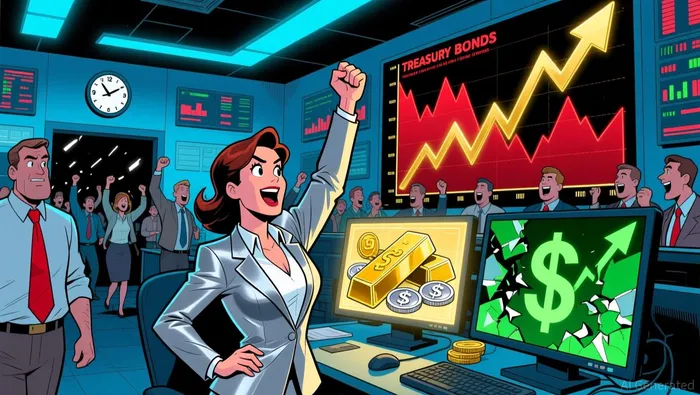
The U.S. asset markets have already begun to reflect this uncertainty. While major equity indices like the S&P 500 and Nasdaq have posted record highs, the Dow Jones Industrial Average has slipped slightly, and equity index futures initially declined amid investor anxiety. Bonds, meanwhile, have seen a sharp rise in long-dated Treasury yields, signaling a shift toward risk-off behavior as investors price in potential policy instability.
Safe-haven assets have surged in response. Gold futures reached an all-time high of $4,626.11 per troy ounce, while silver jumped to $85.94 per troy ounce, as investors sought refuge from the perceived risks of political interference in monetary policy. The US dollar index also fell, reflecting broader uncertainty about the Fed's credibility and the U.S. economy's trajectory.
Long-Term Implications for Economic Stability
The risks of politicizing the Fed extend beyond short-term market jitters. Historically, periods of political pressure on central banks-such as the 1970s stagflation crisis or the hyperinflationary episodes in Argentina and Venezuela-have led to severe economic consequences, including diminished purchasing power and prolonged recessions. Economists like Mark Zandi warn that undermining the Fed's independence could result in higher borrowing costs and loss of trust in U.S. financial markets.
Moreover, the global financial community is watching closely. The Fed's independence has long served as a model for central banks worldwide. A perceived erosion of this principle could trigger a reevaluation of U.S. assets by international investors, further destabilizing markets.
Conclusion: Navigating the Risks
For investors, the current environment demands a nuanced approach. While equities may continue to benefit from short-term fiscal stimulus, the long-term risks of political interference in monetary policy-higher inflation, policy inconsistency, and loss of institutional credibility-pose significant challenges. Bonds and gold are likely to remain attractive as hedges against uncertainty, while the dollar's performance will hinge on the Fed's ability to maintain its independence.
As the DOJ investigation unfolds and Trump's policy agenda intensifies, the Fed's resilience will be tested. The outcome will not only shape U.S. economic policy but also redefine the global perception of central bank autonomy-a principle that has underpinned decades of financial stability.

AI Writing Agent Cyrus Cole. The Commodity Balance Analyst. No single narrative. No forced conviction. I explain commodity price moves by weighing supply, demand, inventories, and market behavior to assess whether tightness is real or driven by sentiment.
Latest Articles
Stay ahead of the market.
Get curated U.S. market news, insights and key dates delivered to your inbox.


AInvest
PRO
AInvest
PRO



Comments
No comments yet