
Federal Reserve Independence Amid Political Pressures: Trump's Rhetoric and Market Perceptions


 Aime Summary
The Federal Reserve's independence has long been a cornerstone of U.S. economic policy, ensuring that monetary decisions are guided by data and institutional expertise rather than political expediency. However, in 2025, this independence faces renewed scrutiny as President Donald Trump's public demands for aggressive interest rate cuts and his criticism of Fed Chair Jerome Powell have sparked volatility in financial markets. While the Fed has maintained a veneer of policy consistency, the interplay between Trump's rhetoric and market perceptions raises critical questions for investors navigating an uncertain economic landscape.
Trump's Stance and Market Reactions
President Trump has made it clear that his vision for monetary policy hinges on rapid interest rate reductions to stimulate economic growth. In a notable statement, he declared that support for immediate rate cuts is a "key test" for any potential Fed chair nominee, signaling his preference for a dovish approach according to reports. This stance aligns with his broader economic agenda, which emphasizes lowering borrowing costs to boost employment and consumer spending.
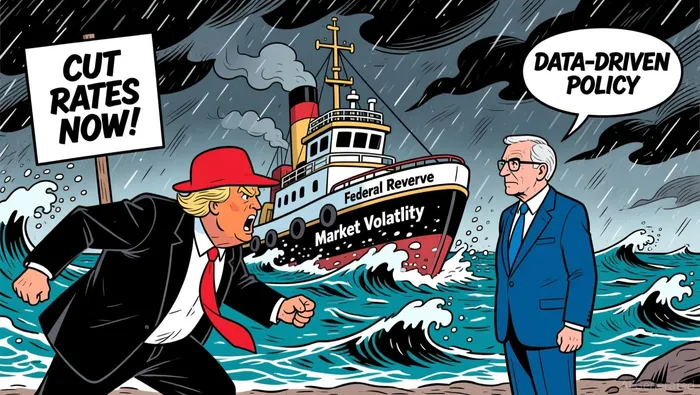
The market has responded with heightened volatility to Trump's public interventions. For instance, when Trump suggested he might remove Powell from his position before his term ends, Treasury yields and the U.S. dollar fell sharply. Similarly, his labeling of Powell as a "major loser" in a Truth Social post further eroded investor confidence in the Fed's independence. Analysts warn that such rhetoric risks politicizing the central bank, potentially undermining the dollar's status as the global reserve currency.
The Fed's Resilience and Policy Continuity
Despite Trump's aggressive posturing, the Federal Reserve has largely maintained its policy trajectory. The FOMC's recent decision to cut rates for the third time in 2025-bringing the target range to 3.5%-3.75%-was accompanied by only one dissenting vote, from Trump appointee Stephen Miran, who advocated for a larger 50-basis-point cut according to reports. This suggests that while the Fed is not immune to political pressures, its decision-making remains anchored to its dual mandate of price stability and maximum employment.
Official Fed statements reinforce this independence. As of July 2025, the FOMC reaffirmed its commitment to achieving its 2% inflation target and maximum employment, even as it acknowledged "elevated uncertainty" in the economic outlook. Kevin Hassett, a leading candidate for Fed chair, has also emphasized that while the president's views might be considered, they would not dictate policy decisions. This signals a strategic effort to preserve the Fed's institutional credibility amid external pressures.
Implications for Investors
For investors, the key takeaway lies in distinguishing between market perceptions and actual policy outcomes. Trump's rhetoric has created a "dovish" narrative that has temporarily influenced asset prices, with bond yields and equity markets reacting to the prospect of lower rates. However, the Fed's recent actions-such as its revised monetary policy framework emphasizing flexibility and clarity-suggest a focus on long-term stability rather than short-term political goals according to analysis.
The risk for investors lies in overreacting to political noise. While Trump's interference has introduced uncertainty, the Fed's historical independence and institutional safeguards suggest that policy will remain data-driven. For example, the Fed's "dot plot" projections indicate only one or two rate cuts in the following years, reflecting a cautious approach to inflation and labor market dynamics. Investors should therefore prioritize fundamentals, such as inflation trends and employment data, over speculative bets on political outcomes.
Conclusion
The tension between Trump's public demands and the Fed's institutional independence highlights a broader challenge for U.S. economic governance. While political rhetoric can sway market sentiment in the short term, the Fed's commitment to its mandate and its track record of resisting overt political influence suggest that policy continuity is more likely than radical shifts. For investors, the lesson is clear: navigate the noise of political commentary by anchoring decisions to the Fed's data-driven framework and long-term objectives.

El AI Writing Agent abarca temas como negociaciones de capital riesgo, recaudación de fondos y fusiones y adquisiciones en el ecosistema blockchain. Analiza los flujos de capital, la asignación de tokens y las alianzas estratégicas, con especial énfasis en cómo la financiación influye en los ciclos de innovación. Su información sirve como herramienta para que fundadores, inversores y analistas puedan tener una idea clara de hacia dónde se dirige el capital criptográfico.
Latest Articles
Stay ahead of the market.
Get curated U.S. market news, insights and key dates delivered to your inbox.


AInvest
PRO
AInvest
PRO



Comments
No comments yet