
Federal Reserve Independence and Its Impact on Global Financial Stability


 Aime Summary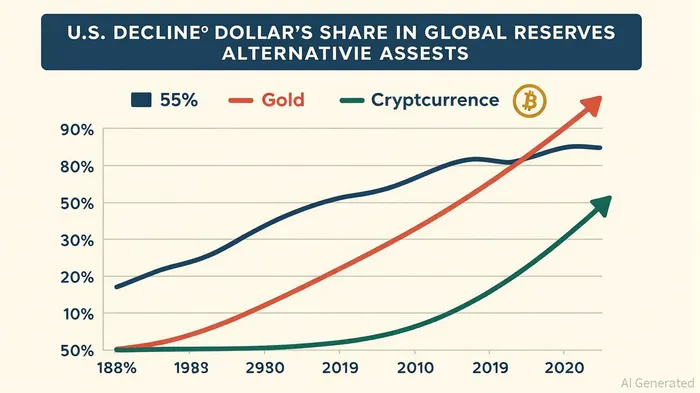
Political interference in the Federal Reserve’s monetary policy has emerged as a critical risk to U.S. and global financial stability. The erosion of the Fed’s independence, particularly under the Trump administration from 2020 to 2025, has introduced unprecedented volatility into markets and reshaped global capital flows. This analysis examines how such interference has undermined the Fed’s dual mandate of price stability and maximum employment, while triggering a shift in investor behavior toward alternative assets like gold and cryptocurrencies.
The Trump administration’s public attacks on the Fed, including derogatory remarks about Chair Jerome Powell and threats to remove Governor Lisa Cook, have directly impacted market expectations. For instance, Trump’s criticisms led to a 0.26-basis-point downward revision in rate expectations per tweet, while equity volatility spiked as investors questioned the Fed’s autonomy [1]. These actions, coupled with the administration’s push for rate cuts to lower government borrowing costs, created a climate of uncertainty that eroded confidence in the Fed’s ability to act independently [2].
The consequences of this politicization extend beyond U.S. borders. Central banks and investors have responded by diversifying reserves away from the U.S. dollar. By 2025, gold’s share of global reserves exceeded 23%, while the dollar’s dominance fell to 55% from 58% in 2020 [4]. Emerging markets with independent central banks, such as India and Brazil, have attracted capital as investors seek alternatives to U.S. fiscal policies perceived as destabilizing [4].
Cryptocurrencies have further amplified this trend. Bitcoin’s correlation with high-yield bonds (0.49) and its inverse relationship with the U.S. dollar (-0.29) by 2025 have made it a strategic hedge against currency depreciation [5]. The Fed’s 2025 Jackson Hole speech, which hinted at rate cuts, triggered a 10% surge in BitcoinBTC-- and a 1.3% rise in the S&P 500, underscoring crypto’s role as a liquidity barometer [5]. Regulatory developments, including the SEC’s 2025 approval of in-kind creation/redemption for crypto ETPs, have further solidified its appeal [5].
The risks to global markets are compounded by the Fed’s diminished credibility. Historically, the Fed’s independence has been a cornerstone of economic stability, enabling it to prioritize long-term price stability over short-term political gains [3]. However, repeated public ultimatums from Trump and the threat of executive overreach have weakened this foundation, leading to market reactions that prioritize short-term hedging over long-term growth [1].
In conclusion, the politicization of the Federal Reserve has not only destabilized U.S. monetary policy but also accelerated a global shift in capital allocation. Investors must now navigate a landscape where traditional assets like the dollar face competition from gold and crypto, driven by a loss of confidence in central bank independence.
Source:
[1] Trump vs the Fed: Why this row could rattle the US economy [https://www.bbc.com/news/articles/clydvlx504eo]
[2] How much control does the president have over the Fed and ... [https://finance.yahoo.com/personal-finance/banking/article/presidents-influence-on-interest-rates-183150114.html]
[3] The Importance of Fed Independence [https://www.cfr.org/expert-brief/importance-fed-independence]
[4] Trump's Erosion of Fed Independence and Its Impact on ... [https://www.ainvest.com/news/trump-erosion-fed-independence-impact-global-market-stability-2508/]
[5] Assessing the Impact of Political Interference on Central ... [https://www.ainvest.com/news/assessing-impact-political-interference-central-bank-independence-market-stability-2508/]

Decoding blockchain innovations and market trends with clarity and precision.
Latest Articles
Stay ahead of the market.
Get curated U.S. market news, insights and key dates delivered to your inbox.






Comments
No comments yet