
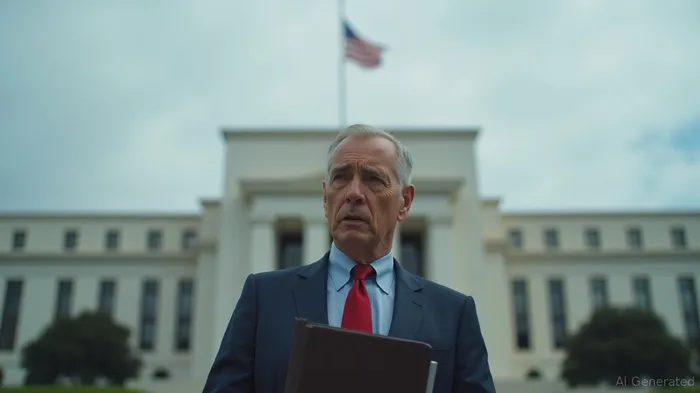
Federal Reserve Independence Faces Unprecedented Test Amid Trump's Pressure
 Aime Summary
In 2021, when inflation surged, the Federal Reserve was criticized for being slow to raise interest rates. However, market expectations for long-term inflation remained relatively stable, which helped the Federal Reserve's anti-inflation efforts proceed more smoothly and at a lower cost. This stability was evident even before the Federal Reserve began raising rates, as the bond market tightened financial conditions on its own.
During a Federal Reserve meeting in Wyoming, an economics professor from the University of California, Berkeley, submitted a paper to global central bank officials. The paper highlighted that the Federal Reserve's credibility is a crucial asset, and any damage to this trust could have significant consequences. The paper noted that maintaining stable long-term inflation expectations, even in the face of high inflation rates of 7% to 8%, requires strong credibility. This credibility is built on institutional safeguards, such as central bank independence, and a good historical record, which can be eroded quickly.
Market reactions to the news of the potential dismissal of Federal Reserve Governor Lisa Cook were initially mild. However, analysts warned that even if the dismissal does not immediately impact policy decisions or market pricing, the seeds of distrust have been planted. For instance, while President Donald Trump may not succeed in removing Cook, this attempt could actually enhance the Federal Reserve's standing. The attitude of the U.S. Senate will be crucial, as Federal Reserve officials require Senate approval, and both parties typically express strong support for central bank independence.
Market participants expect the Federal Reserve to begin lowering interest rates during its September 16-17 meeting, and Cook has indicated that she will continue to participate in policy discussions. Despite this, former Chief Economist of the International Monetary Fund and Honorary Retired Economics Professor at the University of California, Berkeley, Maurice Obstfeld, noted that this move represents a significant challenge to the effectiveness of the Federal Reserve as an independent institution. Its independence is the foundation of its mission to achieve price stability.
This challenge could make it more difficult for the central bank to support employment without disrupting the stability of inflation expectations. Markets may perceive that monetary policy decisions could be more politically motivated, and the central bank could be seen as more focused on government objectives, such as financing large fiscal deficits.
Trump has consistently called for interest rate cuts, believing this would lower the cost of financing the government's large deficits. However, if markets lose confidence in the Federal Reserve's ability to control inflation and demand higher inflation premiums in U.S. Treasury auctions, this strategy could backfire.
Since the 1930s, when Congress passed a series of reforms establishing the current structure of the Federal Reserve, the central bank's reputation and independence have not been fully tested under the pressure of a strong president. The current structure includes a 14-year term for Federal Reserve Board members in Washington and a division of power between the Board and the 12 regional Federal Reserve Banks, reflecting the federal structure of the U.S. government. The underlying logic is that elected officials are often reluctant to make the difficult and unpopular decisions needed to control inflation, while independent experts are more likely to prioritize data and analysis over election results.
However, this structure has been a source of dissatisfaction for Trump and his administration, who have sought to expand executive power. Since returning to the White House in January, Trump has repeatedly pressured the Federal Reserve to cut interest rates without success. In response, Trump cited Cook's past mortgage applications as a reason to dismiss her, providing a pretext for his actions.
Cook, the first Black woman to serve as a Federal Reserve Governor, has a term that extends until 2038, well beyond Trump's presidential term. Two other Federal Reserve Governors appointed by Joe Biden also have terms that exceed Trump's. While Trump could appoint a new chair after Jerome Powell's term ends in May 2023, it is unlikely that he will be able to fill a majority of the Federal Reserve Board with his appointees until 2028, the last full year of his potential second term.
Even then, there is no guarantee that Federal Reserve Governors confirmed by the Senate will comply with White House demands, and regional Federal Reserve Bank presidents, who are independently appointed, also participate in policy decisions. The legal status of Cook's mortgage issues has been referred to the U.S. Department of Justice, but no formal action has been taken yet. On Monday evening, Cook stated in an email that "there is no legal basis for Trump to dismiss me, and he has no authority to do so." Her lawyer, Washington-based attorney Abbe Lowell, stated, "We will take all necessary actions to prevent this illegal behavior."
The developments that follow will test two key questions: first, whether the Federal Reserve's independence in monetary policy is based on practical conventions or has legal protections; and second, how important this independence is for the U.S. and global financial markets, which view the Federal Reserve as a stabilizing force and a cornerstone of the global financial system. For example, during crises, the Federal Reserve has acted swiftly and without political constraints to stabilize markets through tools like currency swap lines, ensuring that other central banks can access the dollar liquidity they and their domestic enterprises may need.
The Federal Reserve Act does allow for the dismissal of a Federal Reserve Governor for "good cause," but it does not define what constitutes "good cause." A recent U.S. Supreme Court ruling seemed to grant the Federal Reserve a carve-out, stating that it cannot be dismissed solely for disagreements over interest rate policy. However, Columbia University law professor Kathleen Jaggar noted that these rulings are not final, and many questions about the Federal Reserve's status remain unanswered.
"The legal system in this area is not well-developed because we have never relied solely on formal law to protect the Federal Reserve's independence. While several presidents have pressured Federal Reserve chairs, we have never faced a situation where a president attempted to dismiss a Federal Reserve Governor," Jaggar said. "If a president is willing to do whatever it takes, based on a broad interpretation of the powers granted to the president under Article II of the U.S. Constitution, to pressure the Federal Reserve to comply with their monetary policy, the independence of the Federal Reserve may be difficult to maintain."

Stay ahead of the market.
Get curated U.S. market news, insights and key dates delivered to your inbox.


AInvest
PRO
AInvest
PRO



Comments
No comments yet