
Federal Reserve's December Rate Decision and Its Impact on Fixed Income Markets
 Aime Summary
The Federal Reserve's December 2025 rate decision
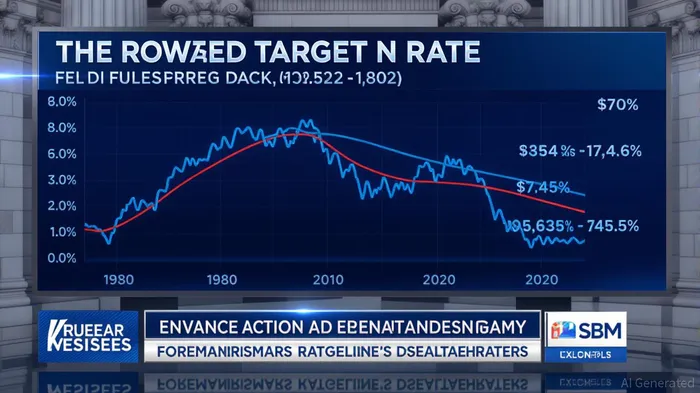
marked a pivotal moment in the ongoing easing cycle, with policymakers cutting the federal funds rate by 25 basis points to a range of 3.5% to 3.75%. This third consecutive rate reduction in 2025 reflects growing concerns over a slowing labor market and persistent inflation,
which remains above the central bank's 2% target. The decision, however, was not unanimous: Governor Stephen Miran advocated for a larger 50-basis-point cut, while Presidents Jeffrey Schmid and Austan Goolsbee opposed any change
according to CNBC reports. The Fed's statement underscored its dual mandate,
acknowledging heightened downside risks to employment while emphasizing the need to maintain inflationary restraint.
The implications for fixed income markets are profound. With the Fed signaling a pause in further rate cuts-projecting only two reductions in 2026 and 2027 before reaching a 3% long-run target-investors are recalibrating their strategies to navigate a shifting rate environment
according to market analysis. The central bank's announcement to begin purchasing Treasury securities to stabilize short-term borrowing costs
adds another layer of complexity, as it signals a willingness to manage liquidity risks amid tightening financial conditions.
Tactical Reallocation: From Cash to Credit
The Fed's easing cycle has prompted a reevaluation of fixed income allocations. Historically, rate cuts have driven capital into bonds, but the 2025 environment demands a nuanced approach.
BlackRock advises investors to move beyond cash and into the "belly" of the yield curve-specifically 3- to 7-year bonds-rather than long-dated Treasuries, which face term premium pressures. This strategy leverages a benign economic outlook while mitigating risks from potential inflation surprises.
Emerging markets debt and senior loans have also gained traction as tactical plays.
Morgan Stanley highlights that emerging markets debt offers a yield premium of nearly 100 basis points on a ratings-adjusted basis, while senior loans have historically delivered positive returns in eight of nine years during Fed easing cycles. These asset classes benefit from lower borrowing costs and resilient fundamentals, particularly in sectors like infrastructure and real estate, where financing opportunities are expanding
according to Titan Funding analysis.
Active Strategies and Valuation Discipline
The U.S. yield curve,
projected to remain range-bound between 4% and 4.75% for 10-year Treasuries, favors active strategies emphasizing credit selection and valuation discipline. Vanguard's analysis underscores the importance of high-yield and municipal bonds, where
attractive entry points and steep yield curves present opportunities for risk-adjusted returns. Meanwhile, the Fed's dovish stance has amplified the appeal of alternatives such as private credit, which offers higher yields and insulation from public market volatility
according to Titan Funding insights.
A softer U.S. dollar, a byproduct of the Fed's easing, further enhances the case for international fixed income.
JPMorgan notes that unhedged USD returns in emerging markets could benefit from stronger local earnings and currency appreciation, particularly in regions with improving fiscal policies. This dynamic aligns with broader global economic recovery trends,
which combined with coordinated monetary policies are fostering a stable investment climate.
Historical Precedents and Forward-Looking Cautions
While the 2025 rate cuts echo past easing cycles, the current environment differs in key respects.
Unlike the aggressive cuts of 2024, this year's reductions are smaller and more measured, reflecting the Fed's cautious approach to balancing growth and inflation. Historical data suggests that long-dated bonds may underperform in shallow rate-cut environments,
reinforcing the preference for intermediate-duration credit. Investors must also remain vigilant about policy uncertainties, such as the incoming administration's proposed tariffs and immigration reforms,
which could disrupt growth trajectories.
In conclusion, the Fed's December decision signals a pivotal shift in monetary policy, with fixed income markets adapting through tactical reallocation. By prioritizing credit quality, intermediate duration, and global diversification, investors can position portfolios to capitalize on the Fed's easing while managing risks in a complex macroeconomic landscape.

Stay ahead of the market.
Get curated U.S. market news, insights and key dates delivered to your inbox.
AInvest
PRO
AInvest
PRO



Comments
No comments yet