
Federal Reserve's December Policy Outlook and Market Implications


 Aime Summary
The Federal Reserve's December 2025 policy decision marked a pivotal moment in its evolving approach to balancing inflation control and economic growth. Amid persistent inflation and a resilient but cooling labor market, the central bank
cut the federal funds rate by 25 basis points, bringing the target range to 3.75–4.00%. This move, however, was not unanimous, with internal divisions underscoring the Fed's struggle to navigate a complex economic landscape. The decision reflects a shift toward a more data-dependent and risk-managed framework, with significant implications for markets and investors.
The Fed's Evolving Rate Decision Framework
The December 2025 FOMC statement emphasized a dual focus on inflation and employment risks. While economic activity expanded "at a moderate pace," job gains slowed, and inflation remained elevated,
prompting the rate cut. Chair Jerome Powell's post-meeting press conference reinforced this cautious stance,
stating that the decision was part of a "risk management approach" to address shifting economic conditions. Notably, Powell clarified that further rate cuts were not a "foregone conclusion,"
a remark that briefly reversed stock market gains.
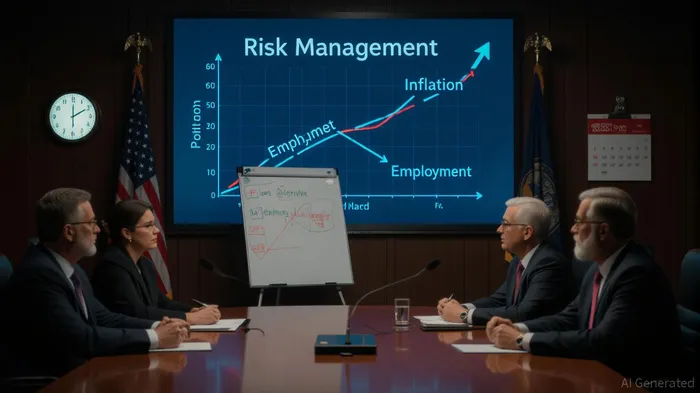
This language highlights the Fed's departure from a rigid, rule-based policy path toward a more flexible framework. The central bank now prioritizes real-time data and evolving risks,
as seen in its response to delayed economic reports caused by a government shutdown. For instance,
the lack of October employment data forced policymakers to rely on private-sector indicators, complicating their assessment of labor market health.
Internal divisions further illustrate this evolution. At the October meeting, Stephen I. Miran advocated for a 50-basis-point cut, while Jeffrey R. Schmid preferred no change
according to internal reports. By December, five of the 12 voting members reportedly opposed further easing
as Reuters reported. Such dissent signals a broader debate within the Fed about the appropriate pace of rate cuts,
with some officials wary of reigniting inflationary pressures.
Inflation Stickiness and Growth Resilience
Despite the rate cut, inflation remains a critical challenge. The , the Fed's preferred gauge, is projected to reach 3.2% in early 2026 before declining
according to Cleveland Fed data. Powell acknowledged that higher tariffs-part of the administration's trade policies-have contributed to inflation, though he stressed the need to prevent these pressures from becoming entrenched
as noted in the press conference transcript. This duality-managing one-time shocks while guarding against persistent inflation-complicates the Fed's mandate.
Meanwhile, growth resilience persists. The labor market, though cooling, remains stable,
. However, hiring momentum has weakened,
. This "K-shaped" economy, where certain sectors thrive while others struggle, adds to the Fed's balancing act
as observed in market commentary.
Market Implications and Investor Strategies
The December decision has significant implications for markets. , with expectations of up to four rate cuts over the next 12 months
according to market analysis. Sectors sensitive to lower rates-such as real estate, utilities, and consumer staples-are likely to benefit, while financials may face pressure due to reduced net interest margins
as noted by Cleveland Fed data.
Investors are also bracing for political uncertainties.
succeeding Powell as Fed Chair has raised concerns about the central bank's independence. Historically, political interference in monetary policy has led to market volatility and eroded credibility,
complicating the Fed's ability to manage inflation and growth.
The S&P 500, currently near record highs, reflects optimism about a gradual rate-cutting cycle. However, this optimism is tempered by risks, including delayed data and potential recessionary pressures
as reported by Plus500. As of Global X notes, the Fed is on a "slow, sustained path toward lower rates," but its success will depend on the pace of disinflation and broader economic stability
according to live commentary.
Conclusion: A Delicate Balancing Act
The Federal Reserve's December 2025 decision underscores its evolving framework, characterized by data dependency, risk management, and internal debate. While rate cuts aim to support employment, they must be balanced against the risk of reigniting inflation. For investors, the path ahead involves navigating sector-specific opportunities and geopolitical uncertainties. As Powell emphasized, the Fed's policy course remains contingent on incoming data-a reminder that monetary policy in 2025 is as much about adaptability as it is about precision.

Stay ahead of the market.
Get curated U.S. market news, insights and key dates delivered to your inbox.






Comments
No comments yet