
Federal Reserve Chairman's Jackson Hole Speech to Guide Market Expectations Amid Political Pressure
 Aime Summary
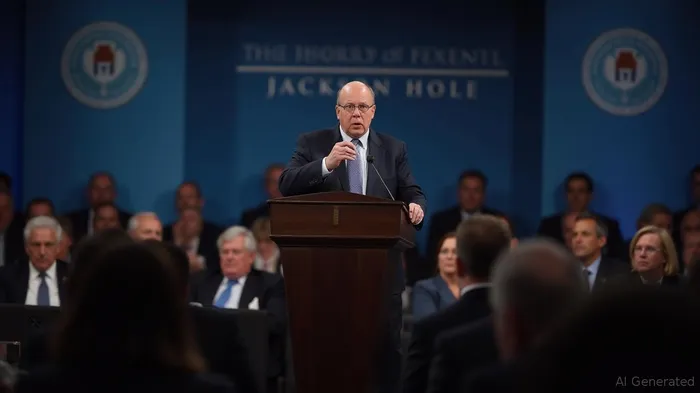
Next week, from August 21 to 23, global investors will be closely watching Jackson Hole, a mountain resort in Wyoming, USA. The Federal Reserve Chairman's speech will provide crucial insights into the future path of US monetary policy. The annual meeting of central bankers, known as the Jackson Hole Symposium, is a highly anticipated event where key figures in the global financial community gather to discuss economic trends and policy directions. This year, the symposium comes at a critical juncture as the global economy faces a myriad of challenges, including inflation, geopolitical tensions, and the lingering effects of the pandemic. The Federal Reserve Chairman's remarks are expected to shed light on the central bank's stance on interest rates, inflation, and economic growth. Investors and analysts will be closely monitoring the speech for any hints on the future direction of monetary policy, particularly in light of recent economic data that has shown mixed signals. The symposium will also feature discussions on global economic issues, with participants from various central banks and international organizations sharing their perspectives. The event is seen as a barometer for the global economy, and any shifts in policy or rhetoric could have significant implications for financial markets worldwide.
The market is holding its breath, with investors widely expecting the Federal Reserve to lower interest rates in the coming weeks. This expectation has driven stock market gains, particularly in sectors sensitive to interest rates. However, any signal that contradicts this expectation could trigger significant market volatility. The Federal Reserve Chairman's speech is one of the most anticipated central bank events of the year, requiring a delicate balance between calming the market and providing a solid economic rationale for the Federal Reserve's decisions.
Behind the speech is immense political pressure. The administration has intensified its criticism of the Federal Reserve Chairman for not lowering interest rates, even suggesting potential replacements. This political interference has made the Federal Reserve's decisions exceptionally challenging. The Federal Reserve Chairman has so far maintained the federal funds rate within the 4.25% to 4.50% range, primarily due to concerns that the administration's tariff policies could exacerbate inflation. Historically, similar political interventions have had disastrous consequences. In the 1970s, pressure from the Nixon administration led then-Federal Reserve Chairman Arthur Burns to maintain low interest rates despite rising inflation, ultimately resulting in double-digit inflation.
The Federal Reserve Chairman has acknowledged that tariffs "could lead to higher inflation, slower economic growth, and increased unemployment," making any decision by the Federal Reserve more complex. Lowering interest rates too early could fuel inflation, while maintaining rates could exacerbate labor market weakness. The Federal Reserve Chairman is navigating a delicate balance between conflicting economic signals and persistent political interference.
Current economic data adds fuel to the debate. While the US economy has largely avoided a recession, achieving a form of "soft landing," the future is fraught with uncertainty. On one hand, inflationary pressures persist. The core consumer price index (CPI) rose 0.3% month-over-month in July, the largest increase since January, with an annual rate of 3.1%. The producer price index (PPI), which measures wholesale inflation, surged 0.9% in the previous month, the largest monthly increase in over three years. These data suggest that tariffs may already be driving up business costs, which could eventually be passed on to consumers. On the other hand, the labor market is cooling. In July, the US added only 73,000 new jobs, with May and June job data revised down by over 250,000. Wage growth has slowed from a 6% annual rate in 2022 to approximately 3.9%. These data have also sparked internal disagreements within the Federal Open Market Committee (FOMC), with two members voting in favor of a rate cut in July's meeting.
Facing this complex situation, the Federal Reserve Chairman is not expected to preemptively reveal the September interest rate decision at Jackson Hole. Instead, the speech will focus on the Federal Reserve's monetary policy framework review, which occurs every five years. This is seen as a key strategy for the Federal Reserve Chairman to defend the central bank's long-term independence. By adjusting the policy framework, the Federal Reserve Chairman can establish guiding principles that transcend his tenure, such as how to respond to supply shocks and how to rebalance the dual mandate of maximum employment and price stability. A former senior official at the Federal Reserve predicts that the Federal Reserve may revert to using "deviations" rather than "shortfalls" to describe employment conditions. This subtle semantic change implies that both overheating and underheating labor markets are problems that need to be addressed, giving the Federal Reserve equal justification to raise or lower interest rates in different scenarios. The Jackson Hole speech will not conclude this battle, but it will demonstrate how the Federal Reserve Chairman balances managing a transitioning economy, confronting political hostility, and refining the decision-making framework. This is not just about a single interest rate decision but about the Federal Reserve's ability to maintain independent breathing in the storm.

Stay ahead of the market.
Get curated U.S. market news, insights and key dates delivered to your inbox.


AInvest
PRO
AInvest
PRO



Comments
No comments yet