
Federal Reserve Building Renovations: Fiscal Oversight or Symbolic Wastefulness?
 Aime Summary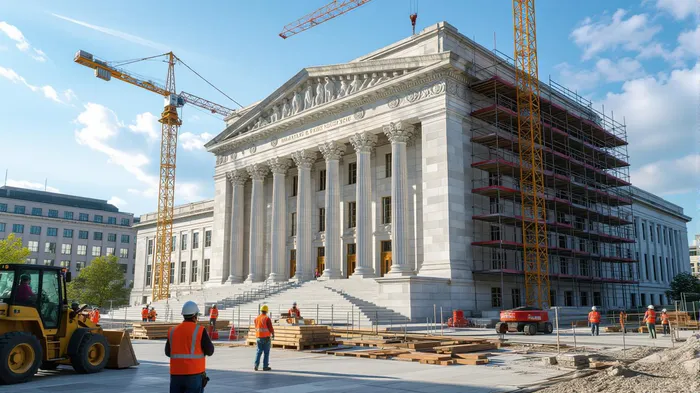
The Federal Reserve's $2.5 billion renovation of its Washington, D.C., headquarters has ignited a heated national debate about the intersection of government spending efficiency, institutional credibility, and public trust. Originally budgeted at $1.9 billion in 2017, the project—focused on the Marriner S. Eccles Building and the 1951 Constitution Avenue Building—has become a lightning rod for criticism, with detractors framing it as a symbol of bureaucratic excess at a time when Americans grapple with inflation and economic uncertainty. Yet for supporters, the project is a necessary investment in safety, functionality, and historic preservation. This article dissects the controversy through the lens of fiscal accountability and its implications for the Fed's role in economic policy.
The Cost Conundrum: Inflation, Unforeseen Challenges, and Design Complexity
The Federal Reserve has attributed the $600 million cost overrun to a mix of inflationary pressures, unforeseen structural issues, and the inherent complexity of renovating two 1930s-era buildings. Key factors include:
- Asbestos and lead removal: Surveys revealed higher-than-anticipated levels of hazardous materials, necessitating costly abatement.
- Modernization demands: Upgrades to electrical, plumbing, HVAC, and security systems to meet 21st-century safety and accessibility standards.
- Design revisions: Collaborative reviews with agencies like the National Capital Planning Commission led to adjustments in plans, including the elimination of water features and scaling back of certain amenities.
Critics, however, argue that these explanations mask poor project management. For example, the cancellation of the New York Avenue Building renovation in 2024 due to cost concerns has been cited as evidence that the Fed could have adopted stricter fiscal discipline from the outset.
Political Scrutiny and the Erosion of Public Trust
The Trump administration has weaponized the renovation as a political cudgel, with figures like OMB Director Russell Vought and National Economic Council Director Kevin Hassett labeling the project “ostentatious” and “the most expensive in D.C. history.” Senate Banking Committee Chairman Tim Scott (R-SC) has likened the renovations to “the Palace of Versailles,” accusing the Fed of prioritizing luxury over fiscal responsibility. These critiques have amplified broader public skepticism about the Fed's independence and its alignment with the economic struggles of everyday Americans.
The timing of the controversy is particularly sensitive. As the Fed grapples with inflation and interest rate normalization, questions about its ability to manage its own budget have spilled into financial markets. The 10-year Treasury yield has remained range-bound between 4.2% and 4.6% since April 2025, while the yield curve has flattened to a historically weak 0.44% spread, signaling investor uncertainty about the Fed's policy credibility.
The Fed's Defense: Safety, Functionality, and Long-Term Value
Federal Reserve Chair Jerome Powell has consistently defended the project, emphasizing that the cost increases stem from inflation and unforeseen conditions rather than wastefulness. The Fed has also underscored that the renovations will consolidate operations, reduce long-term leasing costs, and restore public spaces along the National Mall. Additionally, the use of domestic materials and collaboration with 32 states on procurement has been framed as a commitment to fiscal responsibility.
The Fed's voluntary engagement with oversight bodies—including the National Capital Planning Commission and its independent Office of Inspector General—has been highlighted as a step toward transparency. Powell's request for a fresh audit of the project in 2025 further signals an acknowledgment of public concerns, even as the administration continues to push for “regime change” at the Fed.
Investment Implications: Trust, Credibility, and Market Signals
For investors, the controversy underscores the importance of institutional credibility in shaping economic outcomes. If public trust in the Fed erodes, markets may begin to question its ability to anchor inflation expectations, potentially triggering self-fulfilling inflationary spirals. Defensive assets such as gold and U.S. Treasuries have already seen increased demand in 2025, with gold hitting a yearly high as a hedge against policy uncertainty.
Investors should also monitor the political dynamics surrounding the Fed's independence. If the administration succeeds in imposing stricter budgetary controls or replacing Powell with a more politically aligned figure, the central bank's ability to act as an independent arbiter of monetary policy could be compromised. This could lead to greater volatility in interest rate expectations and a reevaluation of risk assets.
Conclusion: Balancing Fiscal Accountability and Institutional Integrity
The Federal Reserve's building renovations have transcended the realm of infrastructure to become a symbolic battleground for debates about government spending efficiency and institutional credibility. While the Fed has made strides in addressing concerns through transparency and oversight, the political scrutiny highlights the fragility of public trust in an era of heightened polarization.
For investors, the lesson is clear: the Fed's ability to maintain its independence and credibility is not just a policy issue—it's a market issue. As the renovation project unfolds, the central bank's response to criticism will serve as a litmus test for its broader institutional resilience. In the meantime, a diversified portfolio that accounts for policy uncertainty—through allocations to defensive assets and high-quality corporate bonds—may offer a hedge against the ripple effects of this unfolding saga.

Stay ahead of the market.
Get curated U.S. market news, insights and key dates delivered to your inbox.


AInvest
PRO
AInvest
PRO



Comments
No comments yet