
Federal Reserve's $2.5 Billion Renovation Costs: An Analysis of Mismanagement Claims and Real Reasons Behind the Price Tag
ByAinvest
Sunday, Jul 20, 2025 6:56 am ET2min read
The Federal Reserve's building renovation has costs ballooning to $2.5 billion, with critics accusing mismanagement or fraud. However, the price increase is mainly due to challenges of building underground in a former swamp near the Tidal Basin, including difficult foundation work and rising steel prices. The renovation involves adding new office space, removing hazardous materials, and replacing outdated systems. The project has faced setbacks, with costs climbing over 30% since 2023.
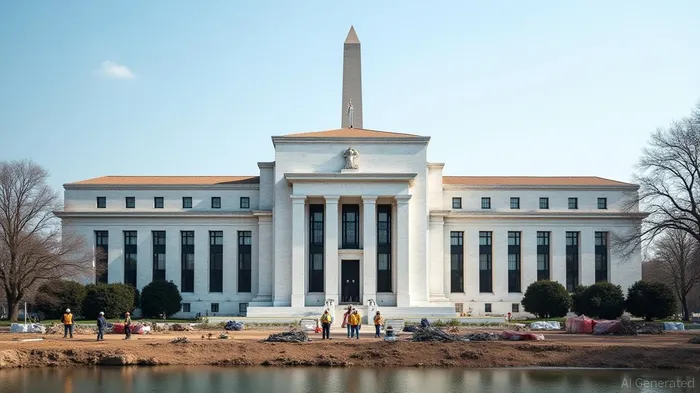
The Federal Reserve's renovation project, which began with an initial cost estimate of $1.9 billion, has seen its budget balloon to $2.5 billion, sparking criticism from allies of former President Donald Trump. The project, which involves the renovation of the Marriner S. Eccles Federal Reserve Board Building and the adjacent Federal Reserve East Building, has faced significant setbacks, with costs increasing by more than 30% since 2023 [1].Critics, including White House officials, have accused the Federal Reserve of mismanagement or fraud, suggesting that the renovation could serve as a pretext for removing Fed Chair Jerome Powell. However, the price tag has less to do with luxurious amenities than the challenges of building in what was once a swamp near the Tidal Basin along the Potomac River [1].
The most significant cost overruns are attributed to underground construction challenges. The project involves converting a parking garage underneath the Eccles Building into additional office space, adding a five-story addition on the north side of the Fed's East Building, and building a 318-space parking garage below the south lawn. These tasks require deep excavation and have proven particularly costly [1].
Foundation work has been particularly difficult, with contractors receiving an award for excellence in the face of adversity from the Washington Building Congress. The project has also faced delays due to the high water table and the need to lower the existing slab to accommodate new basements. These challenges have led to the use of 1,000 micropiles, which are deep foundation steel elements used in ground conditions that do not allow for traditional piles [1].
The rising cost of structural steel has also contributed to the overall price increase. Construction input prices ticked up 0.2% in June, driven by increases in key materials such as copper and fabricated structural metal products. Nonresidential construction input costs are now 2.5% higher than they were a year ago, and the June data predates the steepest tariffs set to take effect in August [2].
The Federal Reserve has defended the renovation work as transparent, attributing the cost overruns to the unique challenges of the project. However, critics argue that the project has been marred by wasteful spending and luxurious amenities. The renovation project is being performed by Fortus, a joint venture between the Dutch design consultancy Arcadis and the Washington, DC-based architecture firm Quinn Evans [1].
The project's design plans have also seen significant changes since they were first introduced. During the first Trump administration, architects proposed using more glass, but Trump appointees to the US Commission of Fine Arts asked for more white marble to align with a proposed mandate from the president requiring all new federal buildings to be classical in style [1].
Despite the challenges and criticism, the Federal Reserve has maintained that the renovation is necessary to ensure the safety and functionality of the historic buildings. The project has faced a tumultuous oversight process but has withstood criticism from various regulatory bodies [1].
References:
[1] https://www.bloomberg.com/news/articles/2025-07-19/trump-s-attacking-powell-over-fed-renovation-here-s-why-it-costs-2-5-billion
[2] https://www.constructiondive.com/news/construction-costs-june-2025-tariff/753255/
Stay ahead of the market.
Get curated U.S. market news, insights and key dates delivered to your inbox.


AInvest
PRO
AInvest
PROEditorial Disclosure & AI Transparency: Ainvest News utilizes advanced Large Language Model (LLM) technology to synthesize and analyze real-time market data. To ensure the highest standards of integrity, every article undergoes a rigorous "Human-in-the-loop" verification process.
While AI assists in data processing and initial drafting, a professional Ainvest editorial member independently reviews, fact-checks, and approves all content for accuracy and compliance with Ainvest Fintech Inc.’s editorial standards. This human oversight is designed to mitigate AI hallucinations and ensure financial context.
Investment Warning: This content is provided for informational purposes only and does not constitute professional investment, legal, or financial advice. Markets involve inherent risks. Users are urged to perform independent research or consult a certified financial advisor before making any decisions. Ainvest Fintech Inc. disclaims all liability for actions taken based on this information. Found an error?Report an Issue


ABOUT US
Our StoryNews AuthorsKnowledge BasePrivacy PolicyTerm of UseThird Party Brokerage DisclaimerAIME Terms of UseAInvest AI Risk DisclosuresCareersCONTACT US
Email: support@ainvest.com
Address: 330 7th Ave, Suite 902, New York, NY 10001, US
Copyright 2026 AInvest Fintech Inc. All rights reserved.


Comments
No comments yet