
Federal Funding Cuts Threaten Education Sector Stability: Time to Reassess Risk Exposure
The University of Arizona's recent loss of $59 million in federal funding—a result of stop-work orders on 64 grants—has exposed a critical vulnerability in the education sector. This crisis is not isolated but part of a broader trend of federal grant instability, which threatens the operational viability of publicly funded institutions and the equities tied to them. For investors, this moment demands a reevaluation of exposure to education-linked stocks, as reduced funding could destabilize endowments, curtail research, and ripple through the broader economy.
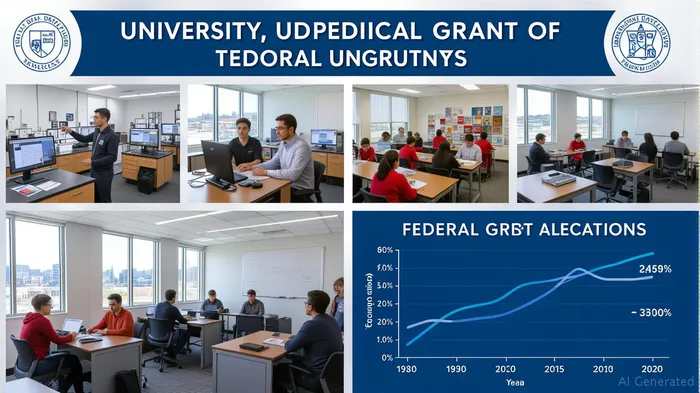
The University of Arizona: A Microcosm of Sector-Wide Risks
The University of Arizona's funding loss stems from a mix of shifting federal priorities, administrative delays, and budget reallocations. While the university has secured temporary relief through state grants and a $20 million Bridge Funding Program, the immediate impact is stark: delayed research projects, frozen faculty hiring, and reduced graduate student support. The crisis underscores a systemic issue—public institutions increasingly operate on a “funding treadmill,” where federal grants are both essential and precarious.
For investors, this raises red flags. Universities with heavy reliance on federal grants (e.g., NIH-funded research) face existential risks if funding dries up. Endowments, already strained by market volatility, may be further diminished as institutions divert resources to plug gaps. The University of Arizona's experience signals that even top-tier research universities are not immune to the whims of federal policy—a risk that could spill into publicly traded education companies.
The Broader Education Sector: A Tsunami of Uncertainty
The University of Arizona's plight is mirrored in K-12 systems, where a $6.2 billion impoundment of federal funds has left states scrambling. The Department of Education's delays in allocating funds for programs like Title I-A and Migrant Education have forced districts to cut staff, reduce course offerings, and scale back after-school initiatives. These cuts disproportionately harm rural and low-income communities, exacerbating equity gaps and reducing demand for education services over time.
For public equities, the implications are clear:
- Reduced enrollment: Budget-strapped families may opt for cheaper alternatives, hurting institutions reliant on tuition.
- Higher compliance costs: Institutions must invest in audits and policy reviews to avoid losing federal aid eligibility—a burden for smaller schools.
- Slower innovation: Research-heavy universities, like UArizona, may delay breakthrough projects, eroding their long-term competitiveness.
Stock Performance: Winners and Losers in the Education Sector
The funding crisis has already begun to reshape the sector's stock landscape. Below is a breakdown of key players and their vulnerabilities:
Strayer Education (STRA): A relative bright spot. Strayer's focus on employer partnerships (e.g., Workforce Edge) and scalable EdTech platforms (Sophia Learning) has insulated it from federal grant volatility. Its Q1 2025 revenue rose 5% to $303.6 million, driven by a 45% surge in ETS segment revenue. Analysts cite its debt-free balance sheet and diversified revenue streams as strengths.
Apollo Education Group (APOL): Struggling under regulatory scrutiny. APOL's flagship University of Phoenix faces enrollment declines and potential divestiture as the sector braces for stricter accreditation rules. Its Q2 2024 revenue dropped 17.5%, and its stock remains under pressure as investors question its long-term viability in a tighter regulatory environment.
Education ETFs (e.g., FUND): Sector-wide volatility has hit ETFs tracking education stocks. The impoundment crisis and compliance risks have dampened investor sentiment, with FUND down nearly 15% year-to-date.
Investment Strategy: Navigating the New Reality
Investors must adopt a three-pronged approach to mitigate risks:
- Prioritize Compliance-Ready Firms: Companies like STRASTRA--, with robust compliance frameworks and diversified revenue, are better positioned to withstand regulatory headwinds.
- Avoid Overexposure to Federal Dependency: Institutions or companies reliant on unstable grant streams (e.g., UArizona's biomedical research arm) face disproportionate risk.
- Consider Short-Term Plays in Compliance Services: Firms offering audit or policy services to universities could see demand spikes as schools prepare for stricter oversight.
Conclusion: The Education Sector's Crossroads
The University of Arizona's funding loss is a wake-up call. Investors must recognize that federal grant instability is no longer an outlier but a systemic risk. While companies like STRA demonstrate resilience through innovation, others like APOL face existential challenges. With the specter of Project 2025—a 23% reduction in domestic spending—looming, now is the time to reassess exposure to education sector portfolios.
For the cautious investor, this is not merely a sector rotation—it's a call to favor firms with sustainable revenue models and the agility to navigate federal uncertainty. The education sector's future will be shaped by those who adapt, not those who assume stability.

Delivering real-time insights and analysis on emerging financial trends and market movements.
Latest Articles
Stay ahead of the market.
Get curated U.S. market news, insights and key dates delivered to your inbox.
AInvest
PRO
AInvest
PRO



Comments
No comments yet