
U.S. Federal Budget Dynamics: Sector Implications and Strategic Asset Allocation in a Shifting Fiscal Landscape
 Aime Summary
The U.S. federal budget in 2025 has become a focal point for investors, as fiscal policy shifts—driven by the One Big Beautiful Bill Act (OBBBA), tariff hikes, and a government shutdown—have created a volatile mix of sector-specific opportunities and risks. With the national debt surpassing $37 trillion and the FY2025 deficit settling at $1.8 trillion, market participants must recalibrate their strategies to navigate the interplay between fiscal expansion, rising interest costs, and sectoral reallocations.
Sector-Specific Market Implications
1. Healthcare and Social Programs: A Long-Term Tailwind
Mandatory spending on Social Security, Medicare, and Medicaid has surged, accounting for a significant portion of FY2025 outlays. These programs are projected to grow as the population ages and healthcare costs rise. For investors, this signals sustained demand for healthcare providers, pharmaceuticals, and medical technology firms. Companies like UnitedHealth GroupUNH-- and CVS HealthCVS-- are likely to benefit from expanded Medicare and Medicaid coverage, while biotech firms with innovative therapies could see increased R&D funding.
2. Education and Student Loan Reforms: A Short-Term Shock
The Department of Education's spending plummeted by 87% in FY2025 due to H.R. 1 reforms, which restructured federal student loan programs. While this creates near-term headwinds for education technology and financial services firms, the long-term impact remains uncertain. Investors should monitor private education providers and fintech companies that cater to alternative lending models, as the sector may adapt to a post-federal loan environment.
3. Tariffs and Manufacturing: Winners and Losers
Customs duties surged by 310% in September 2025, driven by elevated tariffs on imports. This has bolstered domestic manufacturers, particularly in semiconductors (fueled by the CHIPS and Science Act) and energy. However, import-dependent industries—such as automotive and retail—face margin pressures. For example, Tesla's domestic production could gain a competitive edge, while companies like Walmart may see profit compression. Investors should favor firms with strong domestic supply chains and hedge against currency risks for global players.
4. Defense and Government Contracts: A Steady Stream
Defense spending remains a key area of growth, with the Department of Defense's workforce unaffected by the October 2025 shutdown. Lockheed Martin and Raytheon Technologies are poised to benefit from sustained defense budgets. Additionally, the CHIPS Act's $52 billion in semiconductor incentives has spurred investment in tech infrastructure, making firms like Intel and ASML attractive long-term plays.
5. Interest Rates and Debt Servicing: A Looming Overhead
Interest payments on the public debt hit $1 trillion in FY2025, now the second-largest federal expense. This trend pressures long-term bond yields and corporate borrowing costs. Investors in fixed income should prioritize short-duration bonds to mitigate rate risk, while equities in high-yield sectors may face valuation headwinds.
Strategic Asset Allocation in a Fiscal Crosscurrent
1. Overweighting Defensible Sectors
Given the fiscal environment, investors should overweight sectors insulated from deficit-driven volatility. Healthcare, defense, and utilities—whose demand is less sensitive to economic cycles—offer stability. For example, the healthcare sector's 8% outlay growth in FY2025 underscores its resilience.
2. Underweighting Cyclical and Debt-Intensive Sectors
Sectors reliant on discretionary spending, such as education and consumer discretionary, face near-term risks. Similarly, highly leveraged industries (e.g., real estate, industrials) may struggle with rising interest costs. Investors should reduce exposure to these areas or hedge with short-term derivatives.
3. Diversifying Across Asset Classes
The government shutdown and fiscal uncertainty have heightened market volatility. A diversified portfolio—combining equities in resilient sectors, inflation-protected bonds, and alternative assets like gold—can mitigate downside risks. Gold, for instance, has historically performed well during fiscal crises, offering a hedge against currency devaluation.
4. Leveraging Fiscal Policy Catalysts
The OBBBA's tax cuts and spending increases have created winners and losers. Investors should capitalize on undervalued sectors poised for policy-driven growth, such as clean energy (via energy credit repeals) and infrastructure (via CHIPS Act funding). Conversely, sectors facing regulatory headwinds—like traditional energy—may require caution.
Conclusion: Navigating the Fiscal Crossroads
The U.S. fiscal landscape in 2025 is defined by a paradox: short-term surpluses and long-term deficits, sectoral booms and busts, and policy-driven volatility. For investors, the key lies in aligning portfolios with the structural forces shaping the economy. By prioritizing sectors aligned with mandatory spending and technological innovation, hedging against interest rate risks, and maintaining liquidity, investors can position themselves to thrive in an era of fiscal uncertainty.
As the government grapples with a $1.8 trillion deficit and a national debt nearing $37 trillion, the markets will continue to test the resilience of both policymakers and portfolios. Those who adapt swiftly to the fiscal crosscurrents will find opportunities in the turbulence.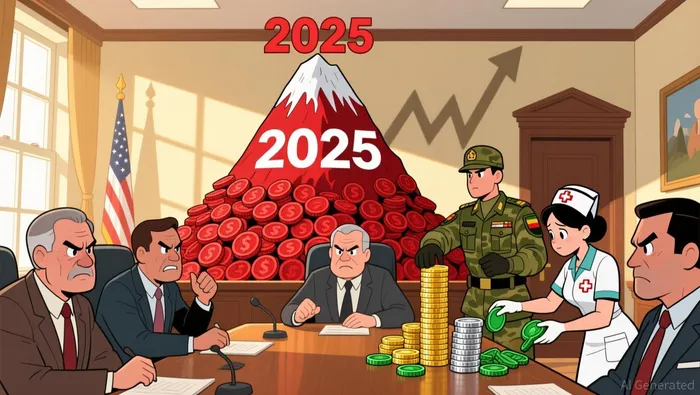

Stay ahead of the market.
Get curated U.S. market news, insights and key dates delivered to your inbox.
AInvest
PRO
AInvest
PRO



Comments
No comments yet