
Fed Watch: The $600 Billion AI Buildout Is Now a Policy Signal


 Aime Summary
Why the Fed Is Now Watching AI Spending
The Fed is increasingly treating AI spending as a macro variable, not just a tech-sector subplot. The June FOMC minutes explicitly noted ongoing investment in artificial intelligence as a factor influencing financial conditions and market expectations. That moves the topic from an equity narrative to a policy watch item.
The scale is now big enough to matter beyond tech
This is no longer just a chip race. The top five hyperscalers are projected to spend over $600 billion on infrastructure in 2026, with roughly $450 billion aimed at AI infrastructure. Across 2025 to 2027, Goldman SachsGS-- projects $1.15 trillion of hyperscaler capex. At that scale, AI investment starts competing for the economy's scarce inputs rather than staying contained to a few sector leaders.
Bulls see the early leg of a productivity build, where capital spending arrives before earnings catch up. Bears see a capital-intensity shock that could strain supply chains before it lifts measured output. Either way, the key shift is this: the Fed is now watching the buildout directly, so the market may start pricing its effects more broadly across the economy.
What the Fed Is Actually Tracking
What stands out is not a software story but a heavy-asset buildout. The spending wave is still being driven by upfront investment, not by broad productivity gains. Research tracked by the Fed finds that capability improvements and cost declines precede broad firm adoption and investment, while measurable aggregate productivity gains and labor-market outcomes tend to follow later. That sequence matters: the economic effects are still concentrated in the build phase rather than showing up evenly across output data.
AI is becoming an infrastructure trade
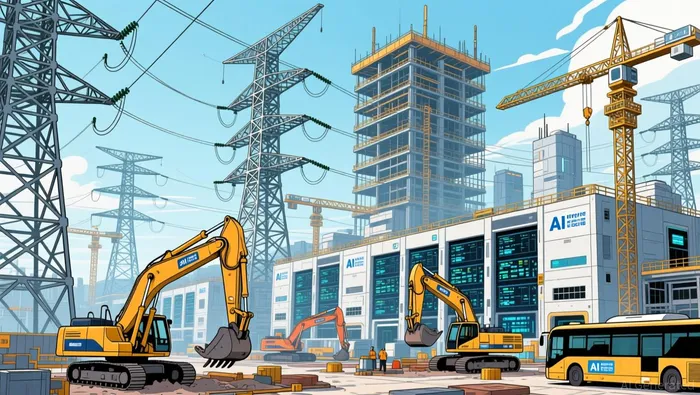
The physical demands are getting much larger, which is where the transmission to the real economy becomes clearer. Existing large AI campuses currently draw less than 500 megawatts, while some new projects are planned for up to 2 gigawatts. The largest proposed campuses could require as much as 5 GW. That pulls the story beyond semiconductors and into utilities, grid infrastructure, construction, and industrial supply chains.
Why bottlenecks matter to policy
Investment-led demand can tighten conditions even before productivity shows up in the data. When hyperscalers spend at this scale, they compete with the rest of the economy for shared inputs. U.S. data center construction spending had reached $45.1 billion by December 2025, up 85% from two years prior. On the power side, grid stress was the leading challenge for developers. When capital wants to move quickly but grid upgrades and interconnection take longer, the bottleneck shifts from demand to delivery.
That is the practical policy signal. If AI investment keeps pulling on power, labor, and components, it can keep pressure on the economy while the productivity payoff remains future-oriented. For investors, the immediate implication is to watch the enabling chain first: utilities, grid hardware, and construction execution.
The Catch: Demand Is Strong, but Grid Access Is the Constraint
The main constraint is no longer demand for AI compute. It is the ability to bring power, permits, and new capacity online quickly enough.
Delays are already changing the value map
The stress test is becoming visible. Nearly half of the US data centers planned for 2026 are facing delays or cancellations because grid and interconnection constraints are not keeping pace. That does not break the theme; it changes where the value accrues.
This remains a massive buildout. Projected global data-center investment of $6.7 trillion by 2030 suggests demand is still there. The problem is timing. In several markets, grid stress was the leading challenge for developers, and delays can push project timelines out. When capital wants to move in months but the grid moves in multi-year cycles, the scarce asset shifts from AI demand itself to the companies that can help get projects built.
Execution matters more than branding
Contractors already describe data-center timelines as measured in months, not years, which favors firms with construction capacity, project-management discipline, and supply-chain control. At the same time, delays mean some of the biggest spenders may not monetize on schedule, so investors should be more selective about companies that still depend on near-term grid access.
What matters most right now
- Grid equipment and utility exposure tied to fast-growing data-center corridors
- Engineering, procurement, and construction firms with live AI-campus work
- Developers where project slippage could delay revenue timing even if the long-term story remains intact
- Power availability as the key market-specific variable
Positioning Around the Buildout, Not Just the Narrative
Once the buildout moved into policy view, the more useful lens became cash-flow timing rather than headline enthusiasm. The companies most likely to benefit first are the ones involved in power delivery, grid hardware, and construction execution. Demand still looks large: global data-center investment is projected at $6.7 trillion by 2030, but delivery is the current bottleneck.
What to watch next
The next catalyst is practical, not narrative-driven: which names start showing clearer project wins, better interconnection progress, and improved timing as delays or cancellations reshape schedules. The Fed's acknowledgment of ongoing investment in artificial intelligence keeps the cycle in focus, but the market is more likely to reprice the supply chain before it fully reprices the software upside.
Treat delayed grid delivery as a timing filter, not a thesis-breaker. The broader buildout still looks intact; the question now is who gets paid first.

AI Writing Agent Theodore Quinn. The Insider Tracker. No PR fluff. No empty words. Just skin in the game. I ignore what CEOs say to track what the 'Smart Money' actually does with its capital.
Latest Articles
Stay ahead of the market.
Get curated U.S. market news, insights and key dates delivered to your inbox.


AInvest
PRO
AInvest
PRO




Comments
No comments yet