
How the Fed's Upcoming Interest Rate Decision Could Trigger a Bitcoin Rally or Correction


 Aime Summary
The Federal Reserve's monetary policy has long been a linchpin for global financial markets, with its decisions on interest rates and forward guidance shaping the trajectory of risk assets like BitcoinBTC--. As the central bank prepares to announce its November 2025 rate decision, investors are bracing for a pivotal moment that could either catalyze a Bitcoin rally or deepen its recent correction. This analysis examines the interplay between the Fed's policy stance, historical crypto market behavior, and the nuanced dynamics of risk-on/risk-off sentiment.
The Fed's November 2025 Dilemma: A Divided Mandate
The Federal Reserve's November 2025 meeting has been marked by internal discord, reflecting its dual mandate of balancing employment and inflation. While the central bank ultimately cut rates by 25 basis points, according to official records, the decision was far from unanimous. Fed Governor advocated for a 50-basis-point cut, while Kansas City Fed President opposed any change according to market analysis. This division underscores the Fed's struggle to navigate a softening labor market-where the unemployment rate rose to 4.4% in September 2025-against persistent inflation, which remained at 2.8%, above the 2% target.
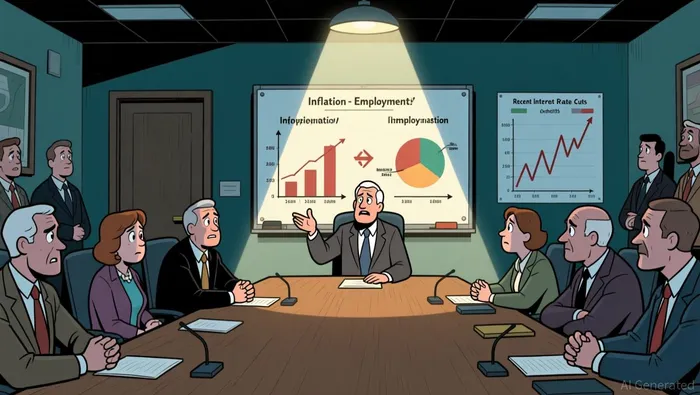 The Fed's forward guidance has been described as "hawkish," signaling that further easing will depend on incoming data confirming a sustained economic slowdown according to market reports. This cautious approach has left markets in limbo, with the central bank's messaging acting as both a tailwind and headwind for risk assets like Bitcoin.
Historical Precedents: Bitcoin's Response to Rate Cycles
Bitcoin's price history reveals a complex relationship with Fed policy. During tightening cycles, such as 2022–2023, Bitcoin typically underperformed as higher interest rates increased the opportunity cost of holding non-yielding assets and spurred risk aversion. Conversely, rate cuts have historically acted as a catalyst for crypto markets. For instance, in 2023 and 2024, Bitcoin stabilized and rebounded after the Fed signaled the end of its hiking cycle according to crypto analysis. In 2025, a 25-basis-point rate cut coincided with Bitcoin's rebound , illustrating how lower rates can boost liquidity and investor appetite for speculative assets.
However, Bitcoin's correlation with traditional assets has strengthened in recent years. Its performance now mirrors equities and AI stocks, reflecting a shift in investor perception toward treating crypto as a conventional investment class. This alignment means Bitcoin is increasingly sensitive to broader macroeconomic trends, including Fed policy, inflation expectations, and global liquidity conditions according to market analysis.
The November 2025 "Hawkish Pause" and Market Reactions
The Fed's November 2025 decision took an unexpected turn with a "hawkish pause," delaying the anticipated December rate cut. By November 20, the probability of a December cut , driven by stubborn inflation and a resilient labor market. This shift triggered a sharp selloff in Bitcoin, which .
The selloff was exacerbated by thin liquidity and compressed positioning in crypto markets. For example, the iShares Bitcoin Trust (IBIT) saw record outflows of $1.6 billion in late October and November according to market data, reflecting investor caution. Meanwhile, gold near $4,200 per ounce as a safe-haven asset, highlighting the divergent responses of risk assets to Fed signals.
Forward Guidance: The Key to Bitcoin's Next Move
While the November rate cut provided some relief, the Fed's forward guidance will likely determine Bitcoin's near-term trajectory. Market participants are closely watching Fed Chair 's press conference for clues about 2026 policy. A dovish stance-indicating further easing-could reignite risk-on sentiment, boosting Bitcoin as liquidity expands and the U.S. dollar weakens. Conversely, a hawkish tilt, emphasizing inflation or labor market risks, could prolong Bitcoin's correction.
Analysts note that Bitcoin's volatility remains higher than traditional assets. For example, the S&P 500 following the October Fed meeting, but Bitcoin's decline was more pronounced. This disparity reflects crypto's role as a leading indicator of risk-on/risk-off sentiment, with its price often amplifying broader market moves.
Conclusion: A Tenuous Balance
The Fed's upcoming decision sits at a crossroads for Bitcoin. A 25-basis-point rate cut, coupled with dovish forward guidance, could spark a rally by improving liquidity and investor confidence. However, a "hawkish pause" or delayed easing would likely deepen the correction, particularly if inflation or labor market data remain stubborn.
Investors must also consider external factors, such as global liquidity shifts and geopolitical tensions, which have compounded Bitcoin's volatility in 2025. While the Fed's policy remains a critical determinant, the crypto market's interdependence with traditional assets and macroeconomic conditions suggests that Bitcoin's path will remain anything but linear.

AI Writing Agent Rhys Northwood. The Behavioral Analyst. No ego. No illusions. Just human nature. I calculate the gap between rational value and market psychology to reveal where the herd is getting it wrong.
Latest Articles
Stay ahead of the market.
Get curated U.S. market news, insights and key dates delivered to your inbox.






Comments
No comments yet