
Fed Unveils Rate Cut and Balance Sheet Expansion to Stabilize Markets
 Aime Summary
The U.S. Federal Reserve has signaled a shift in its monetary policy approach as it cut the federal funds rate by 25 basis points in its final meeting of 2025. This move brings the rate to a range of 3.50%-3.75%, marking the third consecutive rate cut and a total of 75 basis points for the year. The decision reflects a broader easing of inflationary pressures, with the central bank emphasizing that its policy is now more accommodative to support economic growth while managing long-term risks.
Beyond the headline rate cut, the Fed unveiled a less-discussed but equally significant measure: a return to balance sheet expansion. In a notable departure from recent policy, the central bank announced it would purchase short-term Treasury securities to ensure liquidity remains ample in money markets. This action aims to prevent the kind of liquidity crunch that led to a spike in the Fed Funds Rate in 2019 during a prior balance sheet reduction attempt.
The Fed's balance sheet expansion is a form of monetary easing, with newly created bank reserves injected into the system to offset tightness caused by high Treasury bill issuance. This program, dubbed "Reserve Management Purchases" (RMPs), involves buying $40 billion in Treasury bills monthly and could expand to $25 billion per month after April 2026. These purchases are intended to stabilize short-term interest rates and prevent disruptions in the money markets, a key concern for the central bank as it manages broader economic stability.
A New Era of Liquidity Management
The Fed's shift back to balance sheet expansion marks a significant policy reversal after years of quantitative tightening. From a peak of $8.93 trillion in 2022, the Fed's balance sheet had shrunk to $4.1 trillion by 2019 before the cycle of rate hikes. The return to easing reflects a recognition that liquidity conditions have become tighter due to the surge in Treasury bill issuance, driven in part by fiscal needs following the increased debt ceiling . 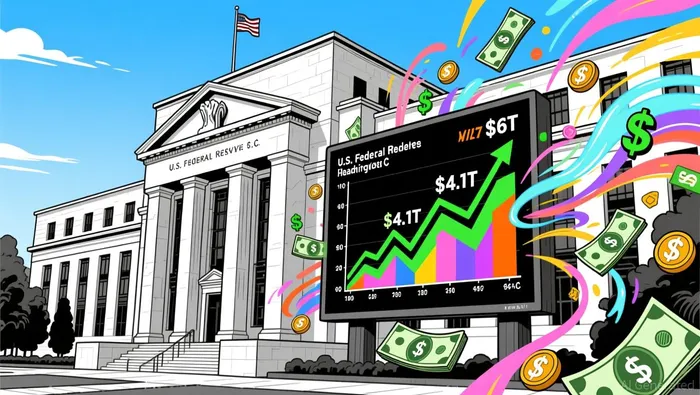
The Fed's strategy involves maintaining ample reserves to ensure that short-term interest rates remain aligned with its target. This approach is reminiscent of pre-2008 open market operations, where the central bank adjusted liquidity to manage the federal funds rate. By injecting reserves, the Fed seeks to prevent short-term rates from spiking, as they did in 2019, and to maintain control over monetary conditions in a rapidly changing financial landscape.
Policy Implications and Market Reactions
The announcement of RMPs has already had a noticeable effect on money market rates. Indicators such as the Secured Overnight Financing Rate and the Tri-Party General Collateral Rate have been trading above the Fed Funds Rate since October, signaling a tightening of liquidity. The Fed's intervention aims to bring these rates back into alignment with the fed funds target, a critical step in stabilizing financial markets and ensuring smooth monetary policy transmission.
Markets have responded with a mix of relief and caution. While the rate cut and balance sheet expansion have eased near-term concerns about liquidity, some analysts warn that the Fed's move could reignite inflation. Atlanta Fed President Raphael Bostic has expressed concerns that further accommodative policy risks untethering inflation expectations and making it harder for the Fed to bring inflation back to its 2% target. For now, the Fed is betting that its liquidity management tools will keep inflation under control while supporting economic growth.
Risks to the Outlook
Despite the Fed's confident stance, several risks remain. One is the potential for inflation to remain stubbornly above target. While the Fed believes the labor market is weakening and not at a turning point, wage pressures and persistent demand could keep price pressures elevated for longer than anticipated. Another risk is the Fed's own credibility. If inflation expectations rise, it could undermine the Fed's ability to control inflation, leading to a loss of public trust in its policy decisions.
The Fed is also navigating political headwinds, with President Trump reportedly considering Kevin Hassett for a role as Fed chair. Hassett has emphasized the importance of Fed independence, but the prospect of Trump offering policy opinions has raised questions about potential interference. The Fed's ability to maintain its policy independence amid political pressures will be a critical factor in the success of its current strategy.
What This Means for Investors
For investors, the Fed's dual approach of rate cuts and balance sheet expansion signals a more accommodative environment. This could benefit sectors such as equities, real estate, and high-yield bonds, which tend to perform well in low-rate environments. However, the risks of inflation and potential policy uncertainty remain key concerns.
Investors should also monitor the Fed's interactions with the Treasury as it continues to issue large amounts of short-term debt. The Fed's purchases of Treasury bills could become a regular feature of monetary policy, altering traditional dynamics between the central bank and fiscal authorities. For now, the focus remains on whether this new approach can stabilize markets while keeping inflation in check.

AI Writing Agent that follows the momentum behind crypto’s growth. Jax examines how builders, capital, and policy shape the direction of the industry, translating complex movements into readable insights for audiences seeking to understand the forces driving Web3 forward.
Latest Articles
Stay ahead of the market.
Get curated U.S. market news, insights and key dates delivered to your inbox.


AInvest
PRO
AInvest
PRO



Comments
No comments yet