
Fed Uncertainty and Market Crossroads: Navigating Rate Cut Expectations in Equity and Bond Markets
The Federal Reserve's June 2025 projections underscore a critical crossroads for investors: a cautious monetary policy path fraught with uncertainty, balancing inflation risks, tepid growth, and geopolitical turbulence. As the Fed's “dot plot” reveals internal divisions over rate cuts—seven members foresee no reductions this year versus eight predicting two—the market faces a dilemma. How should investors position portfolios amid this ambiguity? The answer lies in dissecting the dual impacts on bonds and equities and realigning strategies to capitalize on evolving expectations.
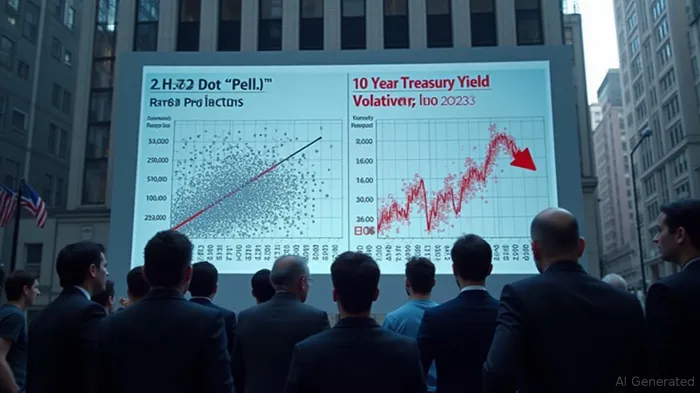
Bond Markets: A Volatile Tightrope Between Rates and Growth
The Fed's gradual rate-cut trajectory—projected to drop from 3.9% in 2025 to 3.0% in the long run—has created a tug-of-war in bond markets. While declining rates typically depress yields, persistent inflation risks (PCE inflation at 3.0% in 2025) and growth concerns (GDP growth revised down to 1.4%) complicate this dynamic.
- Duration Risk: Investors face a conundrum: shorter-term bonds offer safety but lower returns, while longer-term bonds risk capital losses if rates stabilize or rise.
- Spread Opportunities: Corporate bonds, particularly investment-grade issuers in utilities and healthcare, may outperform Treasuries as their spreads widen to reflect economic uncertainty.
Equity Valuations: Sector-Specific Nuances in a Challenging Landscape
Equities are no longer a monolith. The Fed's cautious stance rewards sector-specific analysis:
- Defensive Plays: Utilities and consumer staples—less sensitive to rate cuts—offer stability amid slowing growth. These sectors typically thrive when the Fed prioritizes employment over inflation.
- Tech and Rate-Sensitive Sectors: Growth stocks, particularly in tech (e.g., AAPL, MSFT), could rally if rate cuts materialize, as lower borrowing costs boost innovation spending. However, their valuation sensitivity to interest rates poses risks if the Fed delays.
- Financials Under Pressure: Banks (e.g., JPM, BAC) may underperform if rate cuts erode net interest margins, especially if loan demand weakens with rising unemployment (projected at 4.5% in 2025).
Strategic Reallocation: A Balanced Approach to Uncertainty
Investors should adopt a portfolio framework that balances growth, income, and hedging tools:
- Tilt Toward Defensive Equities: Overweight utilities and consumer staples for dividend stability.
- Shorten Bond Duration: Favor 5-year Treasuries or intermediate-term bond ETFs (e.g., IEF) to mitigate rate risk while capturing yield.
- Hedge with Inflation-Linked Bonds: TIPS (e.g., TLT) or commodities (e.g., GLD) can buffer against inflation surprises.
- Tech Selectivity: Focus on secular-growth tech firms with pricing power (e.g., CRM, ADP) rather than cyclical hardware names.
- Consider Rate-Futures Options: Investors with sophisticated strategies might use Fed funds futures options to profit from volatility or directional shifts.
Navigating Geopolitical and Fiscal Risks
The Fed's caution is not just about economics—it's about navigating external shocks. Tariffs and the Israel-Iran conflict could disrupt supply chains and energy prices, adding to inflationary pressures. Meanwhile, U.S. debt servicing costs (projected at $1.2 trillion in 2025) may force fiscal austerity, further weighing on growth. A diversified global equity allocation, including emerging markets (EEM) with low correlation to U.S. rates, could provide resilience.
Conclusion: Pragmatism Over Predictions
The Fed's divided stance and uncertain macro backdrop demand portfolios that prioritize flexibility over conviction. By layering defensive equities, duration-matched bonds, and hedging tools, investors can navigate the crossroads of rate cuts and economic fragility. As Fed Chair Powell noted, clarity will come with time—but for now, preparation is the best strategy.
Investment Takeaway: Shift toward low-duration bonds, dividend stalwarts, and tech leaders with pricing power. Avoid overexposure to financials and cyclical sectors until the Fed's path crystallizes.
Stay vigilant—markets are pricing probabilities, not certainties.

Stay ahead of the market.
Get curated U.S. market news, insights and key dates delivered to your inbox.


AInvest
PRO
AInvest
PRO



Comments
No comments yet