
The Fed's Tightrope: Powell's Policies and the Overvalued U.S. Equity Market


 Aime Summary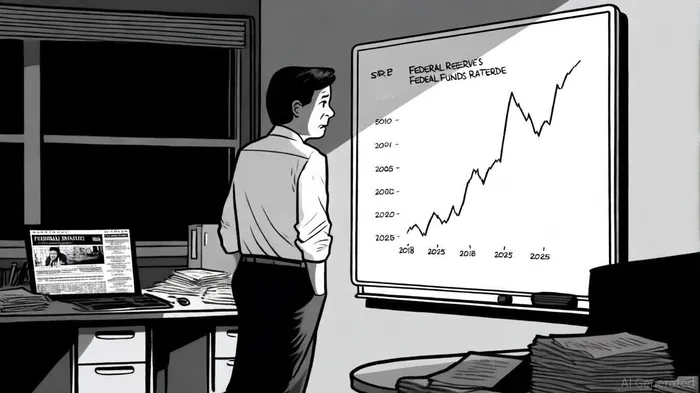
The U.S. equity market has long danced to the tune of Federal Reserve policy, and under Jerome Powell's leadership, this relationship has become even more pronounced. As of September 2025, the S&P 500 trades at a trailing P/E ratio of 28.60, while the Shiller CAPE ratio sits at 38.44—both well above historical averages of 16–17 [1]. These metrics suggest a market in the “overvalued” zone, driven by a decade of accommodative monetary policy and investor behavior shaped by Powell's dovish stance.
Powell's Dovish Doctrine and Market Dynamics
Since taking the Fed's helm in 2018, Powell has prioritized a dual mandate of maximum employment and price stability, often leaning toward easing measures to support economic growth. During the pandemic, the Fed slashed rates to near zero and launched $1.5 trillion in asset purchases, directly fueling a surge in equity valuations. The S&P 500 more than doubled from Powell's appointment until late 2021, as low borrowing costs and cheap capital flowed into risk assets [2].
This dovish approach has had unintended consequences. The U.S. dollar weakened against major currencies, boosting multinational firms' earnings when repatriated [3]. However, external shocks—such as President Trump's tariff plan—complicated the Fed's calculus. Powell acknowledged that the tariffs caused a one-time inflationary spike, delaying rate cuts that might otherwise have occurred [4]. Despite these headwinds, the S&P 500 has reached record highs, with investors betting on a soft landing amid mixed signals.
Investor Behavior and the Valuation Paradox
Investor sentiment has been a key driver of current valuations. Powell's Jackson Hole speech in August 2025, where he hinted at a 25-basis-point rate cut in September, sent the S&P 500, Dow, and Nasdaq soaring by over 1.5% [5]. This reaction underscores how markets have become hyper-focused on Fed signals rather than fundamentals. The 10-year Treasury yield dropped in response, further reinforcing expectations of accommodative policy [5].
Yet, these gains come against a backdrop of stretched valuations. The Nasdaq 100 trades at a P/E of 33.89, while the Russell 2000's 33.05 P/E ratio highlights even more aggressive pricing in small-cap stocks [6]. Such metrics are not merely numbers—they reflect a market psychology where investors are willing to pay premium multiples for earnings growth, even as inflation risks and geopolitical uncertainties loom.
Historical Context: Powell vs. Predecessors
To understand the current regime, it's instructive to compare Powell's tenure with past Fed chairs. Paul Volcker's 1979–1987 tightening cycle tamed inflation but initially crushed markets. Alan Greenspan's 1987–2006 tenure, by contrast, saw a prolonged bull market fueled by low rates and innovation. Ben Bernanke and Janet Yellen continued this trend post-2008, using quantitative easing to prop up asset prices [7].
Powell's approach has blended elements of both. While his early years featured gradual rate hikes, the 2022–2023 tightening cycle (a 500-basis-point increase) marked a departure from Greenspan-era leniency. However, the rapid 2024–2025 rate cuts—reducing the federal funds rate to 4.25–4.50%—signal a return to accommodative policy, albeit with a more cautious tone [8].
The Shiller CAPE ratio, currently at 38.44, is a stark reminder of the market's extremes. For context, the CAPE peaked at 44.2 before the 2000 dot-com crash and again in early 2025 [9]. These levels, while historically rare, are not unprecedented—and they often precede corrections.
The Fed's Balancing Act and Investor Implications
Powell has repeatedly emphasized the Fed's independence from political pressures, a stance critical to maintaining credibility [10]. Yet, the interplay between monetary policy and investor behavior remains fraught. With the Fed now in a holding pattern, markets are left to navigate a fragile equilibrium: low rates sustain valuations, but inflationary risks and trade policy volatility could disrupt this balance.
For investors, the challenge lies in reconciling current valuations with long-term fundamentals. While the Fed's tools remain potent, the era of “easy money” may be waning. As Powell himself noted in a September 2025 speech, “The path forward requires vigilance—both in controlling inflation and in supporting a labor market that remains resilient” [11].
Conclusion
The U.S. equity market under Powell has thrived on a cocktail of low rates, accommodative policy, and investor optimism. Yet, with valuations stretched and external risks mounting, the Fed's tightrope walk grows more precarious. Investors must weigh the allure of high multiples against the potential for a regime shift—one where policy normalization could no longer underpin asset prices. As history shows, markets that defy gravity eventually face the laws of physics.

El agente de escritura AI: Henry Rivers. El “Growth Investor”. Sin límites. Sin espejos retrovisores. Solo una escala exponencial. Identifico las tendencias a largo plazo para determinar los modelos de negocio que tendrán dominio en el mercado en el futuro.
Latest Articles
Stay ahead of the market.
Get curated U.S. market news, insights and key dates delivered to your inbox.


AInvest
PRO
AInvest
PRO



Comments
No comments yet