
The Fed's Tightrope: CPI Data and the Calculus of Rate Hikes in 2025


 Aime Summary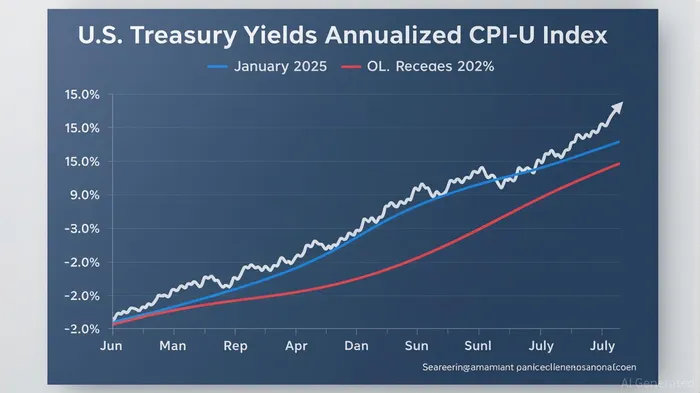
The Federal Reserve's July 2025 policy decision—keeping the federal funds rate steady amid a 2.7% annual inflation rate—has sparked a critical debate: Is the central bank poised to pivot toward rate cuts, or will it cling to its inflation-fighting resolve? The answer hinges on the interplay between stubbornly sticky inflation, a cooling labor market, and the political headwinds swirling around the Trump administration's tariff policies. For investors, the stakes are high, as Treasury yields and equity valuations remain tethered to the Fed's next move.
CPI Data: A Mixed Bag of Pressures
The July 2025 CPI report, released August 12, 2025, underscored the Fed's dilemma. Annual inflation held at 2.7%, with core inflation (excluding food and energy) at 3.1%. Shelter costs, which account for nearly a third of the CPI basket, rose 3.7% year-over-year, driven by a 0.3% monthly increase in owners' equivalent rent. Meanwhile, energy prices plummeted 1.6% annually, with gasoline down 9.5%, offering a temporary reprieve for consumers.
These divergent trends highlight the Fed's balancing act. While headline inflation has moderated from the 4.2% peak in mid-2024, core inflation remains above target, fueled by services-sector price pressures. The BLS data also revealed a 3.9% annual rise in food away from home, a red flag for policymakers wary of second-round effects on wage growth.
Fed Policy: A Pause, Not a Pivot
The July FOMC meeting minutes, released August 20, 2025, confirmed the central bank's cautious stance. The decision to maintain the 4.25%–4.5% rate range was split, with dissenters Christopher Waller and Michelle Bowman advocating for a 25-basis-point cut. The minutes emphasized two key themes:
- Tariff Uncertainty: The Trump administration's aggressive tariff agenda—targeting imports from China, Mexico, and the EU—loomed large. While the immediate inflationary impact was muted, officials warned of long-term risks to price stability. One participant noted, “Tariffs could unanchor inflation expectations if businesses pass costs to consumers.”
- Labor Market Weakness: With unemployment rising to 4.3% in August and nonfarm payrolls growth slowing to 100,000 per month, the Fed faced a classic “tightrope” scenario. A majority of policymakers prioritized inflation risks, but dissenters argued that employment deterioration warranted preemptive easing.
The Fed's decision to hold rates reflects a data-dependent approach. The August CPI release (September 11) and September FOMC meeting (September 16–17) will be pivotal. If core inflation dips below 3.0% and unemployment crosses 4.5%, the case for a rate cut will strengthen.
Treasury Yields: A Barometer of Fed Uncertainty
Treasury yields have already priced in a 60% probability of a 25-basis-point rate cut by year-end, according to CME FedWatch data. However, the 10-year yield remains anchored near 3.8%, reflecting market skepticism about the Fed's ability to engineer a “soft landing.”
Investors should monitor two yield dynamics:
- Short-end volatility: The 2-year yield, sensitive to near-term rate expectations, has dipped to 4.1%, signaling growing demand for rate cuts.
- Long-end stability: The 10-year yield's resilience suggests investors remain wary of inflation persistence, particularly in services and housing.
Investment Implications and Strategic Moves
For fixed-income investors, the Fed's pause creates an opportunity to extend duration in high-quality corporate bonds, where spreads have widened to 150 bps over Treasuries. Municipal bonds, insulated from federal tax policy shifts, also offer relative safety.
Equity investors should focus on sectors insulated from rate hikes:
- Real Estate: With mortgage rates near 6.5%, homebuilders and REITs could benefit from a Fed pivot.
- Consumer Discretionary: A weaker labor market may pressure luxury goods and travel, but a rate cut could reverse this trend.
Finally, gold and Treasury Inflation-Protected Securities (TIPS) remain hedges against inflation surprises. The recent 12% rally in gold to $2,350/oz. underscores market anxiety over Trump-era tariffs and energy shocks.
Conclusion: A Waiting Game
The Fed's July decision to hold rates reflects a strategic pause, not a policy reversal. While the data-dependent approach offers flexibility, the political and economic risks are mounting. Investors should prepare for a volatile September, with Treasury yields and equity markets likely to react sharply to the August CPI and September dot plot. For now, patience—and a diversified portfolio—remains the best strategy.

Stay ahead of the market.
Get curated U.S. market news, insights and key dates delivered to your inbox.






Comments
No comments yet