
The Fed's Surprise Rate Cut and Its Implications for 2026


 Aime Summary
The Federal Reserve's November 2025 rate cut-its third consecutive reduction-has sent ripples through global markets, signaling a pivotal shift in monetary policy. , the central bank
sought to address a fragile labor market and persistent inflation, even as it acknowledged the risks of further easing. This decision, coupled with the resumption of Treasury bill purchases and a cautious outlook for 2026, demands a strategic reevaluation of asset allocations. Investors must now navigate a landscape where monetary policy is no longer tightening but recalibrating, with implications that extend far beyond traditional bonds and equities.
The Fed's Balancing Act: Labor Market, Inflation, and Policy Uncertainty
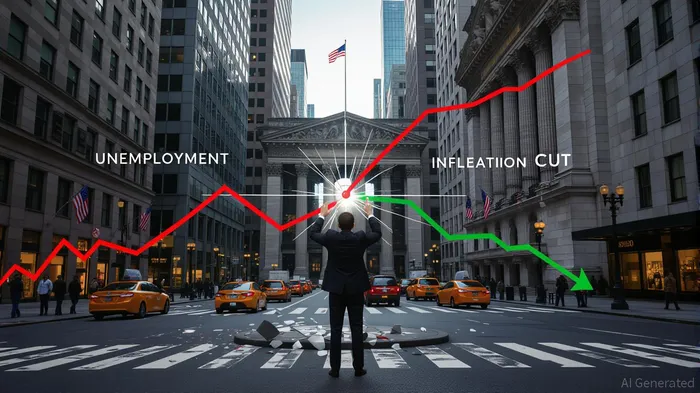
The November rate cut reflects the Fed's struggle to reconcile divergent economic signals. While inflation
as of September 2025, the labor market remains in a "low-hire, low-fire" climate,
stagnating and unemployment rising. This duality has fractured the (FOMC),
with some members advocating for more aggressive cuts to stimulate employment, while others warn of . The central bank's decision to cut by 25 basis points-a compromise-underscores its commitment to data-dependent policymaking,
even as delayed government data (due to a shutdown) complicates its ability to assess the full economic picture.
 For 2026,
the Fed's updated suggests only one additional is expected. This cautious approach implies that monetary policy will remain restrictive for longer than previously anticipated, creating a hybrid environment where easing is gradual but not yet accommodative. Such a backdrop challenges investors to balance growth and .
Strategic Asset Reallocation: Navigating the New Normal
1. Bonds: The Belly of the Curve as a Safe Haven
With the Fed signaling limited further , the 's "belly"-bonds with maturities under 10 years-emerges as a strategic sweet spot.
BlackRock's analysis highlights that short- to intermediate-term bonds are better positioned to capitalize on the Fed's gradual easing while avoiding the volatility of long-dated bonds, which face underperformance risks in a low-inflation, environment. Investors should prioritize high-quality and Treasury securities with maturities aligned with the Fed's projected policy path.
2. Equities: Selectivity in a Broadening Rally
The expectation of improved in 2026, coupled with lower borrowing costs, could fuel a broadening equity rally.
Invesco notes that sectors tied to -such as semiconductors, , and energy-may outperform as demand for , , and other inputs surges. However, investors must remain selective, favoring companies with strong and pricing power over speculative growth plays. Cyclical sectors like industrials and consumer discretionary could also benefit from a modest economic rebound.
#### 3. Real Estate: A Dual Tailwind of Lower Rates and Demand
Real estate, including homebuilders and (REITs), stands to gain from the Fed's rate cuts.
could boost housing demand and affordability, while reduced borrowing costs make property development and acquisitions more attractive. Additionally, urban commercial real estate may see a resurgence as businesses adapt to and AI-driven productivity gains. Investors should focus on core markets with strong and occupancy rates.
4. Commodities and Gold: Diversification in a Fragmented World
Commodities, particularly and energy, are poised to benefit from spending and global supply chain adjustments. , meanwhile, retains its allure as central banks continue to accumulate reserves amid trade tensions and rising levels.
A modest allocation to gold and can enhance portfolio resilience, especially as persist.
Conclusion: A Portfolio for the Uncharted
The Fed's November rate cut marks a turning point in the post-pandemic economic cycle. While the central bank's cautious stance limits the scope for aggressive rate cuts in 2026, it also creates opportunities for investors who prioritize flexibility and diversification. Strategic reallocation should focus on the belly of the yield curve, , and like real estate and commodities. As the Fed navigates a fragile labor market and inflationary tail risks, a balanced, forward-looking approach will be critical to capturing returns in an increasingly uncertain world.

Stay ahead of the market.
Get curated U.S. market news, insights and key dates delivered to your inbox.




Comments
No comments yet