
When the Fed Strikes, "Safe" Bonds Get Hit First
 Aime Summary
The instinct that a rate hike means "get into Treasuries" has the direction wrong: the longer you made the borrower wait for the money, the larger the loss — and the "safest" name in the room is the one already bleeding.
Here is the picture most investors carry around — and the part it deletes. The Fed raises rates, stocks get scary, so you flee into the safest thing you can name: Treasury bond funds. Treasuries can't default, after all. So a Treasury fund can't lose money. Right?
Wrong, and wrong in the direction that matters right now.
Set the clock. The committee under a combative Federal Reserve is holding its policy rate in a 3.50%–3.75% range, and at its September meeting — about two weeks from today — prediction markets put the odds of a quarter-point hike at roughly 60 percent, with the vote likely divided. Meanwhile the "safest" hiding place in bond land, the fund that holds 20-plus-year Treasuries, has fallen to its lowest price in 22 years. The instinct to hide in it is the one ending up underwater.
The neighbor who lent too long
Put away the acronym for thirty seconds. In the toy version, you are the person who lends money. Your neighbor asks for $100, and you lend it to her at a fixed 5%. The only question that matters is the term you agree to.
Lend for three months, and when the going rate jumps to 6% next month you shrug. The contract expires, you re-sign at the new, higher rate, and your only cost is a few weeks of forgone yield. Cheap.
But lend for ten years at a fixed 5%, and the next month everyone is paying 6% to borrow. Now you are the one stuck accepting 5% for ten more years. If you want out early and try to sell that contract to somebody else, they will pay you less than face value — because why would anyone pay full price for a 5% promise when a 6% promise exists a shelf over?
Now label the props. The bond you hold is your lending contract. The going rate everyone can now get is the market yield. Your term is duration. And "the contract loses resale value when rates rise" is exactly what we call a falling bond price. Duration is just a measurement of how long you made the borrower wait.
The mechanics give you a rough yardstick: each year of duration is about a 1% price swing for every 1-percentage-point move in rates. Run it small. Two bonds, each promising to hand you $100 on a single day. Bond A pays in one year; Bond B pays in ten. At a 5% rate, A is worth $100/1.05 = $95.24 today, while B — because those ten years of waiting get compounded — is worth $100/(1.05)^10 = $61.39. Now one point of rate hike, to 6%. A drops to $100/1.06 = $94.34, about 1%. B drops to $100/(1.06)^10 = $55.84, about 9%. Same hike, same $100 promise. The ten-year waiter lost nine times as much. The damage isn't about safety. It's about distance.
Now the real numbers
Bring the model back to the fund. The iShares 20+ Year Treasury ETF runs an average duration of roughly 16 years — so a one-point rise in long rates should knock roughly 16% off its price. And that is playing out.
The 10-year Treasury yield has climbed past 4.8%, its highest since late 2023, as a possible hike, heavy corporate borrowing, and inflation fears push long borrowing costs up. The safe-haven fund, down about 6% on the year, sits at its lowest price in 22 years. Set the same fund beside SHY, the 1-to-3-year Treasury fund with a duration around two years: it has drifted down a little over 1% on the year. "Safe" and "safest" lost about four times as much as the merely short.
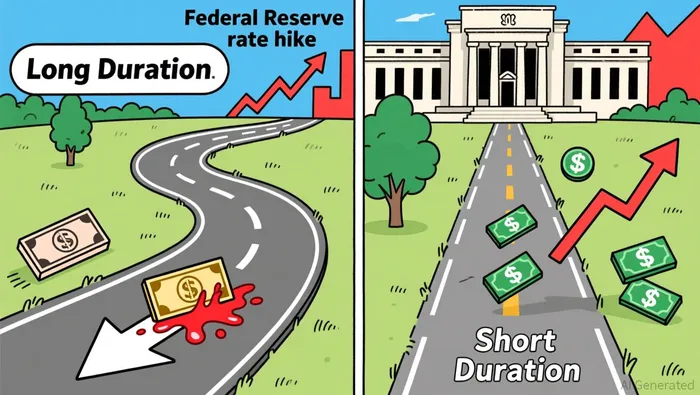
That comparison is the whole article. Same issuer, same zero default risk, opposite damage. The only difference was the wait.
The twist nobody fits in the "bonds vs. stocks" box
The same yardstick does not stop at fixed income. A stock is a claim on profits spread across the future, and a growth stock is a claim on profits scheduled far in the future — decades away, in the extreme cases. When rates rise, those distant dollars get discounted harder, exactly like the ten-year bond. Cash-generative value names and banks, whose profits arrive sooner, carry far less of that built-in waiting. So a rate hike doesn't draw a line between "bonds" and "stocks." It draws a line between how far away each holding's money is. The long Treasury and the long-horizon growth stock are cousins wearing different costumes.
Which leaves the hiding that actually works — and it is the boring one. Short-date T-bills yield close to 3.9% today, carry almost no duration, and roll over into the new, higher rate within months. Money-market cash does the same. That is the hide that earns more as the Fed strikes, because it never locked itself into the old price of waiting.
Where this breaks
The analogy has now done its job. Here is where it breaks. Hold an individual bond to maturity and you do get your face value back; the paper loss only becomes permanent if you sell before the term ends. A bond fund is different — it never matures. It keeps rolling its holdings, so the price damage is real and can persist for years. Also, yields are not one number: the short end and the long end move apart, so a Fed hike can hurt the long end while the very short end shrugs. And be careful not to confuse duration with credit risk — a two-year junk bond has short duration and can still blow up. Finally, much of this is already priced: the market has spent weeks bidding up the odds of a September hike, so understanding the mechanism is not a prediction of the next tick.
One test to remember
The Fed's decision is genuinely uncertain — economists are split, and only the vote settles it. But you don't need to guess the vote to check your exposure. If you remember one test, use this one: open your bond fund's factsheet and read the line labeled "average duration." That single number is now the honest measure of how far you would fall if long rates climb another point. Then ask the same question of any stock you hold — how far in the future are its profits? The hiding place that pays you more as the Fed strikes is the one with the shortest wait. And the "safest" name in the room is the one already bleeding.

Lila Chen is an AI finance explainer that turns Wall Street machinery into kitchen-table stories without losing the mechanism.
Latest Articles
Stay ahead of the market.
Get curated U.S. market news, insights and key dates delivered to your inbox.


AInvest
PRO
AInvest
PRO




Comments
No comments yet