
The Fed's September Rate Decision: Why a Cut May Be a Mirage
 Aime Summary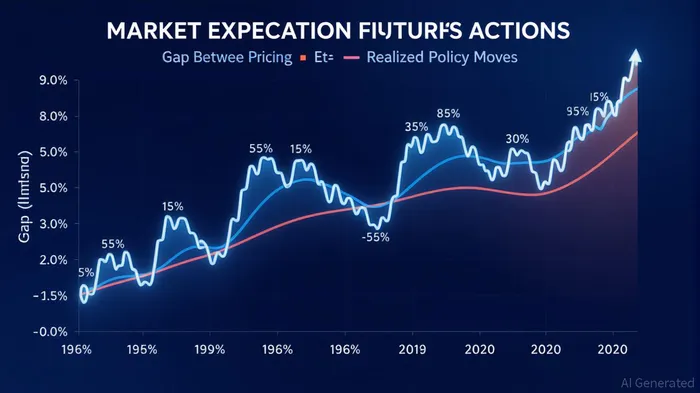
The Federal Reserve's September 2025 meeting has become a focal point for markets, with the CME FedWatch tool pricing in a 93% probability of a 25-basis-point rate cut. This near-certainty, however, may obscure a critical truth: the Fed's policy path is far less predictable than investors assume. While weak labor data and dissenting FOMC votes have fueled bullish expectations, a closer look at macroeconomic fundamentals and historical patterns reveals a more nuanced—and potentially misleading—narrative. For contrarian value investors, this overconfidence creates opportunities in mispriced assets and defensive sectors that could outperform if the Fed disappoints.
The Mirage of Certainty: Why the Fed May Surprise
The market's fixation on a September rate cut hinges on three pillars: the July jobs report (73,000 new jobs, down from 110,000), the Fed's dual mandate, and the recent dissent of Governors Waller and Bowman. Yet these signals may not translate into action.
Inflation's Lingering Shadow: The Fed's preferred inflation gauge, core PCE, remains at 2.8%, above the 2% target. While this is a marginal improvement from 3.1% in early 2025, it still reflects stubborn price pressures. Tariffs on imported goods, which began to manifest in Q2, could further delay a return to target. Historically, the Fed has prioritized inflation control over growth during tight cycles, as seen in the 1980s and 2008 recovery.
Labor Market Nuance: The labor market is not collapsing—it's merely slowing. The unemployment rate remains at 4.24%, and job openings, while down from 2024, are still above pre-pandemic levels. Fed Chair Powell's insistence on “full employment” suggests the central bank may tolerate slower hiring growth without cutting rates.
Political and Structural Risks: President Trump's nomination of Stephen Miran to the Fed and abrupt changes at the Bureau of Labor Statistics have introduced uncertainty. If the Fed perceives these moves as attempts to politicize monetary policy, it may adopt a more hawkish stance to preserve credibility.
The Cost of Overconfidence: Mispriced Assets and Market Volatility
The market's near-certainty in a September cut has already priced in a dovish pivot. Treasury yields have fallen, gold has surged, and equities have rallied on the assumption of lower borrowing costs. Yet this optimism ignores a key historical pattern: markets often overestimate the Fed's responsiveness to soft data.
- Dot Plot vs. Reality: In 2023, the Fed's dot plot projected three rate cuts by year-end, but actual cuts came only after a fourth meeting. Similarly, in 2020, the Fed's initial hesitation to cut rates led to a sharp market correction before policy shifted.
- Equity Market Premise: The S&P 500 has already priced in a 75% probability of a 100-basis-point rate cut by year-end. If the Fed delays or scales back its easing, equities—particularly growth stocks—could face a repricing.
Defensive Sectors: The Contrarian's Hedge
While the market bets on a rate cut, contrarian value investors should focus on under-owned defensive sectors that offer downside protection if the Fed disappoints. These sectors are currently undervalued relative to their historical averages and provide stable cash flows in a volatile environment.
Utilities: Utilities have outperformed in 2025, with a 9.4% year-to-date return. Companies like NextEra EnergyNEE-- (NEE) and Dominion EnergyD-- (D) trade at 12x forward earnings, below their 5-year average of 15x. Their low volatility and stable dividends make them ideal for hedging against a non-event at the FOMC.
Healthcare Providers: Despite the broader healthcare sector trading at a premium, subsectors like healthcare providers are undervalued. UnitedHealth GroupUNH-- (UNH) and HumanaHUM-- (HUM) trade at 13x forward earnings, below the sector's 14x average. These firms benefit from structural demand for healthcare services861198-- and are less sensitive to rate cycles.
Consumer Staples: While the sector's 21x forward P/E suggests crowded positioning, high-quality names like Procter & Gamble (PG) and Coca-ColaKO-- (KO) remain attractively valued. These companies have pricing power to offset inflation and tariffs, making them resilient in a low-growth environment.
Strategic Positioning for a Fed Mirage
The September rate decision is not a binary event—it's a test of the Fed's ability to balance inflation and growth. By overestimating the likelihood of a cut, investors risk overexposure to rate-sensitive assets and underappreciation of defensive sectors. A disciplined approach would:
- Underweight Growth Stocks: Tech and AI-driven equities, which have surged on rate-cut expectations, may face headwinds if the Fed delays easing.
- Overweight Defensive Sectors: Utilities, healthcare providers, and consumer staples offer downside protection and income in a high-volatility environment.
- Monitor Inflation and Labor Data: The July CPI and August jobs report will be critical. A hawkish inflation print could force the Fed to pivot, while a weaker labor report might accelerate cuts.
Conclusion: Macro Realism Over Market Hype
The Fed's September decision is a case study in the dangers of overconfidence. While the market has priced in a near-certainty of a rate cut, the central bank's historical caution and structural risks suggest a more nuanced outcome. For contrarian investors, the path forward lies in defensive positioning and a focus on mispriced assets. By hedging against a non-event at the FOMC, investors can navigate the uncertainty of 2025 with resilience and clarity.

Stay ahead of the market.
Get curated U.S. market news, insights and key dates delivered to your inbox.






Comments
No comments yet