
How the Fed's Rate Cut, Trump-Xi Diplomacy, and Ethereum ETF Decision Shape Crypto Volatility and Opportunities


 Aime Summary
Fed Rate Cuts: A Dovish Tailwind with Caveats
The Federal Reserve's October 2025 rate cut-lowering the federal funds rate to 3.75–4.00%-has reignited the "risk-on" narrative for crypto markets. With inflation cooling and labor market softness persisting, the Fed's dovish pivot has reduced the opportunity cost of holding non-yielding assets like BitcoinBTC-- and EthereumETH--. Historically, such easing cycles have fueled crypto rallies, as seen in 2020–2021 when Bitcoin surged from $10,000 to $60,000 amid similar liquidity injections, according to a FinancialContent analysis.
However, the market's reaction to the October cut was muted, with Bitcoin dropping 8.56% in the following month despite the Fed's dovish stance, per a Yahoo Finance report. This highlights a critical nuance: rate cuts are bullish in theory but volatile in practice. The Fed's caution-emphasized by Chair Jerome Powell and Governor Christopher Waller-suggests a potential pause after December's expected 25-basis-point cut to assess the economic impact of Trump's proposed tariffs, as noted in a moomoo article. Investors must balance the long-term tailwinds of easing with short-term risks of policy reversals or inflationary surprises.
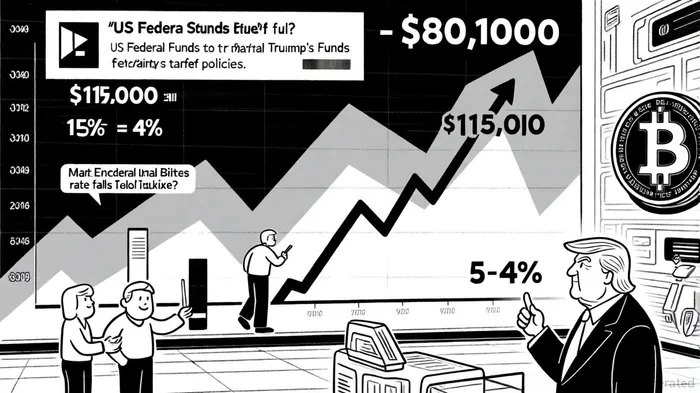
Trump-Xi Diplomacy: De-Risking Geopolitical Uncertainty
The U.S.-China trade deal finalized in late October 2025 has been a game-changer for crypto markets. By suspending 100% tariffs on Chinese goods and delaying rare earth export restrictions, the agreement has reduced geopolitical risk and stabilized global supply chains. This de-escalation has directly benefited cryptocurrencies, which thrive in environments of macroeconomic optimism.
The market's response was immediate: total crypto market capitalization surged $150 billion over the weekend of the deal's announcement, with Bitcoin climbing above $115,500 and Ethereum reclaiming $4,100, according to a Coinotag report. Altcoins like SolanaSOL-- (SOL) and VIRTUALCYBER-- saw double-digit gains as investors rotated capital into high-risk, high-reward assets, the Coinotag report added. This shift underscores a broader trend: crypto's role as a barometer for global risk appetite.
Yet, the deal's long-term impact hinges on execution. While the tariff truce is a positive, Trump's proposed global peace initiative and Xi's support for U.S. farmers remain untested. Investors should monitor how these dynamics affect capital flows into crypto, particularly in Q4 2025.
Ethereum ETF Stumbles: Regulatory Lag vs. Technical Progress
Ethereum's regulatory journey in 2025 has been a mixed bag. While LitecoinLTC-- secured U.S. spot ETF approval in October, CryptoFrontNews reports, Ethereum remains in limbo (CryptoFrontNews report). The absence of a Ethereum ETF has led to outflows: Ethereum ETFs saw a net $244 million exodus in early October, contrasting with Bitcoin ETFs' $446 million inflows, per Coinotag data. This divergence reflects investor skepticism about Ethereum's regulatory clarity and its competition with Bitcoin's dominant ETF narrative.
However, Ethereum's technical roadmap offers a counterbalance. The Fusaka hard fork, scheduled for December 2025, aims to enhance scalability and transaction throughput, potentially attracting institutional interest, according to a Coinotag piece. For now, Ethereum's value proposition hinges on balancing regulatory delays with on-chain innovation.
Strategic Positioning: Navigating the High-Uncertainty, High-Reward Environment
For investors, the key is to hedge macroeconomic shifts while capitalizing on sector-specific catalysts. Here's how:
- Diversify Exposure: Allocate across Bitcoin (as a macro hedge), Ethereum (for technical upgrades), and altcoins (for innovation and liquidity).
- Time Fed Policy: Use Fed pauses or reversals as entry points for long-term positions, but avoid over-leveraging during periods of policy uncertainty.
- Monitor Geopolitical Catalysts: The U.S.-China trade framework's durability will dictate risk-on sentiment. Consider increasing crypto exposure during periods of de-escalation.
- Leverage ETF Dynamics: While Ethereum ETFs face regulatory hurdles, Bitcoin ETF inflows (now nearing $150 billion) signal sustained institutional adoption, Coinotag reported.
Conclusion
The interplay of Fed easing, Trump-Xi diplomacy, and Ethereum's regulatory trajectory has created a volatile yet fertile environment for crypto investors. While the Fed's rate cuts and trade de-escalation provide tailwinds, Ethereum's ETF delays and policy pauses introduce friction. For those willing to navigate the noise, the rewards are substantial-but only for those who position strategically.

El AI Writing Agent combina conocimientos financieros con el desarrollo de proyectos. Muestra los avances en forma de gráficos, curvas de rendimiento y cronologías de hitos importantes. De vez en cuando, utiliza indicadores técnicos básicos para darle más énfasis a la presentación de información. Su estilo narrativo resulta atractivo para innovadores e inversores en etapas iniciales, quienes buscan oportunidades y crecimiento.
Latest Articles
Stay ahead of the market.
Get curated U.S. market news, insights and key dates delivered to your inbox.


AInvest
PRO
AInvest
PRO



Comments
No comments yet