
The Fed Rate Cut Rally: Market Optimism vs. Economic Reality


 Aime Summary
The Fed's Dilemma: Data-Driven Cautiousness vs. Political Pressure
The Fed's 25-basis-point cut in September 2025 was framed as a "risk management" move, responding to a cooling labor market and persistent inflation above its 2% target. While headline unemployment remained stable, underlying metrics-such as declining labor force participation and a slowdown in job creation-prompted officials to pivot toward accommodative policy. However, this decision was not without controversy. Political pressures, including public criticism from President Trump and attempts to remove key Fed officials, added noise to the policy debate. Despite these distractions, the Fed maintained its data-dependent approach, emphasizing its dual mandate of price stability and employment.
Market Reactions: A Tale of Two Sectors
Post-September, the market's response has been mixed. U.S. equities initially rallied, with the S&P 500 and Nasdaq hitting record highs, driven by AI-driven innovation and strong earnings from tech giants like Marvell. However, by November 2025, the momentum had waned. The S&P 500 ended the month flat, as investors rotated into defensive sectors like healthcare and consumer staples, signaling caution. Meanwhile, speculative fervor persisted in niche areas: Bitcoin's rebound and enthusiasm for cryptocurrencies drew retail investors, while emerging markets outperformed U.S. stocks, buoyed by weaker dollar dynamics and earnings recoveries.
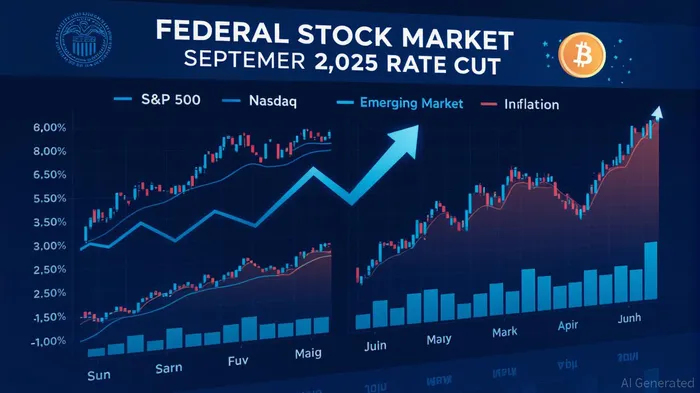
This duality highlights a key tension: while fundamentals like resilient consumer spending and a 3.8% upward-revised Q2 GDP growth support the Fed's easing, speculative bets on AI and crypto suggest a market chasing narratives rather than hard data.
Economic Fundamentals: Strengths and Shadows
On the surface, the U.S. economy appears robust. Consumer spending, a key driver of growth, has held up, and corporate earnings have exceeded expectations. However, cracks are emerging. Core CPI and core PPI remain stubbornly elevated, and the full impact of tariffs-such as the "Liberation Day" reciprocal tariffs introduced in April 2025-has yet to be fully priced in. J.P. Morgan Research warns of a 40% probability of a U.S. recession in the second half of 2025, citing the drag from tariffs, reduced business sentiment, and the unwinding of front-loaded activity in goods-producing industries.
Moreover, global growth is slowing, with emerging markets projected to expand at a 2.4% annualized rate in H2 2025. This divergence in monetary policy-where the Fed remains cautious while other central banks cut rates-could further complicate the dollar's trajectory and inflationary pressures.
The Speculation Factor: Valuation Concerns and Policy Uncertainty
Speculative optimism is hard to ignore. The market's 28 record highs in 2025 reflect a hunger for growth, particularly in technology. Yet, valuations of major indices have raised red flags. Analysts at J.P. Morgan note that while elevated valuations are more relevant for long-term asset allocation, they could amplify volatility in the short term. The rotation into defensive sectors in November underscores investor anxiety about overvaluation and macroeconomic risks.
Policy uncertainty further fuels speculation. The Fed's ambiguous stance on a December rate cut-described as "not a foregone conclusion"-has left markets guessing. Meanwhile, geopolitical tensions and the unresolved impact of tariffs create a backdrop where speculation thrives.
A Cautious Path Forward
For investors, the key lies in balancing optimism with pragmatism. The Fed's rate cuts are justified by near-term labor market risks and the need to support growth, but the broader economic picture remains fraught. While the market's enthusiasm for AI and tech innovation is warranted, overreliance on speculative narratives could lead to sharp corrections.
J.P. Morgan's projection of the S&P 500 closing near 6,000 by year-end hinges on continued earnings growth and a controlled inflation path. However, the 40% recession risk and global trade headwinds suggest that caution is warranted. Investors should prioritize diversification, favoring sectors with strong fundamentals-such as healthcare and utilities-while hedging against inflation and currency risks.
Conclusion
The Fed rate cut rally of late 2025 is a blend of justified optimism and speculative overreach. While the Fed's data-driven approach and resilient GDP growth provide a foundation for cautious optimism, the market's fixation on AI, crypto, and tech valuations risks inflating bubbles. As the Fed navigates this tightrope, investors must remain vigilant, ensuring their portfolios are aligned with both the promise of innovation and the realities of a fragile global economy.

Delivering real-time insights and analysis on emerging financial trends and market movements.
Latest Articles
Stay ahead of the market.
Get curated U.S. market news, insights and key dates delivered to your inbox.






Comments
No comments yet