
Fed's Rate Cut Debate Deepens as Data Delays Fuel Uncertainty


 Aime Summary
The Federal Reserve faces mounting internal divisions as it approaches its December policy meeting, with officials split on whether to proceed with a third interest-rate cut of 2025. While New York Fed President John Williams has signaled support for further reductions, Dallas Fed President Lorie Logan and others argue for patience, citing uncertainty around inflation and the lagged effects of monetary policy. The debate is further complicated by delayed economic data, including the Bureau of Labor Statistics' decision to withhold October inflation and jobs reports, leaving policymakers with only September data to inform their decision.
Logan, who will join the Federal Open Market Committee's voting lineup in 2026, emphasized the risks of overreacting to incomplete information. "Having made two cuts, I'm not certain we have room for more. Monetary policy works with a lag," she stated, warning that premature action could destabilize the economy. Her stance contrasts with Williams, a close ally of Fed Chair Jerome Powell, who suggested on Friday that a "near-term" rate cut could help align policy with a "neutral" stance. The FOMC's October meeting minutes revealed a spectrum of views, with one policymaker even advocating for a 50-basis-point cut, though most favored a 25-basis-point reduction.
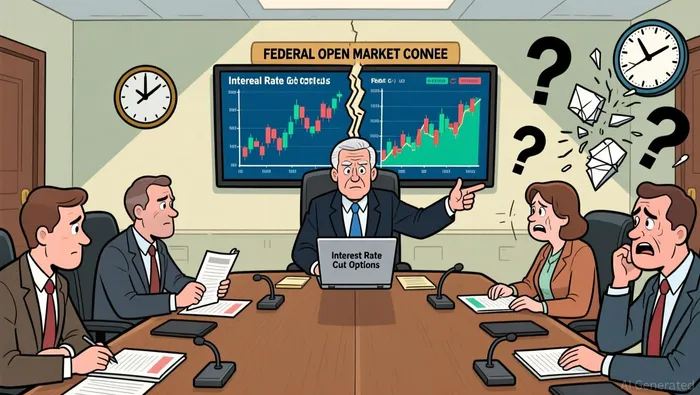 The delayed data release adds to the uncertainty. The BLS will combine October and November inflation data into a Dec. 18 report, leaving the Fed without fresh economic signals until just days before its December 9–10 meeting. This lack of real-time data has heightened the importance of the central bank's Beige Book, which provides a snapshot of regional economic conditions. Meanwhile, the absence of October jobs data-a key barometer for labor market health leaves gaps in the Fed's assessment of whether rate cuts are needed to support a cooling economy.
Political pressures also loom. President Donald Trump has hinted at reshaping the Fed's leadership to push for lower rates, though analysts note that internal divisions may limit his influence. "Powell isn't Trump's biggest hurdle to a rate cut-his own committee is," wrote Vicky Ge Huang in a Wall Street Journal analysis. The Fed's balance sheet, which has paused its asset runoff, remains another focal point. Logan highlighted that maintaining ample reserves will require careful management as economic conditions evolve.
Markets are closely watching the outcome. After Williams' comments, traders increased their bets on a December rate cut, with futures contracts pricing in a roughly 65% probability. However, Boston Fed President Susan Collins and others remain skeptical, arguing that current financial conditions are already accommodative and that additional cuts lack urgency.
The Fed's decision will balance these competing views against a backdrop of global economic shifts, including the U.K.'s autumn budget and central bank meetings in New Zealand and South Korea. With the central bank's tools and independence under scrutiny, the December meeting could set the tone for 2026's monetary policy trajectory.

Stay ahead of the market.
Get curated U.S. market news, insights and key dates delivered to your inbox.






Comments
No comments yet