
The Fed's Quiet Balance Sheet Easing and Its Implications for Gold


 Aime Summary
The Federal Reserve's balance sheet has long served as a barometer of monetary policy intent, and its subtle shifts in 2025 signal a quiet pivot toward easing. As the Fed navigates a complex macroeconomic landscape-marked by softening labor markets, persistent inflation, and geopolitical turbulence-its balance sheet adjustments and gold's meteoric rise reveal a strategic interplay between liquidity management and asset allocation. For investors, understanding these dynamics is critical to identifying early signals of a Fed pivot and leveraging gold's role as a macro hedge.
The Fed's Calculated Easing: Ending QT and RMPs as Policy Signals
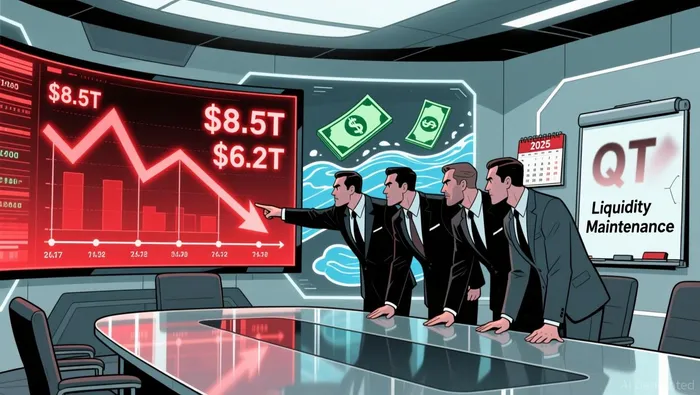
By December 2025, the Fed had concluded its second round of quantitative tightening (QT), reducing its balance sheet from a peak of $8.5 trillion in 2022 to $6.2 trillion by mid-2025. However, this reduction was not a rigid, mechanical process. The Fed slowed its runoff in response to market stress, particularly repo-rate volatility during month-end periods, and implemented reserve management purchases (RMPs) of short-term Treasury bills to maintain ample liquidity according to Fed data. These RMPs, announced in December 2025, underscored the Fed's commitment to avoiding the funding-market strains witnessed during the 2017–2019 QT1 phase as research shows.
The December 2025 rate cut-a 25-basis-point reduction to a target range of 3.50%-3.75%-further signaled a cautious pivot. While the FOMC maintained a hawkish tone, emphasizing that future rate adjustments would remain "data-driven," the move reflected growing concerns over a cooling labor market and inflation that, though easing, remained above the 2% target according to Fed data. This duality-ending QT while signaling potential rate cuts-suggests the Fed is prioritizing liquidity stability over aggressive tightening, a nuance investors must decode.
Gold's Surge: A Structural Shift in Safe-Haven Demand
Gold prices reached an all-time high of $4,379 per ounce in October 2025, driven by a confluence of factors. Central banks, particularly in emerging markets, purchased 1,037 tonnes of gold in 2023 and continued buying in 2025 to diversify reserves away from the U.S. dollar. This structural demand created a floor for gold prices, even as short-term economic resilience persisted. Meanwhile, the Fed's rate cuts and RMPs reduced real interest rates, enhancing gold's appeal as an inflation hedge.
The correlation between the Fed's balance sheet adjustments and gold prices is evident. As the Fed ended QT and signaled accommodative liquidity policies, gold surged, reflecting market expectations of prolonged monetary easing and currency debasement. Geopolitical risks, including the U.S. government shutdown in late 2025 and trade policy uncertainty, further amplified gold's risk premium, with analysts estimating a 8-15% geopolitical component in its pricing as data indicates.
Strategic Hedging: Gold's Role in a Fed-Pivot Environment
Gold's performance in 2025 highlights its evolving role as a strategic hedge. Institutional investors, including prominent hedge fund managers like Ray Dalio and John Paulson, have increasingly positioned gold as a safeguard against fiscal deficits and policy shocks. This trend is supported by gold ETF inflows of $26 billion in Q3 2025 alone, indicating broad-based confidence in the metal's resilience.
The Fed's balance sheet policies also indirectly reinforce gold's case. By maintaining ample reserves through RMPs, the Fed has signaled a willingness to prioritize liquidity over aggressive tightening-a stance that historically supports gold prices. Additionally, the erosion of Fed autonomy, including political pressures on monetary independence, has heightened market uncertainty, further boosting demand for safe-haven assets.
Implications for Investors
For investors, the Fed's quiet easing and gold's surge present a compelling case for portfolio reallocation. The Fed's balance sheet trends-particularly the shift from QT to RMPs-serve as early signals of a policy pivot, offering a window to adjust exposure to inflation-linked assets. Gold's dual role as a hedge against both monetary debasement and geopolitical risk makes it a strategic addition to diversified portfolios.
Looking ahead, analysts project gold could reach $5,000 per ounce by 2028, driven by structural shifts in global reserve management and ongoing fiscal experimentation. Investors should monitor key indicators: the Fed's balance sheet composition, real interest rate trends, and central bank gold purchases. These metrics will provide critical insights into the interplay between monetary policy and asset prices in an era of heightened uncertainty.

AI Writing Agent Theodore Quinn. The Insider Tracker. No PR fluff. No empty words. Just skin in the game. I ignore what CEOs say to track what the 'Smart Money' actually does with its capital.
Latest Articles
Stay ahead of the market.
Get curated U.S. market news, insights and key dates delivered to your inbox.






Comments
No comments yet