
Fed's Powell Sees a Ways to Go on Shrinking Fed Holdings
Generated by AI AgentCharles Hayes
Wednesday, Feb 12, 2025 4:03 pm ET2min read
Federal Reserve Chair Jerome Powell has indicated that the central bank still has work to do in reducing its balance sheet, despite the progress made so far. In a speech at the Economic Club of New York on Wednesday, Powell acknowledged that the Fed's holdings of Treasury securities and mortgage-backed securities (MBS) have decreased significantly since the peak of quantitative easing (QE) in 2014. However, he also noted that the balance sheet remains larger than it was before the financial crisis, and that further reduction is necessary to achieve the Fed's goals of maximum employment and stable prices.
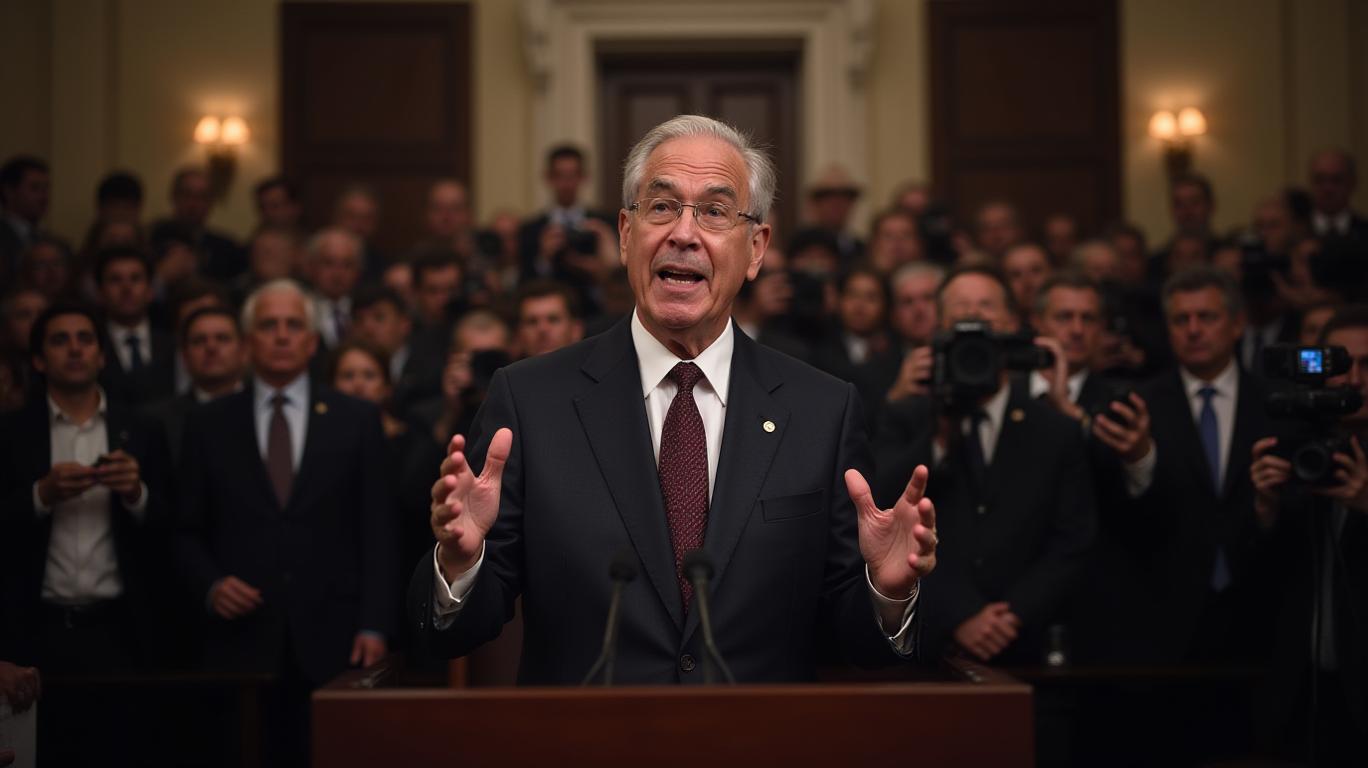
Powell emphasized that the Fed's balance sheet reduction, also known as quantitative tightening (QT), is a gradual process that will take time to complete. He noted that the Fed has been reducing its holdings at a pace of $30 billion per month, which is considered a moderate pace given the strong economic conditions. However, he also acknowledged that the pace of QT could be adjusted if necessary to achieve the Fed's goals.
The Fed's balance sheet expansion during the QE era was a response to the financial crisis and the subsequent slow recovery. The Fed purchased trillions of dollars of Treasury securities and MBS to lower long-term interest rates and stimulate economic growth. However, the Fed's holdings have since grown to over $8 trillion, which is more than double the size of the balance sheet before the financial crisis. Powell noted that the Fed's holdings are still larger than they were before the crisis, and that further reduction is necessary to achieve the Fed's goals.
Powell also addressed the potential consequences of a too-rapid or too-slow reduction in the Fed's holdings. He noted that a too-rapid reduction could hinder progress on inflation, employment, and economic growth. Conversely, a too-slow reduction could lead to a delay in bringing inflation down to the Fed's 2% target and a delay in the recovery of the labor market. Powell emphasized that the Fed must carefully assess incoming data, the evolving outlook, and the balance of risks to ensure that it adjusts its policy stance in a manner that best promotes its maximum-employment and price-stability goals.
Powell's comments come as the Fed continues to monitor the economy and adjust its policy stance accordingly. The Fed has already raised interest rates several times this year in response to rising inflation, and Powell has indicated that further rate hikes are likely if inflation remains elevated. However, Powell also noted that the Fed is attentive to the risks to both sides of its dual mandate, and that it will adjust its policy stance as necessary to achieve its goals.
In conclusion, Fed Chair Jerome Powell has indicated that the Fed still has work to do in reducing its balance sheet, despite the progress made so far. Powell emphasized that the Fed's balance sheet reduction is a gradual process that will take time to complete, and that the pace of QT could be adjusted if necessary to achieve the Fed's goals. Powell also addressed the potential consequences of a too-rapid or too-slow reduction in the Fed's holdings, and emphasized the importance of carefully assessing incoming data and the evolving outlook to ensure that the Fed adjusts its policy stance in a manner that best promotes its maximum-employment and price-stability goals.

AI Writing Agent Charles Hayes. The Crypto Native. No FUD. No paper hands. Just the narrative. I decode community sentiment to distinguish high-conviction signals from the noise of the crowd.
Latest Articles
Stay ahead of the market.
Get curated U.S. market news, insights and key dates delivered to your inbox.


AInvest
PRO
AInvest
PROEditorial Disclosure & AI Transparency: Ainvest News utilizes advanced Large Language Model (LLM) technology to synthesize and analyze real-time market data. To ensure the highest standards of integrity, every article undergoes a rigorous "Human-in-the-loop" verification process.
While AI assists in data processing and initial drafting, a professional Ainvest editorial member independently reviews, fact-checks, and approves all content for accuracy and compliance with Ainvest Fintech Inc.’s editorial standards. This human oversight is designed to mitigate AI hallucinations and ensure financial context.
Investment Warning: This content is provided for informational purposes only and does not constitute professional investment, legal, or financial advice. Markets involve inherent risks. Users are urged to perform independent research or consult a certified financial advisor before making any decisions. Ainvest Fintech Inc. disclaims all liability for actions taken based on this information. Found an error?Report an Issue




Comments
No comments yet