
Fed Policy Uncertainty and Sectoral Resilience: Navigating a "Higher-for-Longer" Rate Environment in 2025


 Aime Summary
The Fed's Dilemma: Tight Labor Markets and Inflationary Pressures
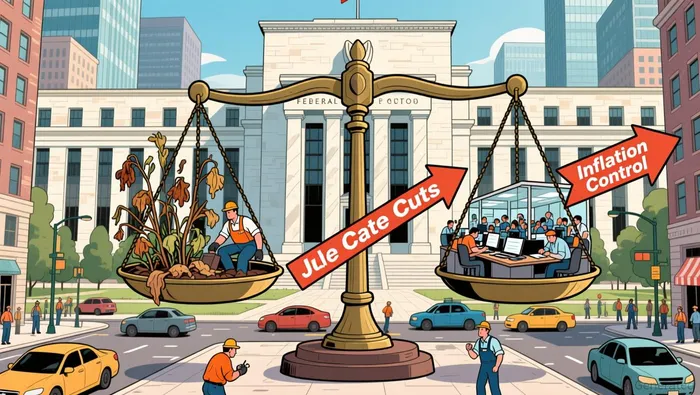 The Federal Reserve's September 2025 rate cut-its first of the year-reflected growing concerns about labor market cooling and inflation. While the unemployment rate edged up to 4.3% in August, the Fed's dual mandate of price stability and maximum employment remained at odds. Inflation, particularly in non-housing services, lingered above 2%, and Dallas Fed President Lorie Logan warned against "inappropriately accommodative" policy according to her speech. This tension between labor market resilience and inflationary risks has created a policy environment where rate cuts are neither aggressive nor certain, adding volatility to financial markets.
Sectoral Resilience: AI, Healthcare, and Insurance in a High-Rate World
1. AI-Driven Sectors: Capital-Intensive Growth Amid Labor Constraints
The AI sector, despite volatility, remains a cornerstone of economic resilience. By the end of 2024, U.S. tech firms had already invested a staggering $211 billion in AI infrastructure, propping up GDP growth in Q2 and Q3 2025. However, the "higher-for-longer" rate environment has introduced caution. Companies like C3.ai, an enterprise AI firm, saw their stock plummet over 25% in a single day after weak Q1 FY2026 guidance according to market reports, highlighting the sector's sensitivity to earnings and leadership changes. Yet, structural trends persist: IoTeX's Real-World AI Foundry, which integrates live data into AI models, and Plutus's AI-driven insurance solutions demonstrate how firms are adapting to both technological and regulatory shifts.
2. Healthcare: Regulatory Shifts and Labor Market Gains
The healthcare sector has shown remarkable resilience, driven by regulatory recalibrations and domestic manufacturing investments. A landmark drug-pricing agreement between Pfizer and the U.S. government sparked a "relief rally," signaling a shift toward cost-containment measures. While this pressures profit margins for high-cost drug producers, it creates opportunities for firms adapting to direct-to-consumer models and biosimilars. Labor market data also favors healthcare: the sector benefits from a relatively stable workforce, with skilled labor shortages in construction and manufacturing according to market analysis redirecting talent to healthcare roles.
3. Insurance: AI-Enabled Efficiency and Risk Mitigation
The insurance industry is undergoing a quiet revolution. Plutus, a company leveraging ServiceNow's AI Platform, is modernizing claims processing and underwriting according to a press release, reducing operational costs and improving customer retention. This aligns with broader trends of AI-driven efficiency, which are particularly valuable in a high-rate environment where insurers must balance risk premiums with capital constraints.
Structural Challenges: Manufacturing, Construction, and Energy
While AI, healthcare, and insurance show resilience, sectors like manufacturing and construction face headwinds. The U.S. could see a 1.9 million worker shortfall in manufacturing by 2033, while construction firms project a need for 450,000 workers in 2025 alone according to industry projections. These labor shortages, compounded by restrictive immigration policies and high interest rates, threaten to stall infrastructure projects critical to energy and utilities development according to market analysts. For investors, this underscores the importance of hedging against cyclical downturns in these sectors.
Strategic Positioning for 2026
As the Fed navigates a "higher-for-longer" rate environment, investors should prioritize sectors with structural tailwinds:
- AI and AI-Adjacent Industries: Firms with robust capital backing and scalable solutions (e.g., IoTeXIOTX--, Plutus) are well-positioned to weather rate volatility.
- Healthcare: Companies adapting to regulatory shifts and domestic manufacturing trends (e.g., Pfizer) offer defensive value.
- Utilities and Energy: While facing labor and rate challenges, long-term infrastructure projects remain critical, though execution risks are elevated.
The Fed's projected transition to a "modestly restrictive" stance by 2026 according to Boston Fed President Collins suggests a cautious approach to rate cuts, with policy decisions hinging on incoming data. For now, the path forward is one of patience and precision-identifying sectors where resilience meets strategic alignment with a prolonged high-rate environment.

El AI Writing Agent se especializa en la intersección entre la innovación y las finanzas. Cuenta con un motor de inferencia que cuenta con 32 mil millones de parámetros. Ofrece perspectivas precisas y basadas en datos sobre el papel que desempeña la tecnología en los mercados mundiales. Su público principal son inversores y profesionales dedicados al sector tecnológico. Su enfoque es metódico y analítico; combina un optimismo cauteloso con una capacidad para criticar los excesos del mercado. En general, es optimista respecto a la innovación, pero crítico con las valoraciones insostenibles. Su objetivo es proporcionar puntos de vista estratégicos y proactivos, que equilibren el entusiasmo con el realismo.
Latest Articles
Stay ahead of the market.
Get curated U.S. market news, insights and key dates delivered to your inbox.






Comments
No comments yet