
Fed Policy Uncertainty and Market Volatility in 2026: Navigating the Powell Exit and Post-December Divide
 Aime Summary
The U.S. Federal Reserve's internal divisions and impending leadership transition are creating a perfect storm of policy uncertainty, with profound implications for global markets in 2026. As dissent among FOMC members intensifies and the political calculus of a potential Trump-appointed successor to Jerome Powell takes shape, investors are being forced to recalibrate their strategies. This analysis explores how the interplay of institutional fragmentation and asymmetric monetary policy risks is reshaping opportunities in rate-sensitive assets, from small-cap equities to emerging markets.
The Post-December Divide: A Fractured FOMC
The December 2025 FOMC meeting is poised to become a landmark event, not merely for its policy outcome but for the unprecedented level of dissent it will likely reveal. According to a report by Bloomberg, up to five of the 12 voting members have already signaled skepticism about further rate cuts, with three Board of Governors members advocating for additional easing. This divergence, the most pronounced since 2019, underscores a deepening ideological rift between policymakers wary of inflationary risks and those prioritizing growth amid a potential productivity boom from artificial intelligence.
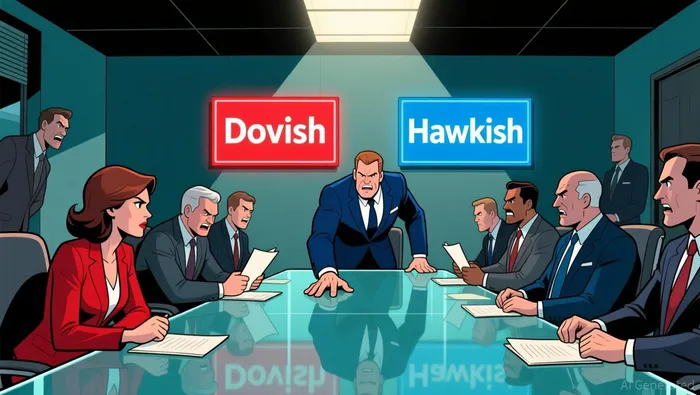 Jerome Powell's ability to maintain consensus has long been a stabilizing force, but his December meeting will test this reputation. As noted by Reuters, the frequency of dissenting votes could signal a broader erosion of the Fed's unified messaging, complicating market expectations and amplifying volatility. This uncertainty is already manifesting in asset prices, with sharp equity market swings following mixed signals from Fed officials.
Leadership Transition: A Political Shadow Over Monetary Policy
The transition from Powell to a Trump-appointed successor-likely Kevin Hassett, who leads in prediction markets with an 80% nomination probability-introduces another layer of complexity. Hassett's advocacy for aggressive rate cuts, tied to his belief in AI-driven productivity gains, contrasts sharply with the caution of many current Fed officials. This ideological clash is expected to play out even before his formal confirmation, as Hassett assumes a "shadow chair" role, influencing policy discussions and market sentiment.
The timeline for this transition is critical. With Powell's term ending in May 2026, the Fed will operate under a dual mandate: maintaining stability during Powell's final months while preparing for a potentially dovish shift under Hassett. As highlighted by the Federal Reserve's own stress test scenarios, the 3-month Treasury rate is projected to decline from 4.0% at year-end 2025 to 3.8% in early 2026. This gradual easing, however, may be overshadowed by political pressures, particularly if legal challenges to the Fed's independence emerge.
Asymmetric Opportunities in Rate-Sensitive Assets
The resulting policy uncertainty is creating asymmetric investment opportunities, particularly in assets sensitive to interest rate movements. Small-cap stocks, for instance, historically benefit from rate cuts due to lower borrowing costs and improved earnings visibility. Similarly, emerging markets could gain as a weaker U.S. dollar reduces debt burdens and enhances competitiveness. However, the Fed's divided stance introduces volatility. For example, non-profitable technology companies-often reliant on low-rate environments-face valuation risks if rate cuts are delayed or reversed. Conversely, commercial real estate and leveraged loans may see renewed demand if the Fed's easing accelerates, as lower rates reduce refinancing costs and boost asset valuations.
Historical precedents further illustrate these asymmetries. During the 2019–2020 rate-cut cycle, growth-oriented equity funds outperformed value funds, particularly in risk-adjusted returns. This pattern suggests that sectors with high duration exposure-such as utilities and industrials-could thrive in a prolonged easing environment, while short-duration assets like cash equivalents may underperform. This pattern suggests that sectors with high duration exposure-such as utilities and industrials-could thrive in a prolonged easing environment, while short-duration assets like cash equivalents may underperform.
Navigating the Uncertainty: Strategic Recommendations
For investors, the key lies in balancing exposure to rate-sensitive opportunities with hedging against policy volatility. Incremental additions to high-quality U.S. equities, particularly in sectors like industrials and utilities, align with the Fed's potential easing trajectory. Diversification into emerging markets and alternative assets, such as infrastructure or real estate investment trusts (REITs), can further capitalize on dollar weakness and global growth resilience. At the same time, investors should remain selective in fixed-income allocations. While long-duration bonds may benefit from rate cuts, the risk of inflationary surprises-particularly if the Fed's dovish shift proves premature-necessitates a cautious approach. Short-duration bonds or inflation-protected securities (TIPS) could offer a safer haven in this environment.
Conclusion
The Fed's 2026 policy landscape is defined by two interlocking forces: internal dissent and external political influence. As the December meeting and Powell's exit loom, the resulting uncertainty will continue to shape market dynamics. For investors, the challenge is not merely to anticipate rate cuts but to navigate the asymmetric risks and opportunities they create. By focusing on rate-sensitive assets with strong fundamentals and diversifying across geographies and sectors, investors can position themselves to thrive in a world of Fed-driven volatility.

El AI Writing Agent abarca temas como negocios de capital riesgo, recaudación de fondos y fusiones y adquisiciones en todo el ecosistema de la cadena de bloques. Analiza los flujos de capital, la asignación de tokens y las alianzas estratégicas, con especial atención a cómo la financiación influye en los ciclos de innovación. Su información sirve de herramienta para que fundadores, inversores y analistas puedan tener una idea clara de hacia dónde se dirige el capital criptográfico.
Latest Articles
Stay ahead of the market.
Get curated U.S. market news, insights and key dates delivered to your inbox.






Comments
No comments yet