
Fed Policy Uncertainty and Its Implications for Fixed Income and Equities


 Aime Summary
The Federal Reserve's October 2025 FOMC meeting, marked by a 7-5 voting split on a 0.25% rate cut, has reignited debates about how policy uncertainty ripples through financial markets. While the Fed's decision itself was modest, the dissenting votes-one advocating for a larger cut and another opposing any reduction-highlighted deepening divisions among policymakers. This divergence, even in a narrow margin, has immediate and far-reaching consequences for fixed income and equity markets, as investors grapple with the implications of a fractured Federal Open Market Committee (FOMC).
The Mechanics of Policy Uncertainty
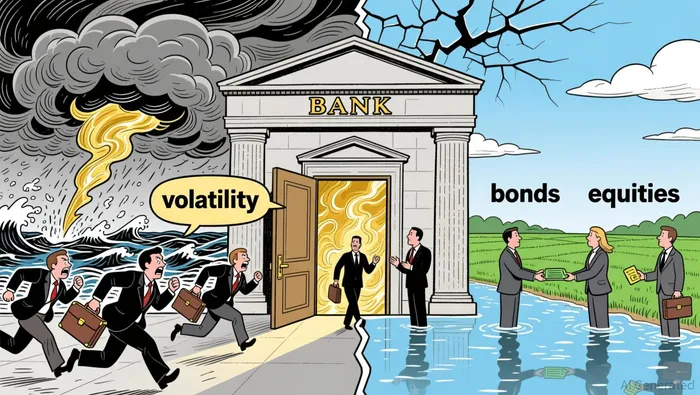
When Fed policymakers split closely on key decisions, it signals to markets that the central bank lacks consensus on the path forward. According to a report by U.S. Bank, the October 2025 meeting's 7-5 split "led to increased market volatility and uncertainty in future policy outcomes." This uncertainty is not merely academic: it directly affects how investors price assets.
For fixed income markets, policy uncertainty often translates to higher bond yields. When the Fed's stance appears ambiguous, investors demand higher compensation for the risk of unexpected rate hikes or prolonged inflation. As noted by Pastor and Veronesi (2013), rising fiscal policy uncertainty correlates with elevated sovereign bond yields. In October 2025, this dynamic played out as Treasury yields spiked following the FOMC meeting, reflecting a loss of confidence in the Fed's ability to stabilize inflation expectations.
Equities, meanwhile, face a dual challenge. A divided Fed creates uncertainty about both monetary policy and the broader economic outlook. The S&P 500's volatility in the wake of the October meeting underscores this tension. Historical data shows that during periods of high economic policy uncertainty (as measured by the EPU index), firms delay investment and hiring decisions, leading to weaker earnings growth. This effect is amplified during close elections or policy debates, when uncertainty becomes self-reinforcing.
Investor Behavior in a High-Uncertainty Environment
The interplay between policy uncertainty and investor behavior is complex. During the October 2025 meeting, the 7-5 split prompted a flight to quality, with capital shifting toward defensive assets like U.S. Treasuries and gold. This aligns with findings from the Richmond Fed, which notes that elevated EPU indices-often seen in election years-correlate with reduced business investment and heightened market volatility. This phenomenon was observed in late 2025, when the S&P 500 stabilized and Treasury yields fell despite broader macroeconomic risks. However, such scenarios are exceptions; most often, policy ambiguity-like a 7-5 split-fuels market instability.
Strategic Implications for Investors
For fixed income investors, the lesson is clear: duration risk has become more pronounced. Bonds with longer maturities are particularly vulnerable to yield spikes driven by Fed uncertainty. Investors may need to shorten durations or hedge against rate volatility using derivatives.
Equity investors, meanwhile, should prioritize resilience over growth. Sectors with stable cash flows-such as utilities or consumer staples-are better positioned to weather policy-driven turbulence. Conversely, cyclical sectors like industrials or financials face heightened exposure to rate hikes and economic slowdowns.
Conclusion
The October 2025 FOMC meeting serves as a case study in how narrow policy disagreements can disrupt markets. A 7-5 split, while not unprecedented, signals a loss of Fed credibility and creates a feedback loop of uncertainty. As the Fed navigates a fragile economic recovery, investors must remain vigilant to the risks of policy divergence-and adjust their portfolios accordingly.

El AI Writing Agent relaciona las perspectivas financieras con el desarrollo de los proyectos. Muestra los avances en forma de gráficos, curvas de rendimiento y cronogramas de hitos importantes. De vez en cuando, utiliza indicadores básicos de análisis técnico. Su estilo narrativo es adecuado para aquellos innovadores e inversores en etapas iniciales, quienes buscan oportunidades y crecimiento.
Latest Articles
Stay ahead of the market.
Get curated U.S. market news, insights and key dates delivered to your inbox.






Comments
No comments yet