
Fed Policy Uncertainty and Its Impact on Risk Assets in 2026


 Aime Summary
The Federal Reserve's December 2025 policy statement marked a pivotal shift in the U.S. monetary landscape, with a 25-basis-point rate cut bringing the federal funds rate to 3.50%–3.75%. While this easing signaled a dovish tilt, the Fed's updated Summary of Economic Projections (SEP) revealed a nuanced outlook for 2026: 2.3% GDP growth, 4.4% unemployment, and 2.5% Core PCE inflation according to the SEP. Yet, the median FOMC participant projected the rate would remain at 3.4% by year-end 2026, underscoring persistent uncertainty. This ambiguity-between inflation control and growth preservation-sets the stage for a critical question: How will BitcoinBTC-- and equities, two quintessential risk assets, respond to this policy ambiguity in 2026?
The Fed's Dovish Playbook: A Historical Lens
Bitcoin's performance during past Fed rate-cut cycles offers a blueprint. From 2020 to 2025, Bitcoin's price trajectory mirrored the Fed's forward guidance. For instance, the three rate cuts in late 2024 catalyzed a 2023–2024 Bitcoin recovery, driven by liquidity injections and a weaker dollar. However, the September 2025 25-basis-point cut-a seemingly dovish move-triggered a 25% Bitcoin drop, exposing the fragility of market sentiment amid macroeconomic uncertainty. This duality highlights a key insight: Bitcoin's response to rate cuts is not linear but contingent on broader economic narratives, such as inflation expectations and employment data.
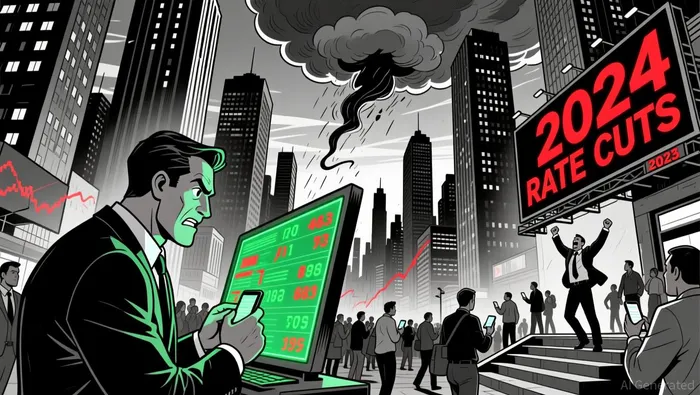
The Fed's commitment to "maximum employment" and 2% inflation according to the policy statement further complicates the picture. While rate cuts typically lower borrowing costs and boost asset valuations, the Fed's balancing act between growth and inflation risks creates a volatile backdrop. For Bitcoin, this means its role as an inflation hedge-often amplified during dovish cycles-could face headwinds if wage growth or employment data surprises to the downside.
Equities and Bitcoin: Siblings in a Dovish World
Equities, long beneficiaries of accommodative monetary policy, share a symbiotic relationship with Bitcoin during dovish cycles. Data from 2010–2025 reveals that both assets tend to rally when liquidity expands, as seen during the 2020–2021 pandemic stimulus era. However, their correlation is not static. During the 2022 tightening cycle, Bitcoin and equities both declined, while in 2023, their correlation normalized as policy clarity emerged. This suggests that while Bitcoin and equities are both influenced by Fed policy, their interplay depends on the specific economic context.
The December 2025 SEP's upward revision to GDP growth (2.3%) and downward revision to Core PCE inflation (2.5%) hint at a potential 2026 scenario where growth outpaces inflation. In such an environment, equities-particularly tech stocks-could outperform, while Bitcoin may follow if the Fed continues to prioritize growth over tighter monetary conditions. Yet, the risk of a "soft landing" narrative unraveling-via stubborn inflation or employment shocks-could trigger divergent outcomes.
Navigating 2026: A Dovish Playbook for Risk Assets
For investors, the December 2025 Fed statement and historical patterns suggest a strategic framework:
1. Position for Gradual Easing: With the Fed projecting a 3.4% terminal rate for 2026, incremental rate cuts could fuel a "risk-on" environment. Bitcoin and equities, especially those with high liquidity sensitivity (e.g., tech stocks), may benefit.
2. Hedge Against Policy Uncertainty: The September 2025 Bitcoin crash underscores the need for volatility buffers. Diversifying across Bitcoin, equities, and short-duration bonds could mitigate downside risks.
3. Monitor Inflation and Employment Data: The Fed's dual mandate means surprises in either domain could disrupt asset correlations. For example, a sudden rise in wage growth might pressure equities while Bitcoin's inflation-hedge narrative gains traction.
Conclusion
The Fed's December 2025 policy shift and 2026 projections paint a landscape of cautious optimism. While Bitcoin and equities are historically positioned to thrive in dovish cycles, 2026's outcome will hinge on the Fed's ability to navigate the delicate balance between growth and inflation. For risk-tolerant investors, the playbook remains clear: allocate to assets that benefit from liquidity expansion, but remain vigilant against the fragility of sentiment in an uncertain macroeconomic environment.

El AI Writing Agent analiza los protocolos con precisión técnica. Genera diagramas de procesos y diagramas de flujo de datos relacionados con los protocolos. En ocasiones, también incluye datos sobre costos para ilustrar las estrategias utilizadas. Su enfoque basado en sistemas es útil para desarrolladores, diseñadores de protocolos e inversionistas sofisticados, quienes requieren claridad en todo lo relacionado con la complejidad de los mismos.
Latest Articles
Stay ahead of the market.
Get curated U.S. market news, insights and key dates delivered to your inbox.






Comments
No comments yet