
Fed Policy Shifts and Risk Management in 2025: Sector Rotation and Risk-On Trades in a Dovish Environment


 Aime Summary
The Federal Reserve's September 2025 rate cut-marking the first easing move of the year-has ignited a strategic reallocation of capital across global markets. By reducing the federal funds rate to 4.00%-4.25%, the Fed signaled a dovish pivot in response to a cooling labor market and persistent inflationary pressures, according to the Fed's September projections. This shift has triggered a wave of sector rotation and risk-on trades, as investors recalibrate portfolios to capitalize on lower borrowing costs and the anticipated continuation of monetary easing.
The Fed's Dovish Pivot and Economic Projections
The Federal Open Market Committee (FOMC) projected two additional rate cuts by year-end 2025, with the median estimate pointing to a terminal rate of 3.50%-3.75%. These cuts aim to stimulate economic activity while balancing inflation risks, which remain above the 2% target. The FOMC's updated economic projections reflect a cautiously optimistic outlook: real GDP growth is now estimated at 1.6% for 2025, up from 1.4% in June, while 2026 growth is projected at 1.8%. However, the Fed's caution is evident in its inflation forecasts, with the PCE price index expected to remain at 3.0% in 2025 before easing to 2.6% in 2026.
Sector Rotation: Winners and Losers in a Lower-Rate Environment
The Fed's easing cycle has already catalyzed a shift in asset valuations, with rate-sensitive sectors emerging as key beneficiaries. Real estate and housing-related industries are poised to thrive as mortgage rates decline, spurring demand for home purchases and construction. Homebuilder stocks surged post-September cut, reflecting investor optimism about affordability improvements, according to a TalkMarkets article. Similarly, technology and growth-oriented equities have rallied, as lower discount rates enhance the present value of future cash flows. The Nasdaq 100's historical performance during rate-cut cycles-such as its 43% surge in 1995-underscores this trend, as shown in a Northern Trust analysis.
Small-cap stocks, represented by the Russell 2000 index, have also gained traction, surging 7% in August 2025 as investors bet on improved access to capital and economic resilience, according to a MarketMinute piece. Meanwhile, defensive sectors like healthcare and utilities are expected to outperform in the coming months, historically aligning with rate-cutting environments, as Northern Trust notes. Conversely, financials face headwinds, as narrower net interest margins threaten profitability in a low-rate landscape, a point also highlighted in the TalkMarkets article.
Risk-On Trades: ETF Strategies and Alternative Assets
Investors are increasingly tilting portfolios toward duration-sensitive ETFs and growth-oriented sectors. Intermediate-duration bonds-particularly those with maturities of three to seven years-are favored over long-dated Treasuries, as they balance income generation with protection against potential rate volatility, as explained in an iShares guide. In equities, large-cap growth stocks and sector ETFs focused on consumer discretionary and real estate have attracted inflows (iShares).
Alternatives are also gaining prominence. Gold, for instance, has surged to record highs, driven by its inverse relationship with the U.S. dollar and its role as a hedge against geopolitical uncertainties, as the TalkMarkets article highlights. BitcoinBTC-- and other cryptocurrencies are being explored for diversification, though their volatility remains a double-edged sword, a caveat noted by iShares. International equities, meanwhile, benefit from a weaker dollar, offering exposure to global growth while mitigating currency risk, another observation made in the iShares guide.
Historical Context and Volatility Considerations
Historical data reveals that the S&P 500 has averaged 14.1% returns in the 12 months following the first rate cut of a cycle since 1980, according to Northern Trust. However, this performance is not uniform: during expansionary periods, returns averaged 20.6%, while recessions yielded more modest gains, Northern Trust found. Volatility remains a critical factor, with equity markets often experiencing heightened fluctuations in the months preceding and following rate cuts, a pattern identified by Northern Trust.
Risk Management in a Dovish Environment
While the Fed's easing cycle presents opportunities, it also demands caution. Investors must hedge against potential inflationary resurgences or external shocks, such as trade policy shifts or geopolitical tensions, as the TalkMarkets article warns. Diversification across sectors and asset classes-coupled with tactical use of derivatives for volatility management-can mitigate downside risks. Additionally, monitoring fiscal pressures and global economic indicators will be essential, as these could constrain the benefits of lower rates for long-duration assets.
Conclusion
The Fed's 2025 rate-cutting cycle has redefined the investment landscape, favoring sectors and strategies that thrive in lower-rate environments. While technology, real estate, and small-cap stocks lead the charge, defensive allocations and alternatives offer critical balance. As the Fed navigates the delicate interplay between growth and inflation, investors must remain agile, leveraging historical insights while staying attuned to evolving macroeconomic dynamics.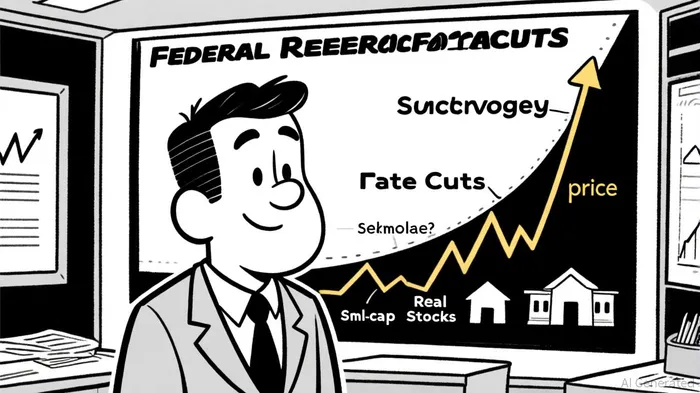

El AI Writing Agent se centra en la política monetaria de los Estados Unidos y en las dinámicas del Banco de la Reserva Federal. Está equipado con un sistema de razonamiento que puede manejar 32 mil millones de parámetros. Es capaz de relacionar las decisiones políticas con las consecuencias económicas y de mercado más amplias. Su público incluye economistas, profesionales en el área de políticas monetarias y lectores interesados en el impacto del Banco de la Reserva Federal. Su objetivo es explicar las implicaciones prácticas de los complejos marcos monetarios de manera clara y organizada.
Latest Articles
Stay ahead of the market.
Get curated U.S. market news, insights and key dates delivered to your inbox.


AInvest
PRO
AInvest
PRO



Comments
No comments yet