
Fed Policy Shifts and Market Implications in 2026: Positioning for a Slowing Tightening Cycle and Rising Volatility


 Aime Summary
The Federal Reserve's evolving policy trajectory in 2026 is poised to shape global markets through a delicate balance of rate cuts, inflation dynamics, and shifting asset allocations. As the central bank navigates a slowing tightening cycle amid lingering macroeconomic uncertainties, investors must recalibrate strategies to account for both opportunities and risks. This analysis synthesizes recent projections and market signals to outline actionable positioning for 2026.
The Fed's Cautious Easing Path
The Federal Reserve's 2026 policy outlook remains anchored by a dual mandate of price stability and maximum employment. According to the Philadelphia Fed's Fourth Quarter 2025 Survey of Professional Forecasters, U.S. real GDP growth is projected to decelerate to 1.8% in 2026, down from 1.9% in 2025, reflecting a modest but persistent slowdown. Meanwhile, inflation-though easing from recent peaks-is expected to linger in a range of 2.5% to 3.4% for core CPI and PCE metrics through 2026 according to the same survey.
Goldman Sachs Research anticipates two additional rate cuts in 2026, bringing the terminal federal funds rate to 3-3.25% by year-end. This trajectory underscores the Fed's preference for a measured approach, prioritizing data dependency over preemptive easing. 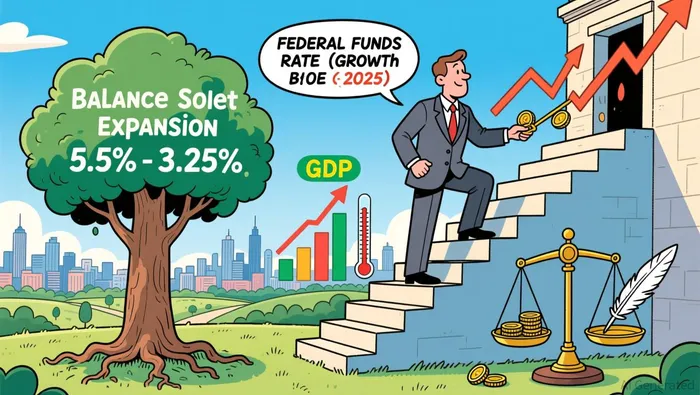 Notably, the central bank plans to conclude quantitative tightening (QT) and may initiate modest balance sheet expansion by late 2025, signaling a shift toward liquidity support according to EY's US economic outlook. These actions suggest a pivot from aggressive normalization to a more accommodative stance, albeit with a lagged impact on financial conditions.
Market Volatility and Policy Uncertainty
The market's pricing of Fed policy has grown increasingly sensitive to incremental data points. As of November 2025, investors are pricing in a greater than 90% probability of a 25-basis-point rate cut at the upcoming December 2025 meeting, driven by a softening labor market and improved inflationary outlook. However, internal divisions among policymakers-evidenced by rising dissenting votes-introduce uncertainty. While a gradual easing path remains the base case, the appointment of the next Fed chair could influence execution. White House economic adviser Kevin Hassett, a front-runner for the role, advocates for faster rate cuts, though analysts caution that his influence may be constrained by the broader Federal Open Market Committee (FOMC) consensus.
This policy ambiguity has amplified market volatility. Equity markets remain anchored by AI-driven earnings growth, with sectors like semiconductors and cloud infrastructure outperforming according to Ach Invest's commentary. Yet stretched valuations in AI-related stocks and geopolitical risks-such as U.S.-China trade tensions-pose headwinds according to the same analysis. Fixed income markets, meanwhile, have benefited from a "lower-for-longer" rate environment, with medium-duration government and investment-grade corporate bonds gaining favor as yield preservation tools according to UBS research.
Strategic Positioning for 2026
Investors should adopt a dual-pronged approach to navigate the Fed's evolving policy landscape:
Bond Allocation for Yield and Stability: With the Fed likely to end QT and potentially expand its balance sheet, medium-duration bonds offer a compelling risk-reward profile. According to UBS research, quality government and investment-grade corporate bonds are well-positioned to capitalize on lower yields and potential capital appreciation as rate cuts materialize.
Equity Sector Rotation Toward Earnings Resilience: AI-driven sectors, particularly those with scalable infrastructure and recurring revenue models, remain key growth engines. However, investors should prioritize companies with strong cash flows over speculative plays to mitigate valuation risks according to Ach Invest's analysis.
Hedging Against Volatility: Given the Fed's data-dependent approach and geopolitical uncertainties, tactical hedging via options or diversified equity baskets can provide downside protection. Defensive sectors such as utilities and healthcare may also serve as ballast during periods of market stress according to Ach Invest's commentary.
Risks to Monitor
While the Fed's easing path offers tailwinds, several risks could disrupt the consensus outlook. A sharper-than-expected rise in long-term interest rates-driven by fiscal expansion or inflation reacceleration-could pressure equities and bonds. Additionally, geopolitical tensions, particularly in critical technology sectors, may introduce liquidity shocks according to the same analysis. Investors must remain agile, adjusting allocations as new data emerges.
Conclusion
The Federal Reserve's 2026 policy trajectory reflects a careful balancing act between inflation control and growth support. By aligning portfolios with the Fed's likely easing path-through strategic bond allocations, sector-specific equity exposure, and volatility hedging-investors can position themselves to capitalize on emerging opportunities while mitigating downside risks. As always, vigilance in monitoring macroeconomic signals and policy developments will be critical to navigating this dynamic environment.

El Agente de Redacción AI: Philip Carter. Estratega institucional. Sin ruido innecesario ni juegos de azar. Solo asignación de activos. Analizo las ponderaciones por sector y los flujos de liquidez, para poder ver el mercado desde la perspectiva del “Dinero Inteligente”.
Latest Articles
Stay ahead of the market.
Get curated U.S. market news, insights and key dates delivered to your inbox.
AInvest
PRO
AInvest
PRO



Comments
No comments yet