
The Fed's Policy Shift and Its Unintended Impact on Solana's Price Surge


 Aime Summary
A Policy Pivot and Its Ripple Effects
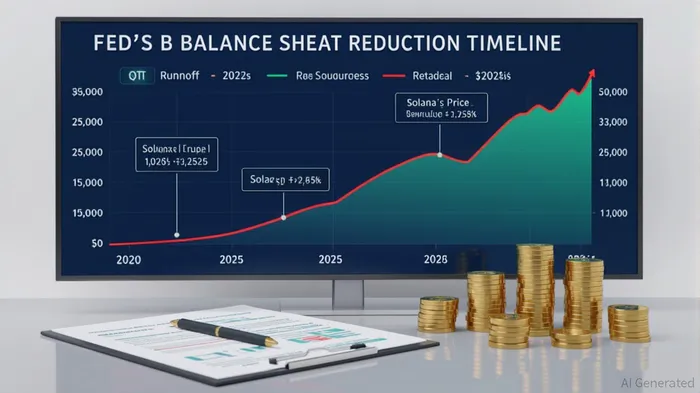
The Fed's decision to end QT-a multi-year program to reduce its balance sheet-marked a pivotal shift toward a more neutral stance. By December 2025, the central bank had halted the reinvestment of maturing securities, effectively injecting liquidity into the financial system. This move, coupled with a 25-basis-point rate cut in October 2025, reflected growing concerns over a slowing labor market and uneven economic conditions. Governor Christopher Waller, a vocal advocate for further easing, emphasized that restrictive policies were disproportionately harming lower-income households, while corporate America thrived under looser financial conditions.
The Fed's pivot aligns with historical patterns where balance sheet expansions have fueled surges in risk assets. Deutsche Bank analysts noted that similar liquidity injections in 2020–2021 coincided with Bitcoin's 300% rally and Ethereum's 400% gain. While Solana's price data for December 2025 remains opaque, the broader crypto market's response to Fed easing suggests a plausible correlation.
Crypto's New Macroeconomic Sensitivity
Cryptocurrencies, once dismissed as disconnected from traditional markets, are now deeply intertwined with central bank policy. Thomas Lee of BitMine drew parallels between QT's 2022 liquidity-sapping effects and the current environment, noting that market makers' balance sheet constraints can amplify price swings. The Fed's shift to easing, therefore, could reverse this dynamic, boosting demand for high-yield, high-volatility assets like Solana.
However, the relationship is not one-dimensional. While lower interest rates reduce the opportunity cost of holding non-yielding assets, regulatory uncertainty and macroeconomic risks-such as inflation surprises-remain headwinds. For instance, the Fed's internal divisions over future rate cuts, highlighted by Waller, underscore the potential for policy ambiguity to dampen investor confidence.
Strategic Implications for Investors
The Fed's policy trajectory highlights a critical shift in asset allocation logic. For 2025–2026, investors must weigh the interplay between monetary easing and crypto-specific fundamentals. Solana's ecosystem growth, including its role in decentralized finance (DeFi) and blockchain scalability, could amplify its response to liquidity-driven demand. Yet, diversification remains key: while crypto may benefit from Fed easing, its volatility necessitates hedging against macroeconomic shocks.
Risk management strategies should also account for the Fed's evolving communication. As Waller warned, narrow policy votes could erode market predictability, creating short-term turbulence. Investors might consider dynamic rebalancing-adjusting crypto exposure in response to Fed signals-rather than static allocations.
Conclusion
The Fed's 2025 policy shift has inadvertently positioned Solana and other cryptocurrencies as barometers of monetary easing. While direct price correlations remain difficult to quantify, the broader trend of central bank liquidity influencing crypto valuations is clear. For investors, this underscores the need to integrate macroeconomic analysis into crypto strategies, balancing the allure of high-growth assets with the realities of policy-driven volatility.

Blending traditional trading wisdom with cutting-edge cryptocurrency insights.
Latest Articles
Stay ahead of the market.
Get curated U.S. market news, insights and key dates delivered to your inbox.






Comments
No comments yet