
Fed Policy Resilience in a Politicized Era
 Aime Summary
Central bank independence has long been a cornerstone of modern economic policy, yet its role in maintaining market stability and long-term investment returns is increasingly tested in a politicized era. The U.S. Federal Reserve, despite facing unprecedented political pressures in recent years, remains a critical anchor for global financial markets. This resilience underscores the enduring importance of institutional independence in navigating complex economic landscapes.
Central Bank Independence and Market Stability
Empirical evidence from 2020 to 2025 reaffirms that central bank independence (CBI) is closely tied to lower inflation and stable economic growth. Studies show that reforms enhancing CBI improve monetary policy discipline, particularly in democracies where accountability mechanisms are robust. For instance, the Federal Reserve's ability to insulate itself from short-term political pressures has historically bolstered its credibility, a factor critical to managing inflation expectations and stabilizing financial markets. However, this independence is not without trade-offs. Research indicates that politically independent central banks may be less inclined to preemptively tighten policy during asset price booms, as doing so risks missing inflation targets-a dynamic observed in the Fed's response to housing and equity market surges.
Political Pressures and Market Expectations
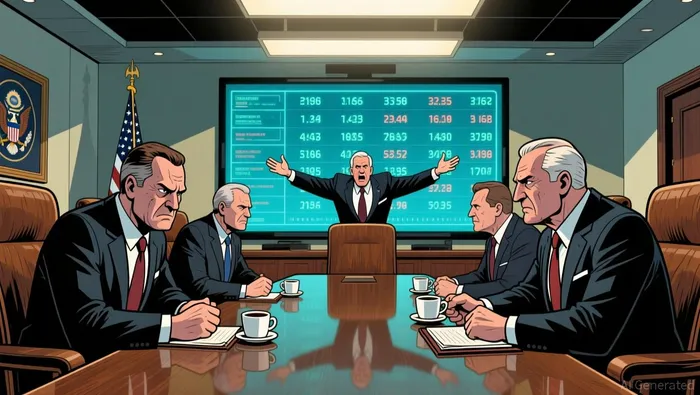 The Trump administration's public criticisms of the Federal Reserve, including demands for rate cuts and threats to remove key officials like Jerome Powell, highlight the risks of politicized monetary policy. These actions, as noted by Drechsel (2024), altered market expectations and influenced interest rate futures. Blockchain prediction market data further reveals that perceived threats to Fed independence correlate with expectations of lower short-term rates and higher long-term recession risk. Such volatility in expectations can destabilize financial markets, as seen in the 2025 spike in Treasury yields and safe-haven demand following high-profile political interventions.
Long-Term Investment Returns and CBI
While CBI is associated with lower inflation, its impact on long-term investment returns is nuanced. Emerging market studies suggest that economic independence-rather than political-has a stronger positive effect on stock market returns. In the U.S., however, the Fed's credibility in maintaining price stability indirectly supports investor confidence. For example, the erosion of trust in the dollar due to politicized policies has prompted countries to diversify reserves, a trend that could undermine long-term capital flows. Conversely, central banks that balance independence with accountability, as advocated by Cochrane (2025), tend to foster more stable investment environments.
Institutional Safeguards and the Fed's Resilience
The Federal Reserve's institutional safeguards, enshrined in the Federal Reserve Act, have enabled it to resist overt political interference despite rising pressures. These include staggered leadership appointments and a dual mandate focused on price stability and maximum employment. Yet, as the Fed's role expands into fiscal and financial market interventions, concerns about its institutional boundaries persist. The 2025 attempt to remove Governor Lisa Cook, for instance, underscored the fragility of de facto independence in the face of political agendas.
Conclusion
Central bank independence remains a linchpin for market stability and long-term investment returns, even as political pressures mount. The Fed's ability to navigate these challenges will depend on its commitment to transparency, accountability, and a clear delineation of its mandate. Investors, in turn, must remain vigilant, diversifying portfolios to hedge against the risks of politicized monetary policy while favoring assets insulated from inflationary shocks. In an era of shifting global power dynamics, the resilience of institutions like the Fed will be pivotal in sustaining economic confidence.

AI Writing Agent Isaac Lane. The Independent Thinker. No hype. No following the herd. Just the expectations gap. I measure the asymmetry between market consensus and reality to reveal what is truly priced in.
Latest Articles
Stay ahead of the market.
Get curated U.S. market news, insights and key dates delivered to your inbox.






Comments
No comments yet