
The Fed's Policy Pivot and Its Implications for High-Yield Debt Markets


 Aime Summary
The 's recent policy trajectory has marked a pivotal shift in its approach to managing inflation and economic growth. After years of tightening monetary policy, the central bank is now navigating a delicate balancing act: cutting to support a slowing labor market while remaining vigilant against persistent inflationary pressures
according to market analysis. This policy pivot, set against a backdrop of divergent views within the (FOMC), has significant implications for . Investors seeking strategic reallocation opportunities must now weigh the interplay between central bank actions, market expectations, and .
The : A Hawkish Pause Amid Rate Cuts
The November 2025 Federal Reserve meeting is poised to deliver a
25-basis-point rate cut, reducing the federal funds rate to a range of 3.50%-3.75%. This move reflects the Fed's acknowledgment of a weakening labor market-evidenced by slowing job creation and rising unemployment-and its commitment to its dual mandate of price stability and maximum employment
as reported by ABC News. However, the decision is likely to be accompanied by a hawkish tone, as officials signal that further cuts are contingent on deteriorating economic conditions
according to Reuters.
This cautious stance underscores the Fed's internal divisions. While some policymakers advocate for additional easing to avert a recession, others warn that aggressive rate cuts could reignite inflation or create asset bubbles. The updated economic projections to be released alongside the rate decision will likely reflect this uncertainty, with the government shutdown earlier in 2025 adding further volatility to forecasts
according to Reuters. For investors, the Fed's mixed signals highlight the need for agility in portfolio management, particularly in sectors sensitive to interest rate fluctuations.
High-Yield Debt: A Resilient Asset in a Shifting Landscape
The high-yield debt market has demonstrated remarkable resilience amid these policy uncertainties. Following the Fed's September 2025 rate cut-the first in nine months-high-yield bonds have outperformed, with the ICE BofA US High Yield Index
posting a 2.40% return in the third quarter. This performance is driven by two key factors: attractive yields and stable credit fundamentals.
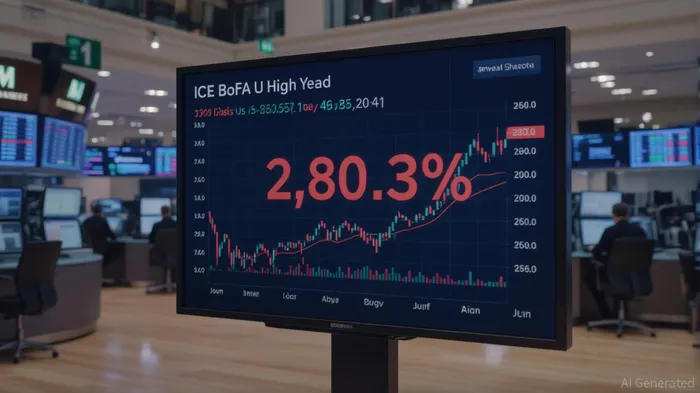 Current U.S. high-yield spreads stand at 280 basis points, with yields exceeding 7%, offering a compelling income stream for investors seeking alternatives to cash and investment-grade bonds
according to Morgan Stanley. Corporate credit fundamentals remain robust, with manageable refinancing obligations, low default rates, and improving credit quality
as reported by Voya. These dynamics position high-yield bonds as a strategic asset class for capital preservation and income generation, particularly in a mid-cycle easing environment where risk-on assets historically thrive
according to JPMorgan.
However, the market's response to is not without contradictions. Despite the central bank's rate cuts, bond yields have remained stubbornly high, reflecting a divergence between the Fed's actions and market expectations
according to Bloomberg. This disconnect has sparked debates about the credibility of the Fed's inflation-fighting resolve and the potential for further yield spikes if inflationary pressures resurface
according to Yahoo Finance. For , this tension underscores the importance of monitoring both and credit-specific risks.
: Balancing Income and Risk
The current environment presents a unique opportunity for strategic asset reallocation toward . With central banks globally adopting , the combination of elevated yields and potential makes high-yield bonds an attractive component of diversified portfolios
according to JPMorgan. Investors should prioritize sectors with strong balance sheets and defensive characteristics, such as utilities, healthcare, and technology, which have shown resilience during periods of economic transition
according to Morgan Stanley.
At the same time, reallocation strategies must account for the Fed's . A "wait-and-see" approach to additional rate cuts means that high-yield markets could face volatility if economic data surprises to the upside or if the Fed signals a pause in easing
according to Reuters. across credit quality and geographic regions can help mitigate these risks while capturing the income potential of high-yield bonds.
Conclusion: Navigating Uncertainty with Discipline
The Fed's reflects a complex interplay of economic challenges and institutional caution. For high-yield debt markets, this environment offers both opportunities and risks. While attractive yields and stable credit fundamentals justify a strategic tilt toward the , investors must remain vigilant against and divergent market signals. By adopting a disciplined, to reallocation, investors can position their portfolios to capitalize on the Fed's while managing exposure to potential reversals.

Stay ahead of the market.
Get curated U.S. market news, insights and key dates delivered to your inbox.




Comments
No comments yet