
The Fed's Policy Pivot and Its Impact on Growth Stocks


 Aime Summary
The Federal Reserve's November 2025 policy decision marked a pivotal shift in its approach to balancing inflation control with labor market concerns. By cutting the federal funds rate by 25 basis points, bringing the target range to 3.75–4.00%, the Federal Open Market Committee (FOMC) signaled a recalibration of priorities amid a slowing economy and persistent inflationary pressures
according to a CBS News report. This move, though modest, reflects the Fed's acknowledgment of a deteriorating labor market-where the unemployment rate had climbed to 4.4% as of September 2025-and its willingness to tolerate higher inflation in the short term to avert a more severe economic contraction
as financial analysis indicates. For investors, the decision raises critical questions about how to reallocate assets in response to shifting monetary signals, particularly for growth stocks, which have long been sensitive to interest rate cycles.
A Divided FOMC and Uncertain Trajectory
The rate cut was not a unanimous decision. Stephen Miran, a member of the FOMC, advocated for a more aggressive 50-basis-point reduction, while Jeffrey Schmid preferred no change at all
according to a CBS News report. This division underscores the Fed's internal struggle between its dual mandate: maintaining price stability while fostering maximum employment. Governor Christopher Waller and Atlanta Fed President Raphael Bostic emphasized that inflation remained the "more pressing risk," noting that core inflation was likely to linger above 2% through 2026
according to a Federal Reserve speech. 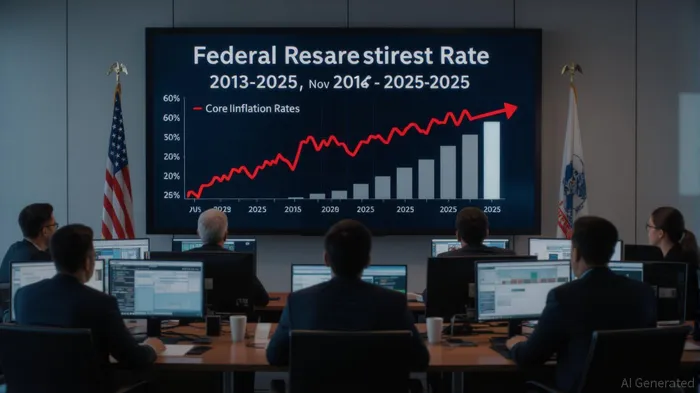 Yet, with job growth weakening and consumer confidence eroding, the Fed's pivot toward accommodative policy has created a fragile equilibrium.
For growth stocks, this uncertainty complicates valuation dynamics. Lower rates typically boost the present value of future earnings, favoring long-duration assets like tech equities. However, the Fed's caution-evidenced by its insistence that inflation remains a "primary concern"-suggests that further rate cuts in 2026 may be limited, particularly if economic growth accelerates or inflation resurges
as Goldman Sachs analysis suggests. This duality forces investors to weigh the short-term tailwinds of cheaper capital against the risk of a premature tightening cycle.
Market Reactions: A Mixed Signal for the Nasdaq
The Nasdaq index's response to the Fed's November 2025 decision was emblematic of this tension. Ahead of the rate cut, the Nasdaq 100 Index fell 0.06% on December 4, 2025, as investors grappled with conflicting signals: optimism over the anticipated easing of monetary policy and pessimism about the broader economic outlook
according to Fortune analysis. Yet, by December 8, the index had recovered some ground, with stocks hovering near record highs as traders priced in an 87.2% probability of a 25-basis-point cut
according to market minute reporting. This volatility highlights the market's sensitivity to the Fed's forward guidance.
The December rate cut also reignited hopes for a "Santa Claus rally," a seasonal phenomenon that could provide a near-term boost to growth stocks. Goldman Sachs Research notes that easier financial conditions, combined with tax cuts and reduced tariff impacts, could create a favorable environment for high-risk, high-return assets in early 2026
as Goldman Sachs analysis indicates. However, the Nasdaq's performance remains contingent on the Fed's ability to navigate its dual mandate without triggering a resurgence in inflation. As of November 2025, median one-year-ahead inflation expectations held steady at 3.2%, while medical cost expectations spiked to 10.1%-a reminder that the path to 2% remains fraught
according to New York Fed research.
Strategic Reallocation: Balancing Opportunity and Risk
For investors, the Fed's policy pivot necessitates a nuanced approach to asset allocation. Growth stocks, particularly those in artificial intelligence and energy, have historically thrived in low-rate environments. Lower borrowing costs reduce discount rates, making future cash flows more valuable-a critical factor for companies with high reinvestment needs
according to market analysis. However, the Fed's emphasis on price stability means that growth equities cannot be viewed in isolation. A cooling labor market and persistent inflationary pressures could limit the magnitude of rate cuts in 2026, capping the upside for risk assets
as Goldman Sachs analysis suggests.
Strategic reallocation should therefore focus on sectors with strong tailwinds from the Fed's pivot while hedging against macroeconomic risks. For instance, AI-driven tech firms may benefit from both cheaper capital and structural demand, but their valuations remain stretched in some cases, with many trading at premiums to fair value
according to Morningstar analysis. Conversely, defensive sectors or short-duration bonds could offer ballast in a scenario where inflation surprises to the upside or growth disappoints.
Conclusion: Navigating the Fed's Tightrope
The Federal Reserve's November 2025 decision is a microcosm of its broader challenge: walking a tightrope between inflation control and economic stability. For growth stocks, the immediate outlook is cautiously optimistic, with the Nasdaq poised to benefit from lower rates and a potential Santa rally. Yet, the Fed's divided stance and the stickiness of inflation suggest that this optimism should be tempered with caution. Investors must remain agile, adjusting their portfolios to reflect not just the Fed's current trajectory but its evolving calculus in a world of persistent uncertainty.
As the Fed prepares to meet again in early 2026, the key question will be whether its policy pivot proves sufficient to reignite growth without sacrificing its inflation credibility. Until then, the Nasdaq-and the broader market-will continue to dance on the knife's edge of monetary policy.

Stay ahead of the market.
Get curated U.S. market news, insights and key dates delivered to your inbox.






Comments
No comments yet