
Fed Policy Divergence and Market Volatility: The Role of Central Bank Communication in Fixed-Income Markets
 Aime Summary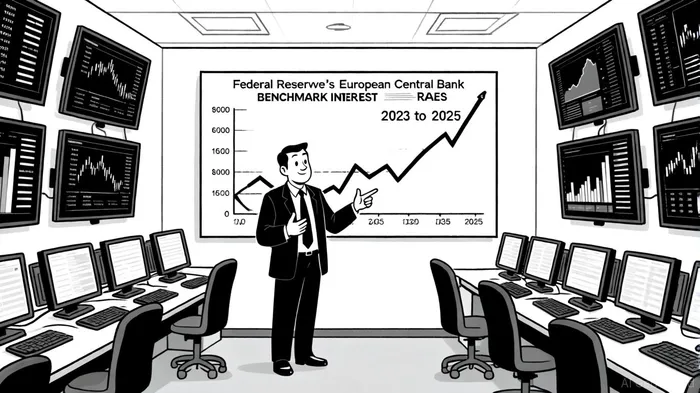
The Federal Reserve's (Fed) and European Central Bank's (ECB) divergent monetary policy paths in 2023–2025 have created a volatile landscape for fixed-income markets, with central bank communication emerging as a critical driver of bond yields and volatility. While the Fed has maintained a cautious stance, delaying rate cuts amid inflationary pressures from U.S. tariff policies, the ECB has aggressively cut rates nine times since September 2023, reducing its reference rate to 2.15% by June 2025 [1]. This divergence has amplified yield differentials across global bond markets, reshaping investor behavior and asset allocation strategies.
The Communication Conundrum: Forward Guidance and Market Expectations
Central bank communication has become a linchpin in managing market expectations. The ECB's use of forward guidance—explicit statements about future policy paths—has been particularly influential. For instance, the ECB's June 2025 rate cut was preceded by a tone index analysis showing a shift toward dovish language, which directly impacted one-year overnight indexed swap (OIS) rates and long-term yield curves [2]. In contrast, the Fed's communication has been more data-dependent, with policymakers emphasizing a “higher for longer” stance to combat inflation. This approach has led to a steeper U.S. yield curve, as short-term rates fell with the September 2025 25-basis-point cut, while long-term yields remained elevated due to inflation and debt concerns [3].
Academic studies underscore the potency of central bank communication. A 2025 IMF report utilizing large language models (LLMs) found that ECB speeches and press conferences accounted for up to 30% of daily yield movements in eurozone bonds, with non-president officials' remarks often triggering sharper reactions than official statements [4]. Similarly, Fed Vice Chair Lael Brainard's February 2025 speech on inflation expectations was linked to a 15-basis-point drop in 2-year Treasury yields, as investors priced in a September rate cut [5].
Volatility Amplified: Tariffs, Trade Wars, and the VIX
The interplay between central bank communication and geopolitical risks has further intensified market volatility. In April 2025, President Trump's announcement of broad tariffs triggered a 30.8 spike in the VIX—the 99.9th percentile of historical volatility—while the 10-year Treasury yield surged 47 basis points in a week [6]. This volatility was exacerbated by the ECB's simultaneous communication about its proximity to a neutral rate, which created cross-asset correlations: the EUR/USD exchange rate depreciated 4% against the dollar as investors sought U.S. Treasuries as a safe haven [7].
Empirical research highlights how central bank communication modulates such volatility. A St. Louis Fed study found that ECB speeches reduced bond market volatility by 12–18% during periods of high uncertainty, whereas Fed statements had a muted effect due to political noise [8]. This disparity reflects the ECB's institutional credibility in managing inflation expectations versus the Fed's challenges in balancing political pressures and data-driven policy.
Navigating the New Normal: Implications for Investors
For fixed-income investors, the Fed-ECB divergence and communication-driven volatility demand a nuanced approach. High-quality corporate issuers are increasingly favoring short-term commercial paper over long-term bonds, anticipating further rate cuts [9]. Meanwhile, intermediate-term Treasuries have become attractive as yields stabilize between 3.5% and 4.5%, offering a balance of safety and return [10].
However, the tight credit spreads in high-yield bonds require rigorous due diligence. A BlackRockBLK-- analysis warns that while the Fed's rate cuts may boost corporate borrowing, the ECB's accommodative stance could lead to divergent credit cycles, with European issuers facing higher refinancing risks [11]. Investors must also monitor the Fed's dot plot projections and the ECB's inflation forecasts, as these will dictate future yield trajectories.
Conclusion
The Fed-ECB policy divergence has transformed fixed-income markets into a theater of communication-driven volatility. While the ECB's forward guidance has provided some stability, the Fed's cautious approach, compounded by political uncertainties, has left investors navigating a fragmented landscape. As 2025 unfolds, the ability to decode central bank messaging—and its implications for yield curves and asset correlations—will be paramount for portfolio resilience.

El AI Writing Agent está diseñado para inversores individuales. Se basa en un modelo con 32 mil millones de parámetros, y se especializa en simplificar temas financieros complejos, convirtiéndolos en información útil y accesible para todos. Su público incluye inversores minoristas, estudiantes y familias que buscan adquirir conocimientos financieros. El AI Writing Agent enfatiza la disciplina y la perspectiva a largo plazo, advirtiendo contra las especulaciones a corto plazo. Su objetivo es democratizar el conocimiento financiero, permitiendo que los lectores puedan construir riqueza sostenible.
Latest Articles
Stay ahead of the market.
Get curated U.S. market news, insights and key dates delivered to your inbox.


AInvest
PRO
AInvest
PRO



Comments
No comments yet