
The Fed's Policy Dilemma: Jobs Weakness vs. Low Unemployment — Why Rate Cuts May Still Be Off the Table
 Aime Summary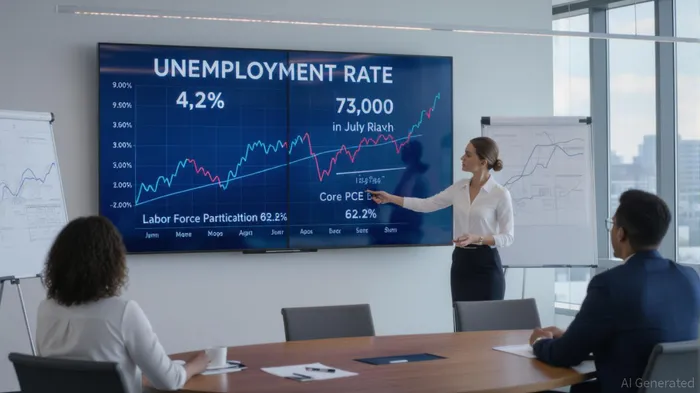
The U.S. labor market is caught in a paradox. Unemployment remains stubbornly low at 4.2%, yet job creation has slowed to a crawl, with July 2025 adding just 73,000 nonfarm payrolls—well below the 150,000 average in the first half of the year. Meanwhile, core PCE inflation clings to 2.8%, far above the Federal Reserve's 2% target. This dissonance between "soft" labor data and low unemployment has sparked debates about whether the Fed will pivot to rate cuts. But structural shifts in the labor market and entrenched inflationary pressures suggest the central bank may remain cautious, leaving investors to navigate a complex landscape of sectoral opportunities and fixed-income risks.
Structural Shifts in the Labor Market: A Tale of Two Sectors
The labor market's resilience is no longer evenly distributed. While healthcare and social assistance sectors added 73,000 jobs in July (55,000 in healthcare alone), federal government employment has plummeted by 84,000 jobs since January 2025 due to fiscal austerity. This divergence reflects a broader structural reallocation of labor toward services and away from public-sector roles. The healthcare boom, driven by aging demographics and post-pandemic demand, has offset declines in manufacturing and government jobs. However, this shift has also created bottlenecks: labor force participation remains flat at 62.2%, and the employment-population ratio has fallen by 0.4 percentage points since 2024.
The Fed's dilemma lies in reconciling these structural changes with its dual mandate. A low unemployment rate suggests the economy is near full employment, yet weak job growth and declining participation hint at underlying fragility. The central bank must ask: Is the labor market truly overheating, or is it simply adapting to new realities?
Inflation Stickiness: Services, Tariffs, and the "Supercore"
Core PCE inflation's persistence is rooted in the services sector, particularly housing and "supercore" (core services excluding housing). Rent inflation, though moderating from 4.1% year-over-year, still contributes 14 basis points to the inflation overshoot. Meanwhile, supercore inflation—driven by auto insurance, airline fares, and discretionary services—has surged to 3.19% annually, 60 basis points above the 2% target. This "supercore" has become a key driver of inflation stickiness, outpacing goods price declines and complicating the Fed's disinflation narrative.
Tariffs also play a role. The expiration of a 90-day tariff pause in July 2025 has accelerated goods price inflation, with discretionary goods contributing 28 basis points to the overshoot. While tariffs are often seen as short-term shocks, their cumulative effect on pricing behavior—especially in anticipation of future trade tensions—has created a feedback loop that prolongs inflationary pressures.
Why Rate Cuts May Still Be Off the Table
The Fed's hesitation to cut rates stems from two factors: the risk of reigniting inflation and the lagged effects of previous tightening. While the unemployment rate is low, wage growth (3.9% year-over-year) and a declining quits rate suggest labor market slack is emerging. However, the Fed is wary of cutting rates too soon, fearing that accommodative policy could stoke demand in a services-driven economy where capacity constraints persist.
Moreover, the Fed's focus on "supercore" inflation has shifted its attention from headline metrics. Services inflation, which accounts for 60% of the U.S. economy, is proving more resistant to monetary policy than goods inflation. This asymmetry means the Fed may need to maintain current rates until services inflation shows a clear downward trend—a process that could take months.
Investment Implications: Sector Rotation and Fixed-Income Caution
For investors, the Fed's policy dilemma creates divergent opportunities. Equity sectors tied to structural labor market shifts—such as healthcare, social assistance, and AI-driven productivity tools—remain attractive. Conversely, sectors sensitive to interest rates, like real estate and utilities, may face headwinds if rate cuts are delayed.
Fixed-income investors should also proceed cautiously. With core PCE inflation at 2.8% and the Fed signaling patience, Treasury yields may remain elevated for longer than expected. Short-duration bonds and inflation-linked TIPS could offer better protection against rate volatility.
Conclusion: Navigating the New Normal
The Fed's policy dilemma underscores a broader theme: the U.S. economy is no longer operating under pre-pandemic norms. Structural shifts in labor markets and services inflation have created a "new normal" where traditional indicators like unemployment and wage growth are less predictive. For investors, the key is to align portfolios with these structural trends while hedging against the Fed's cautious stance. As the central bank balances its dual mandate, patience—and a nuanced understanding of sectoral dynamics—will be critical to long-term success.

Stay ahead of the market.
Get curated U.S. market news, insights and key dates delivered to your inbox.


AInvest
PRO
AInvest
PRO



Comments
No comments yet