
The Fed's Policy Crossroads: Navigating Rate Hikes and Market Volatility Post-Trump Pressure
The Federal Reserve finds itself at a critical juncture, balancing its dual mandate of price stability and maximum employment against growing political pressures and economic uncertainties. As President Donald Trump's trade policies reshape inflation dynamics and labor market resilience, the central bank's independence faces its sternest test since the 2020 pandemic crisis. For investors, this crossroads demands a nuanced strategy: prioritizing sectors insulated from rate fluctuations while hedging against the risks of prolonged policy uncertainty.
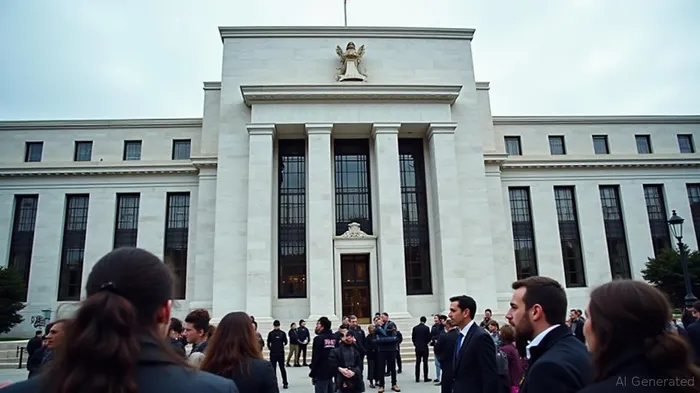
The Fed's Delicate Pause
The Federal Open Market Committee (FOMC) held rates steady at 4.25%–4.5% in its May meeting, a decision framed by Chair Jerome Powell as maintaining a “wait-and-see” approach to assess tariff-driven inflation risks. While the May CPI report showed inflation at 2.4% year-over-year—above the 2% target—the Fed noted lingering uncertainties from trade policy, which could amplify price pressures later in 2025.
The June Summary of Economic Projections (SEP) will be pivotal. Analysts anticipate a dovish tilt, with traders pricing in a September rate cut as markets bet on the Fed's patience. However, the central bank's language remains cautious: Powell emphasized that the Fed's framework review—examining its 2020 “average inflation targeting” and employment “shortfalls” language—will ensure policy remains adaptable to new challenges like persistent supply-side disruptions.
Central Bank Independence Under Siege
The Trump administration's aggressive tariff policies have injected a new layer of political risk into the Fed's calculus. While the central bank has maintained its independence, the administration's public criticism of trade partners has clouded the economic outlook. The Fed's May statement acknowledged increased inflation risks from tariffs, but stopped short of endorsing—or opposing—specific trade measures.
This political-economic tension has sparked debate over the Fed's ability to insulate monetary policy from executive branch influence. Historically, the Fed's credibility rests on its apolitical stance, but the proximity of trade decisions to inflation and employment metrics complicates that separation. For markets, this ambiguity creates a dual dilemma: pricing in rate cuts while bracing for potential policy overreach.
Bond Yields and Equity Valuations: A Volatile Dance
The tug-of-war between rate-cut expectations and policy uncertainty has created whiplash in fixed-income markets. The 10-year Treasury yield, a benchmark for mortgage rates and corporate borrowing costs, has oscillated between 3.4% and 3.8% this year—a narrow range reflecting divided investor sentiment.
Equity markets, meanwhile, face a dual challenge. Growth-sensitive sectors like tech and consumer discretionary have rallied on rate-cut hopes, while rate-sensitive sectors—utilities and real estate—have lagged as investors rotated toward perceived “winners” of an easing cycle. However, this rotation may be premature. The Fed's caution underscores that a cut is not guaranteed, and any misstep in inflation or employment data could upend expectations.
Investment Strategy: Prioritize Stability, Hedge Against Volatility
Investors should focus on sectors that thrive in low-rate environments while shielding portfolios from policy whiplash. Utilities and real estate—both rate-sensitive and dividend-heavy—offer defensive characteristics. Utilities, for instance, have historically performed well when rate cuts stabilize borrowing costs, while REITs benefit from falling mortgage rates boosting demand for commercial and residential properties.
To hedge against inflation and policy uncertainty, consider inflation-linked derivatives such as Treasury Inflation-Protected Securities (TIPS) or inflation swaps. These instruments adjust payouts with price changes, mitigating the risk of unexpected inflation spikes—a scenario where tariffs could prolong higher-than-expected costs.
Conclusion
The Fed's crossroads is not merely a technical debate over rates but a test of its institutional resilience. For investors, the path forward requires balancing exposure to sectors that benefit from rate stability with tools that insulate against the Fed's evolving challenges. Utilities and real estate provide a defensive anchor, while inflation-linked derivatives act as a shield against the storm clouds of political interference and economic uncertainty. In this environment, patience—and preparation—will be the hallmarks of prudent portfolio management.

Stay ahead of the market.
Get curated U.S. market news, insights and key dates delivered to your inbox.


AInvest
PRO
AInvest
PRO



Comments
No comments yet