
The Fed's Policy Crossroads: Betting on 2025 Rate Cuts Amid White House Pressure
The Federal Reserve stands at a critical juncture in 2025, torn between its inflation-fighting mandate and relentless political pressure to ease monetary policy. With the White House demanding aggressive rate cuts to counter tariff-driven economic headwinds, the central bank's internal divisions and external pressures are creating a fertile environment for tactical investing. Here's how to capitalize on the mispricing opportunities arising from this policy crossroads.
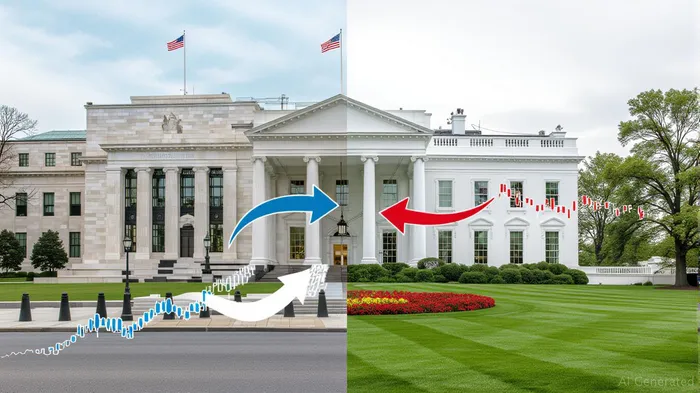
The Fed's Internal Struggle: Rate Cuts or Caution?
The June 2025 FOMC minutes reveal a stark divide among policymakers. While the median projection calls for a 3.9% federal funds rate by year-end, dissents highlight extreme ranges—from 3.6% to 4.5%. This dispersion underscores uncertainty around inflation's persistence. Core PCE inflation is projected at 3.1% for 2025, but 14 of 20 officials see upside risks, suggesting lingering inflationary pressures. Meanwhile, Fed Chair Powell has repeatedly emphasized a “wait-and-see” approach, wary of premature cuts that could reignite inflation. However, dissenters like Governors Waller and Bowman argue that tariff-induced inflation could prove transitory, justifying a July rate cut.
The Fed's dilemma is compounded by its confidence intervals: a 70% probability that 2025 PCE inflation will range from 2.0% to 4.0%. This wide spread implies markets could misprice the likelihood of a rate cut, creating opportunities in fixed income and equities.
White House Pressure: A Catalyst for Policy Shift?
President Trump's relentless criticism of the Fed—demanding “rate cuts by a lot” and threatening to replace Powell—adds political volatility. While the Fed's independence is legally shielded, the administration's trade policies have directly impacted the economy. Tariffs on Chinese imports, now at 145% on certain goods, have raised core goods PCE inflation by 0.08% (per Minton and Somale's analysis). This inflationary drag has forced the Fed to downgrade GDP growth to 1.4% for 2025 while raising inflation forecasts.
The White House's rhetoric has also influenced market expectations. shows a widening gap: the Fed's median path implies three cuts by end-2026, but futures markets price in a 50% chance of a rate cut by September . This divergence suggests markets are underestimating the Fed's potential to act sooner if tariff impacts prove temporary.
Mispricing Opportunities: Where to Bet?
Fixed Income: Short-Duration Bonds and MBS
The Fed's cautious stance has kept Treasury yields elevated (10Y at 4.3% as of June 2025), but political pressures may force an earlier pivot. Investors can exploit this by:
- Buying short-duration Treasuries (e.g., 2-5Y): These are less sensitive to rate cuts but offer a cushion if inflation cools.
- Overweighting Agency MBS: The Fed's scaled-back QT program (Treasury runoff cut to $5B/month) has reduced MBS supply, supporting prices. .
Equities: Rotate to Rate-Sensitive Sectors
If the Fed cuts rates in Q4 2025, utilities and real estate—historically rate-sensitive—could rebound. Utilities (XLU) currently trade at a 20% discount to their 10Y average P/E, while REITs (IYR) yield 5.2%, near decade highs. Meanwhile, sectors like industrials and consumer discretionary—exposed to tariff volatility—might lag unless trade tensions ease.
Commodities: Gold as a Hedge Against Policy Uncertainty
Central banks' gold accumulation (up 24% YTD 2025) signals distrust in fiat currencies. With the dollar's dominance waning (now 58% of global reserves vs. 70% in 2015), gold could surge. . Bank of America's $4,000/oz target by year-end aligns with this structural shift.
Risks and Triggers to Monitor
- Tariff Impact: If August 2025 inflation data shows core PCE exceeding 3.5%, the Fed may delay cuts, hurting rate-sensitive stocks.
- Labor Market: A U3 unemployment rate above 4.5% could force the Fed's hand, prompting a September cut.
- Global Divergence: The ECB's easing cycle and BoJ's potential rate hike create currency risks. The dollar's strength hinges on Fed policy timing.
Conclusion: Position for a Fed Pivot
The Fed's 2025 crossroads presents a clear playbook:
1. Shorten bond duration while maintaining exposure to MBS.
2. Rotate into utilities and REITs, using the S&P 500's historical resilience during Fed holds as a guide ().
3. Hold gold as insurance against policy missteps or geopolitical flare-ups.
Markets may underprice the Fed's ability to balance politics and economics—but investors who bet on a September cut or a Q4 pivot could profit handsomely. Stay disciplined, track the data, and let the Fed's crossroads work in your favor.
Disclaimer: Past performance does not guarantee future results. Always conduct your own research or consult a financial advisor before making investment decisions.

Stay ahead of the market.
Get curated U.S. market news, insights and key dates delivered to your inbox.


AInvest
PRO
AInvest
PRO



Comments
No comments yet