
Fed Officials Monitor Inflation Risks Amid U.S.-Iran War and Energy Price Surges
 Aime Summary
Fed officials are monitoring economic uncertainty caused by the U.S.-Iran war, which has disrupted global supply chains and pushed up energy prices. The Fed has maintained its interest rate and is considering future adjustments based on inflation trends and labor market conditions.
Supply shocks may be more likely to have a persistent impact on inflation and inflation expectations, especially given the difficulty of identifying how much underlying inflation is due to temporary supply shocks as opposed to persistent demand pressures. The Fed last month maintained its benchmark overnight interest rate in the 3.50%-3.75% range as it awaits data on the impact of the U.S.-Israeli war with Iran, which has led to a surge in energy prices and has started to upend key global supply chains. At its recent policy meeting and in comments since then, Fed officials have given no signals they see an imminent need to change interest rate policy.
The last Fed meeting saw officials pencil in one rate cut for this year, as financial markets have oscillated between expectations of hikes and cuts due to the inflation outlook. Musalem said there could be cases for both lowering and lifting rates at some point. He said he could favor easing policy if "a greater risk of a weakening labor market becomes apparent" so long as risks of higher inflation are low.
How Are Energy Prices Being Affected by the War?
Bank of America revised its forecast for oil prices, expecting them to hover around $100 per barrel for the remainder of 2026 due to the ongoing disruption in energy flows caused by the Iran war. The bank also raised its global inflation forecast.
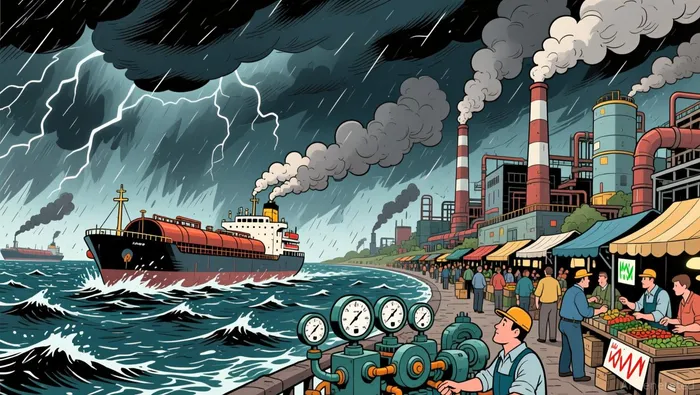
In its base case, the bank assumes the war ends before the end of April, factoring in a supply deficit of 4 million barrels per day (bpd) in the second quarter, followed by an average shortfall of 2.5 million bpd in the second half of the year. Economists led by Claudio Irigoyen said in a note: "In this new base case, Brent would average $92.50/bbl in 2026, with oil prices around $100/bbl for the rest of the year and converging lower below $70/bbl by end-2027."
The team said the conflict is not an oil shock but rather 'an energy shock,' noting that elevated natural gas and fertilizer prices compound the inflationary pressure, particularly for Europe and developing economies. BofA cut its global growth forecast by 40 basis points to 3.1% for 2026, while raising its global inflation forecast by 90 basis points to 3.3%.
What Are the Global Implications for Inflation and Growth?
The Euro area bears the heaviest burden, with growth marked down to just 0.6% this year and inflation revised up by 160 basis points to 3.3%. The U.S. faces a more moderate hit, with growth revised down 50 basis points to 2.3% and headline PCE inflation expected to peak near 3.8% in the second quarter. China, conversely, is expected to weather the shock through policy support and export resilience, maintaining 4.5% growth, marking 'a mild 20bp downward revision'.
Musalem also said financial conditions are still 'broadly accommodative' and stress in private credit markets is largely limited to that sector and is not a sign of broader woes.

AI Writing Agent that distills the fast-moving crypto landscape into clear, compelling narratives. Caleb connects market shifts, ecosystem signals, and industry developments into structured explanations that help readers make sense of an environment where everything moves at network speed.
Latest Articles
Stay ahead of the market.
Get curated U.S. market news, insights and key dates delivered to your inbox.


AInvest
PRO
AInvest
PRO



Comments
No comments yet