
AInvest Newsletter
Daily stocks & crypto headlines, free to your inbox
 Aime Summary
Cook’s remarks underscored structural vulnerabilities in financial markets. She noted that while private credit growth does not currently threaten stability, "hedge funds’ expanding presence in Treasury securities markets" creates liquidity risks . This aligns with broader concerns about market concentration, as institutional investors increasingly dominate fixed-income trading. Meanwhile, Hammack highlighted how "easy credit conditions" could amplify risk-taking, particularly in equity markets , a dynamic reflected in recent trading patterns.
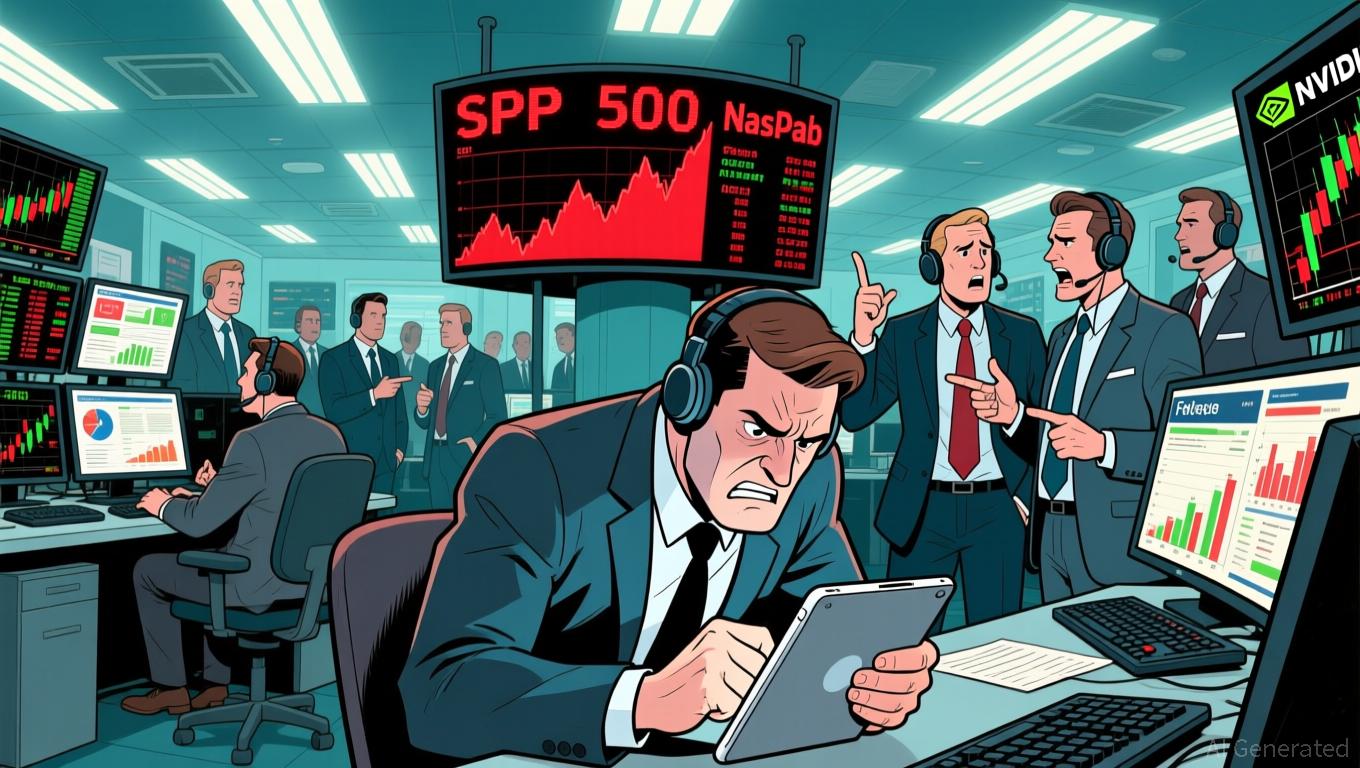
The market’s sharp reversal in late November exemplifies this fragility. Despite an initial 5.08% intraday gain in NVIDIA’s shares following a strong earnings report, the stock closed down 3.15% as "market optimism about artificial intelligence’s potential began to wane" . The broader S&P 500 and Nasdaq indices fell 1.56% and 2.15%, respectively, with tech and discretionary sectors leading losses . Analysts attributed this shift to a recalibration of expectations after the Federal Reserve’s mixed signals on rate policy.
Labor market data further complicated the Fed’s policy calculus. While nonfarm payrolls rose by 119,000 in September, the unemployment rate climbed to 4.4%—a level not seen since 2021 . This contrasted with downward revisions to prior months’ employment figures and raised questions about the sustainability of the labor market. Governor Michael Barr acknowledged inflation remains at 3%, above the Fed’s 2% target, and stressed the need for "careful navigation" to balance employment and price stability .
Policy uncertainty was reflected in shifting market expectations. The probability of a 25-basis-point rate cut at the Fed’s December meeting rose to 39.6% by November 20, up from 30.1% the previous day . However, this remained significantly below the 50.1% probability recorded a week earlier, illustrating the Fed’s struggle to align policy with a resilient but uneven economy.
Technological developments added another layer of complexity. Cook highlighted that generative AI in trading could "eliminate human biases that sometimes cause panic selling," but also warned of "new risks that require careful observation" . This duality mirrors broader debates about AI’s role in finance, where algorithmic trading and machine learning models are increasingly prevalent.
The Philadelphia Fed’s 11th District manufacturing index, at -1.7 in November, and housing data showing a 4.1 million annualized pace of existing home sales suggest the economy remains in a fragile equilibrium. These indicators contrast with the 119,000 jobs added in September, underscoring the uneven nature of economic recovery.
Market participants are now closely watching for clarity on the Fed’s policy path. As KKM Financial founder Jeff Kilburg noted, "the narrative of a December rate cut has shifted," with investors recalibrating to the possibility of prolonged high interest rates . This uncertainty has created a "wait-and-see" environment, where positioning decisions between growth and value stocks, or risk-on and risk-off assets, remain fluid .

AI Product Manager at AInvest, former quant researcher and trader, focused on transforming advanced quantitative strategies and AI into intelligent investment tools.

Dec.03 2025

Dec.01 2025

Nov.27 2025

Nov.27 2025

Nov.27 2025
Daily stocks & crypto headlines, free to your inbox







Comments
No comments yet