
Fed Leadership Stability Amid Political Turmoil: Assessing the Impact of Powell's Tenure on Market Confidence and Long-Term Investment Strategy
 Aime Summary
In the volatile interplay between monetary policy and political pressures, the Federal Reserve's leadership under Jerome Powell has emerged as a critical linchpin for global financial markets. From 2018 to 2025, Powell's tenure has been defined by a dual challenge: navigating inflationary surges and geopolitical tensions while resisting direct political interference. The Federal Reserve's ability to maintain institutional independence and credibility has not only shaped market confidence but also redefined long-term investment strategies. This article examines the interplay of these forces and offers insights for investors navigating a landscape of uncertainty.
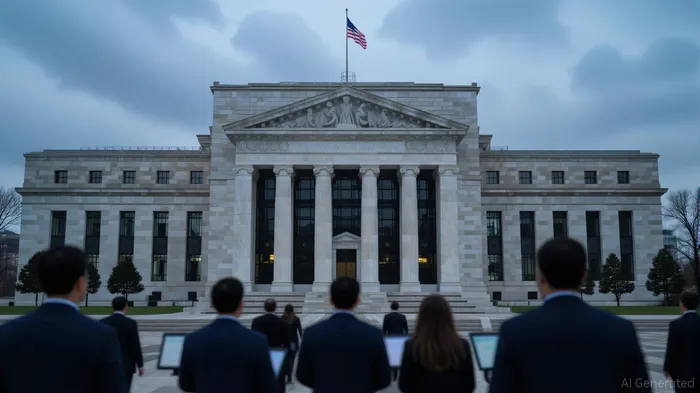
The Fed's Fight for Independence: A Pillar of Market Confidence
Powell's leadership has been tested by unprecedented political scrutiny, particularly during the Trump administration's aggressive critiques of his policies. Despite threats of removal and accusations of political bias, the Fed has preserved its institutional independence—a cornerstone of market trust. The Federal Reserve Act of 1913, reinforced by legal precedents, has shielded the Fed from arbitrary removal, but the perception of interference has introduced volatility. For instance, in May 2025, reports of Trump seeking lawmakers' opinions on replacing Powell triggered a 0.8% dip in the S&P 500 and a 1.2% drop in the U.S. dollar index before markets rebounded.
This “TACO Trade” (Trump Announces Controversial Outcome but then Cans it) dynamic has become a feature of investor behavior. While Powell's tenure has not ended abruptly, the constant threat has forced the Fed to adopt a more transparent communication strategy. Powell's emphasis on clarifying the central bank's dual mandate—price stability and maximum employment—has helped anchor expectations, even as political noise persists.
Policy Decisions: Balancing Inflation and Employment Amid Uncertainty
The Fed's 2025 policy decisions reflect a delicate balancing act. In May 2025, the FOMC held the federal funds rate steady at 4.25–4.5%, citing heightened risks from Trump's tariffs and workforce reductions. This pause allowed the Fed to assess the economic fallout from policies that, while politically motivated, risked triggering stagflation—a scenario last seen in the 1970s. Powell's acknowledgment of “dual risks” (higher unemployment and inflation) underscored the central bank's data-dependent approach.
The Fed's balance sheet normalization—a gradual reduction of Treasury and mortgage-backed securities holdings—has also been a key policy tool. By shrinking its balance sheet, the Fed aims to restore market liquidity while maintaining flexibility to respond to shocks. However, this strategy faces headwinds as inflation expectations rise. The University of Michigan's consumer inflation forecast hit 4.4% in July 2025, up from 3.8% in early 2024, reflecting growing skepticism about the Fed's ability to contain price pressures.
Institutional Investor Strategies: Hedging Against the Unknown
The evolving policy environment has compelled institutional investors to recalibrate their portfolios. Three key strategies have emerged:
TIPS as Inflation Hedges
Treasury Inflation-Protected Securities (TIPS) have gained traction as a defense against inflation. In Q2 2025, TIPS returned 0.5%, outperforming nominal Treasuries. With the 30-year Treasury yield exceeding 5%, investors are increasingly allocating to TIPS to preserve purchasing power. However, the market's pricing of a 60% chance of a September 2025 rate cut has introduced volatility, as real yields fluctuate with expectations of Fed action.Gold as a Safe-Haven Asset
Gold has surged 26% year-to-date in 2025, driven by geopolitical tensions and a weakening U.S. dollar. Central banks, including those in emerging markets, have purchased 710 tonnes of gold quarterly, signaling a shift toward diversification. Gold-backed ETFs like SPDR Gold Shares (GLD) have provided liquidity, with J.P. Morgan projecting gold to reach $3,675 per ounce by year-end.Defensive Equity Sectors
Healthcare and consumer staples have outperformed as investors seek stable cash flows. The Health Care Select Sector SPDR Fund (XLV) rose 5% in 2025, bolstered by inelastic demand for medical services. Similarly, the Consumer Staples Select Sector SPDR Fund (XLP) has benefited from rate cuts, with companies like Procter & Gamble leveraging pricing power to offset inflation.
The Road Ahead: Navigating a New Normal
As Powell's term nears its 2026 expiration, the Fed's future remains uncertain. A Trump administration could prioritize dovish policies, potentially eroding the Fed's independence. Investors must prepare for a landscape where policy uncertainty is the norm. Key actions include:
- Diversification: Allocating across TIPS, gold, and defensive equities to hedge against inflation and political risk.
- Duration Management: Shortening bond maturities to mitigate rate volatility.
- Scenario Planning: Stress-testing portfolios for stagflation or abrupt policy shifts.
The Fed's ability to maintain credibility will determine whether markets can weather the storm. For now, Powell's tenure has demonstrated that institutional independence, even under pressure, remains a vital pillar of financial stability.
In conclusion, the intersection of Fed leadership and political turmoil has reshaped investment strategies. While the path forward is fraught with challenges, a disciplined approach rooted in diversification and scenario analysis offers a roadmap for resilience. As Powell's era draws to a close, the lessons of his tenure will remain a benchmark for navigating the complexities of modern finance.

Stay ahead of the market.
Get curated U.S. market news, insights and key dates delivered to your inbox.


AInvest
PRO
AInvest
PRO



Comments
No comments yet