
The Fed's Latest Rate Decision and Its Implications for Global Markets


 Aime Summary
The Federal Reserve's November 2025 decision to cut the federal funds rate by 25 basis points,
according to reports, marks a pivotal shift in monetary policy. This move, the third consecutive rate reduction for the year, reflects a delicate balancing act between moderating inflation and addressing slowing labor market growth. With the Fed signaling a "hawkish cut"-a reduction that implies caution about further easing unless new data justifies it-investors are recalibrating their strategies to navigate the evolving landscape. This analysis explores the implications of the Fed's decision for global markets, focusing on strategic asset reallocation, sector rotations, and currency dynamics.
Strategic Asset Reallocation: Bonds, Equities, and Alternatives
The Fed's rate cuts have immediate ramifications for fixed-income and equity markets.
According to BlackRock, . This environment favors intermediate-duration bonds over long-dated ones, as
the latter face headwinds from persistent inflation and reduced global demand for U.S. Treasuries. .
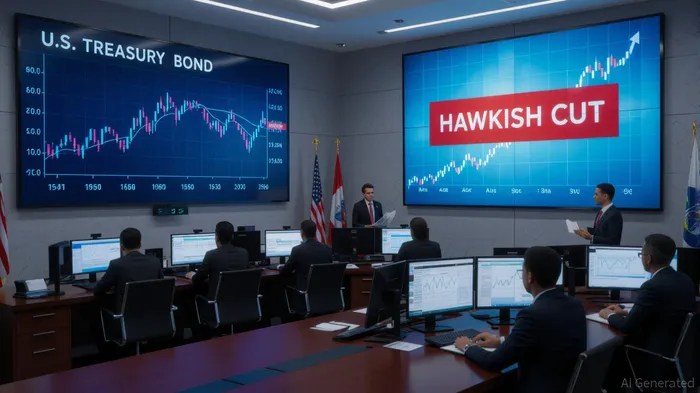 Equity markets, meanwhile, are experiencing sector rotation.
Defensive sectors such as utilities . While a dovish Fed could catalyze a "Santa Rally" in December,
concerns about stretched valuations in AI/tech stocks may temper gains. A balanced approach-tilting toward sectors with resilient cash flows while hedging against volatility-appears prudent.
Commodities: Silver's Structural Deficit and Gold's Resurgence
The Fed's rate cuts have reduced the opportunity cost of holding non-yielding assets like gold and silver, boosting their appeal.
A Saxo Bank report highlights , are creating a compelling case for the metal. .
Gold, too, benefits , .
Currency Strategies: Dollar Volatility and Hedging Opportunities
The U.S. dollar's valuation is a critical focal point.
A "hawkish cut" in December 2025 could stabilize the dollar by signaling higher barriers for future rate reductions. However, broader global dynamics-such as
's potential rate hold and the Bank of Japan's gradual normalization-may limit the dollar's upside. For major currency pairs, EUR/USD is poised to strengthen if the ECB maintains a neutral stance, while
USD/JPY faces downward pressure .
Investors are advised to adopt options-based strategies, such as long straddles or bear call spreads, to
hedge against volatility . These approaches allow participation in price movements without committing to a directional bias, a prudent tactic in an environment of heightened uncertainty.
Forward Guidance and Policy Uncertainty
The Fed's forward guidance emphasizes flexibility, with
stressing .
The central bank's plan to conclude , as balance sheet normalization could influence liquidity conditions.
Analysts at J.P. Morgan and note diverging views on the pace of future cuts, , . This uncertainty underscores the importance of dynamic asset allocation and risk management.
Conclusion
. , . , , . , .

Stay ahead of the market.
Get curated U.S. market news, insights and key dates delivered to your inbox.




Comments
No comments yet