
The Fed's Inflation Dilemma: What the September PCE Data Means for Markets
 Aime Summary
The PCE Data: A Mixed Signal for the Fed
The September PCE report highlights divergent trends in the U.S. economy. Core PCE inflation, which excludes volatile food and energy components, edged up 0.3% monthly and 2.8% annually according to the Bureau of Economic Analysis. This aligns with market expectations but falls short of the Fed's goal of sustained disinflation. Services inflation, a key component of core PCE, continues to outpace goods inflation, which rose just 0.9% year-over-year according to the Bureau of Economic Analysis. This disparity reflects persistent demand for labor-intensive sectors like healthcare and housing, complicating the Fed's assessment of inflationary pressures.
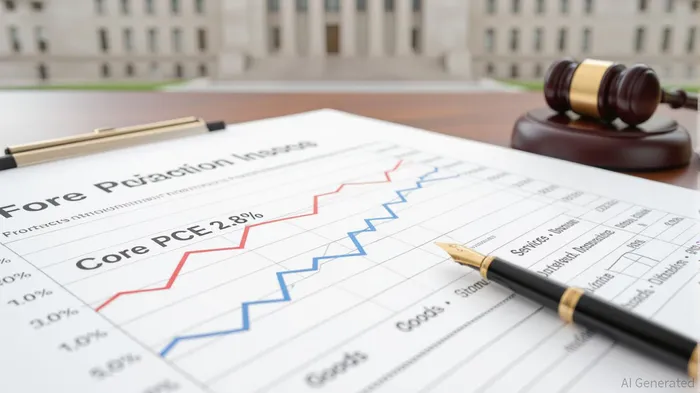 According to a report by the Bureau of Economic Analysis, the data suggests that while headline inflation is cooling, core inflation remains "stickier than anticipated," particularly in services according to the Bureau of Economic Analysis. This duality has fueled debate among Fed officials. Some argue that further rate hikes are unnecessary, given the slowing momentum in inflation, while others caution against premature easing, fearing a resurgence of price pressures according to market analysis.
Policy Implications: A Rate Cut on the Horizon?
The Federal Open Market Committee (FOMC) is set to convene on December 9-10, 2025, to deliberate its next move according to the Federal Reserve. Market expectations, as reflected in the CME FedWatch tool, indicate an 87% probability of a 25 basis point rate cut at this meeting according to financial data. This anticipation is bolstered by the latest PCE data, which shows inflation trending closer to the Fed's target. However, Fed Chair Jerome Powell has emphasized that a rate cut is "not a foregone conclusion," underscoring the central bank's data-dependent approach according to market analysis.
The Fed's dilemma lies in reconciling inflation trends with broader economic signals. While the labor market remains resilient-with unemployment projected at 4.5% in 2025 according to the Federal Reserve-manufacturing activity has weakened, and consumer affordability is strained by rising tariffs according to consumer data. These mixed signals suggest the Fed may adopt a cautious stance, prioritizing inflation control while avoiding excessive tightening that could stifle growth.
Investment Positioning: Navigating Uncertainty
Investors are already adjusting their portfolios in anticipation of a rate cut. U.S. equity futures and global indices like the Stoxx 600 have shown modest gains, reflecting a shift toward risk-on behavior according to market analysis. Defensive sectors such as healthcare and energy have outperformed, as have small-cap stocks, which are less sensitive to interest rate fluctuations according to Schwab analysis. Meanwhile, the U.S. dollar has weakened against the yen and other currencies, while Treasury yields have eased according to market analysis.
Expert analysis suggests a continued focus on quality-driven assets and sectors poised to benefit from a lower-rate environment. For instance, the energy sector has gained traction due to its exposure to inflation-linked demand, while healthcare remains a haven amid demographic-driven growth according to Schwab analysis. Investors are also hedging against potential volatility by maintaining positions in gold and crude oil, which offer protection against inflationary shocks according to market analysis.
However, the path forward is not without risks. A hotter-than-expected PCE reading could delay rate cuts, triggering a reversal in market sentiment through higher Treasury yields and a stronger dollar according to market analysis. Conversely, a cooler print may accelerate the timeline for additional cuts in 2026, extending the current momentum in risk assets according to Schwab analysis.
Conclusion: A Wait-and-See Approach
The September PCE data places the Fed at a crossroads. While inflation is trending downward, the pace of disinflation remains uneven, particularly in services. The December meeting will be critical in determining whether the Fed prioritizes further rate cuts to support growth or maintains a pause to monitor inflationary resilience.
For investors, the key is to adopt a flexible strategy that balances growth and risk management. Positioning in defensive sectors, small-cap equities, and inflation-linked assets provides a hedge against both rate-cut optimism and potential policy missteps. As the Fed navigates this inflation dilemma, staying attuned to economic data and central bank signals will remain paramount.

Delivering real-time insights and analysis on emerging financial trends and market movements.
Latest Articles
Stay ahead of the market.
Get curated U.S. market news, insights and key dates delivered to your inbox.






Comments
No comments yet