
The Fed's Inflation Dilemma and Market Resilience
 Aime Summary
Inflation Softening, but Risks Linger
The U.S. core CPI inflation rate for September 2025 stood at 3.0% year-over-year, a marginal decline from 3.1% in July and August 2025. This softening, while modest, reflects a moderation in shelter costs and transportation services, which had previously driven inflation higher according to data. However, the core CPI still rose 0.2% month-on-month in September, underscoring persistent inflationary pressures in categories like medical care (+3.3%) and used vehicles (+5.1%) as reported by BLS.
The absence of October 2025 data due to a government shutdown complicates the assessment, but trends from September and preliminary November estimates suggest core inflation likely remained near 3% according to economic analysis. While this represents progress toward the Fed's mandate, the Federal Reserve's preferred gauge-the core PCE price index-remained at 2.8% annually in September, slightly below the CPI but still above the 2% target according to Fox Business. This divergence highlights the challenge of disentangling transitory factors from structural inflationary forces.
Consumer Spending: A Mixed Signal
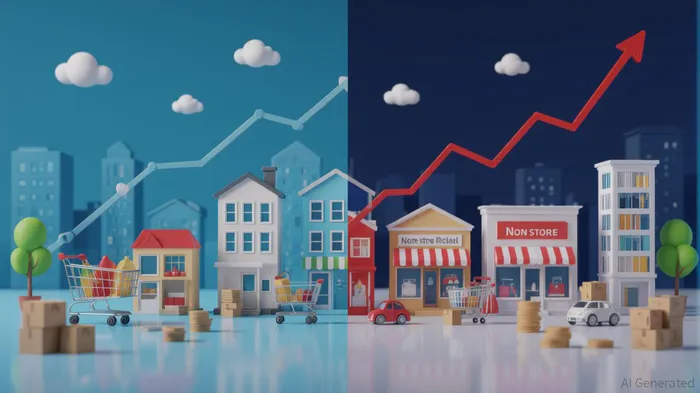 Consumer spending, a critical driver of economic growth, has shown signs of stalling. Retail sales in September 2025 increased by 0.2%, the smallest gain in four months, with declines in discretionary categories like clothing and nonstore retailers. Meanwhile, the broader Personal Consumption Expenditures (PCE) data revealed a 0.3% monthly rise in total consumer spending, with core PCE inflation at 2.8% annually according to PCE data.
This duality-robust headline spending but weakening discretionary demand-points to a bifurcated consumer landscape. Essential categories like housing and healthcare continue to see elevated spending, while consumers are pulling back on nonessentials. The Deloitte financial well-being index further underscores this trend, noting that households anticipate higher grocery prices and are prioritizing essentials over discretionary purchases. Such behavior could constrain long-term economic momentum, even as headline data remains positive.
Equity Market Resilience: A Tale of Two Sectors
The S&P 500 index demonstrated resilience in Q4 2025, gaining 0.13% in November and 2.3% in October, with a year-to-date return of 16.45% according to SP Global. This performance was largely driven by the "Magnificent Seven" tech stocks, whose dominance in the index amplified gains despite broader economic headwinds according to MMBB. However, this concentration raises questions about the sustainability of the rally.
While the market's optimism is partly fueled by expectations of a Fed rate cut in December 2025, the underlying economic fundamentals remain mixed. Below-trend GDP growth in Q4 2025 (0.8% annualized) and a rising unemployment rate (4.4% in September) suggest vulnerabilities according to Ameriprise. Moreover, elevated stock valuations and reliance on a narrow set of high-growth stocks could leave the market exposed to corrections if inflation or consumer spending data disappoint.
The Fed's Dilemma: Policy Tightening vs. Economic Stability
The Federal Reserve's next move hinges on reconciling these conflicting signals. On one hand, the moderation in core CPI and core PCE inflation provides a rationale for rate cuts, particularly if inflation continues to trend downward. On the other, the labor market's weakening and uneven consumer spending patterns could justify a cautious approach to avoid reigniting inflation.
Market participants are pricing in a high probability of a rate cut in December 2025, driven by the expectation that the Fed will prioritize economic stability over further tightening. However, this optimism may be premature. If inflation proves sticky in the coming months-particularly in sectors like housing and healthcare-the Fed could delay cuts, exacerbating market volatility.
Conclusion: A Temporary Bounce?
The current market rally appears to be a temporary bounce rather than a sustainable upturn. While inflation has softened and consumer spending remains resilient in essential categories, the broader economic environment is marked by fragility. The S&P 500's performance is heavily reliant on a narrow set of stocks, and macroeconomic risks-including a potential government shutdown and uneven labor market-remain unresolved.
Investors should remain cautious, balancing optimism about potential Fed easing with vigilance toward inflationary risks and sector-specific vulnerabilities. A sustainable market rally will require broader economic participation and a clearer path for inflation to return to the 2% target-a scenario that remains uncertain in the near term.

Delivering real-time insights and analysis on emerging financial trends and market movements.
Latest Articles
Stay ahead of the market.
Get curated U.S. market news, insights and key dates delivered to your inbox.


AInvest
PRO
AInvest
PRO



Comments
No comments yet