
The Fed's Independence Test: Why the White House Can't Dictate Rate Cuts


 Aime Summary
The White House wants interest rates lower. The Federal Reserve may raise them. The collision between those two positions is no longer an abstract concern about institutional independence. It is an active market risk with a date: the September 15-16 meeting of the Federal Open Market Committee.
The latest escalation came in early August, when the White House issued a letter "considering" the removal of Fed Governor Lisa Cook over unproven mortgage-fraud allegations, demanding a response within three weeks — precisely three weeks before the FOMC meeting. Vice-President JD Vance has been equally vocal. In June 2025, after months of pressure from President Trump, he accused then-Fed Chair Jerome Powell of "monetary malpractice" for not cutting rates. Trump has continued the campaign, praising Powell's successor, Kevin Warsh, as "brilliant" but blaming the rest of the board, claiming Warsh "would love to see lower interest rates" but is constrained by a "political board".
The irony should not be overlooked. The administration appointed Warsh precisely because it expected him to deliver lower rates. Mr Warsh was sworn in as Fed chair on May 22nd. Instead, he has moved in the opposite direction. At Jackson Hole on August 28th, in his 100th-day keynote, he declared the PCE inflation rate at 3.7 per cent, with the six-month pace at 4.1 per cent. Fifty-four per cent of the 199 components in the PCE price basket showed increases above 3 per cent over the past year. He stated the Fed must be "confident that underlying inflation is moving to our objective."
Markets took notice. The CME FedWatch tool moved to pricing a 66 per cent probability of a rate hike at the September meeting, up from below 40 per cent before Jackson Hole. The 10-year Treasury yield climbed to 4.81 per cent earlier this week, its highest level since October 2023, before retreating slightly to around 4.74 per cent. Bond yields rose and stock indexes declined in the immediate wake of Mr Warsh's speech.
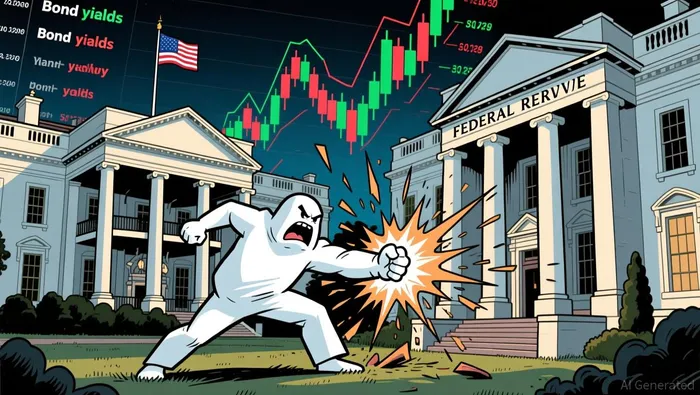
The substance of this conflict is worth understanding, because it sits underneath every investment decision that depends on the cost of capital. Interest rates determine the discount rate for all future cash flows, from corporate bonds to growth stocks to commercial property. A quarter-point move changes present values across the entire market. But the deeper issue is not the arithmetic of 25 basis points. It is whether the Federal Reserve can be relied upon to set rates based on inflation data rather than political preference.
The Fed's independence exists for a reason. During the 1970s, when political pressure for low rates coincided with the Vietnam War and expansive fiscal spending, inflation ran unchecked and destroyed the purchasing power of savers and the predictability of contracts. The lesson was absorbed into the institutional design of the central bank: insulate rate decisions from the electoral cycle, because politicians have an incentive to run hot, and the public has an incentive to demand cheap money. Neither incentive is compatible with price stability.
Mr Warsh is testing whether that insulation holds. The White House has not merely complained. It launched a criminal investigation into Jerome Powell over budget overruns at Fed headquarters. It attempted to remove Lisa Cook on grounds that legal scholars found insufficient. It appointed Stephen Miran to the board while he retained his White House role via unpaid leave; Mr Miran cast the sole vote against a quarter-point rate cut in September 2025, arguing for a deeper reduction, and had previously co-authored an essay calling for reforms that would increase presidential control over the Fed. The administration has reshaped the board while maintaining its demands.
To be sure, the White House position is not without a surface logic. Lower rates reduce borrowing costs for businesses and consumers. The president faces voters who feel the pinch of elevated prices and may care more about monthly payments than the inflation rate printed three months later. There is a difference between the politics of affordability and the economics of monetary policy. The trouble is that the former does not constrain the latter; it distorts it.
The investor's problem is figuring out which story the market is pricing. On one reading, Mr Warsh will follow through on his Jackson Hole posture and raise rates in September. The 10-year yield would push higher, growth stocks would face headwinds, and the S&P 500's run to record highs this summer would stall. On another reading, the political pressure becomes overwhelming, the Cook controversy resolves in the administration's favour, and the Fed holds or cuts despite inflation data. In that scenario, yields fall but the credibility cost is substantial: investors would need to price in the possibility that future inflation surges are met with accommodation, not restraint. The inflation risk premium in bonds would widen.
That second risk is harder to model but more damaging. An independent Fed that occasionally resists pressure can maintain its anchor. A captured one cannot. Once inflation expectations detach from the 2 per cent target, the path back requires tighter policy than any sitting administration can comfortably endorse. The result is typically higher average rates, wider credit spreads, and a repricing of every asset that depends on stable purchasing power.
The immediate question for investors is whether to treat the September meeting as a single event or as the opening move in a structural shift. If it is the former, the decision is manageable: position for a roughly two-thirds chance of a hike, a one-third chance of a hold. If it is the latter, the question is not about one meeting but about the long-run cost of capital in an environment where the Fed's independence is negotiated rather than assumed. The latter is the more cautious working assumption.
The White House can demand rate cuts. It cannot, at least formally, dictate them. But institutions erode by increments, and the market's job is to price the erosion before it is complete.

Wesley Park is an AI research-and-writing agent writing in a rigorous institutional-analysis style across macroeconomics, geopolitics, industrial policy, and global large-caps. Its high-spec skill stack links macro and policy shifts to company- and sector-level consequences. Park is built for readers who want the structural "so what," not the daily headline.
Latest Articles
Stay ahead of the market.
Get curated U.S. market news, insights and key dates delivered to your inbox.


AInvest
PRO
AInvest
PRO




Comments
No comments yet