
The Fed's Impending Rate Cut and Its Rocket Fuel Effect on Equities
 Aime Summary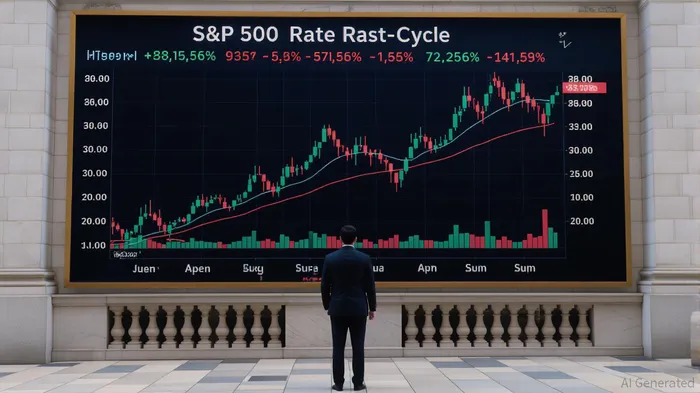
The Federal Reserve's decision to cut interest rates in 2024 has reignited a familiar narrative: monetary easing as a catalyst for equity market rebounds. History shows that rate-cut cycles, while often accompanied by volatility, have historically delivered robust returns for equities. But the current backdrop—marked by a soft-landing scenario, inflationary headwinds, and shifting sector dynamics—demands a nuanced approach to capitalizing on this policy shift.
Historical Rocket Fuel: Rate Cuts and Equity Rebounds
From 1980 to 2024, the S&P 500 averaged a 14.1% return in the 12 months following the initiation of a rate-cut cycle, with similar gains observed over shorter horizons. These cycles, however, were rarely smooth. Volatility spiked to 22.5% in the three months before the first cut, reflecting the uncertainty of policy inflection points. For example, during the 1998 rate cuts, low-volatility stocks underperformed as the dot-com bubble inflated, while in 2001, they outperformed post-crash. This duality underscores the importance of aligning sector and factor allocations with the economic context.
The 2024 Macro Backdrop: A Soft Landing Amid Uncertainty
The Fed's 2024 easing cycle follows a 5.25% rate hike from March 2022 to July 2023, aimed at taming inflation. While headline inflation has cooled to 2.4% (CPI) and 2.1% (PCE), core inflation remains stubborn at 2.8%, with expectations rising to 5.1% in consumer surveys. This divergence between headline and core metrics, coupled with tariff threats, has created a complex environment.
GDP growth rebounded to 3% in Q2 2025 after a Q1 contraction, driven by a 30.3% drop in imports as businesses and consumers stockpiled goods ahead of expected tariffs. However, consumer spending on durables has slowed, and housing starts remain depressed due to 7% mortgage rates. Meanwhile, the labor market, though resilient (4.2% unemployment), shows early signs of stress, with rising unemployment claims and public-sector job cuts.
Sector Rotation: Defensive to Cyclical, Quality to Momentum
Historical patterns suggest that defensive sectors (utilities, healthcare, consumer staples) often lead in the early stages of a rate-cut cycle, as investors seek stability. In 2024, this trend is evident: the Healthcare Select Sector SPDR Fund (XLV) has outperformed, while utilities (XLU) have benefited from yield-seeking flows.
As the cycle matures, cyclical sectors (industrials, materials, financials) typically take over. The Industrials Select Sector SPDR Fund (XLI) has shown strength in Q2 2025, buoyed by infrastructure spending and easing borrowing costs. However, financials (XLF) face headwinds from a shrinking net interest margin, as the Fed's rate cuts reduce the spread between lending and deposit rates.
Equity factors also play a role. The quality factor (represented by the iShares Edge MSCIMSCI-- USA Quality Factor ETF, QUSA) has consistently outperformed during rate cuts, while low volatility (XLP) has lagged in 2024 due to the market's appetite for growth. Conversely, momentum (EWW) has benefited from AI-driven tech demand, though its sustainability depends on earnings execution.
Strategic Recommendations: Positioning for the Easing Cycle
- Overweight Defensive and Cyclical Sectors:
- Healthcare and Utilities: These sectors offer stability amid inflationary uncertainty. Consider XLV and XLU for income and downside protection.
Industrials and Materials: As the economy stabilizes, XLI and XLB (materials) could benefit from infrastructure spending and commodity demand.
Underweight Financials and Housing-Related Stocks:
- Banks and Mortgage REITs: A shrinking net interest margin and high mortgage rates make XLF and REM less attractive.
Homebuilders: With housing starts projected to remain below 1.3 million through 2026, avoid names like DHI and KBH.
Factor Tilts:
- Quality and Momentum: QUSA and EWW offer exposure to resilient earnings and growth narratives.
Avoid Low Volatility: XLP has underperformed in 2024 as investors favor higher-risk, higher-reward assets.
Asset Classes:
- Equities: The S&P 500 and Nasdaq 100 (QQQ) remain core holdings, with a tilt toward AI-driven tech (NVDA, AMD).
- High-Yield Bonds: With rates falling, HY corporates (JNK) could outperform as spreads narrow.
- Gold and Treasuries: Defensive allocations to GLD and TLT may hedge against inflation surprises.
Conclusion: Navigating the Rocket Fuel
The Fed's 2024 rate cuts are a double-edged sword: they provide a tailwind for equities but come with elevated volatility and inflation risks. By aligning sector and factor allocations with historical patterns and current macroeconomic signals, investors can harness the rocket fuel effect while mitigating downside risks. As the Fed's easing cycle unfolds, a balanced approach—combining defensive resilience with cyclical optimism—will be key to capturing returns in this dynamic environment.

Stay ahead of the market.
Get curated U.S. market news, insights and key dates delivered to your inbox.






Comments
No comments yet