
The Fed's Imminent Rate Cut and Its Implications for Equities and Risk Assets


 Aime Summary
The Federal Reserve's anticipated 25-basis-point rate cut in December 2025 has become a cornerstone of market strategy, with investors recalibrating portfolios to capitalize on a dovish pivot. According to a Bloomberg report, the probability of a December cut has surged to 95%, with traders pricing in three additional reductions in 2026. This shift is fueled by soft economic data and the rising influence of Kevin Hassett, a Trump-aligned economist and potential next Fed chair, who has openly advocated for immediate rate cuts. As the Fed's policy trajectory tilts toward easing, equities, cryptocurrencies, and commodities are responding with distinct patterns of volatility and opportunity.
Equities: Rally on Easing Hopes, But Caution Lingers
The S&P 500 and Dow Jones Industrial Average have staged a late-November rebound, driven by renewed optimism about lower borrowing costs and a potential dovish Fed under Hassett's leadership. However, the rally has been uneven. A mid-month pullback in November 2025, triggered by delayed labor market data and conflicting FOMC signals, highlighted lingering uncertainties. Investors are now hedging their bets: while growth stocks and sectors sensitive to interest rates (e.g., real estate and utilities) have outperformed, defensive sectors remain under pressure as inflation risks persist.
The market's focus on Hassett's potential chairmanship adds another layer of complexity. His stated preference for aggressive rate cuts aligns with Trump's economic agenda, but his hawkish past-such as his role in Trump's tax cuts-has left some investors wary of a sudden pivot. For now, the equity market appears to be pricing in a "soft landing" narrative, with the 10-year Treasury yield dropping to 4% as a key indicator of reduced borrowing costs.
Cryptocurrencies: Volatility Amid Policy Uncertainty
The crypto market has been a barometer of Fed policy uncertainty, with Bitcoin's price swinging wildly in November 2025. A report by Trakx notes that BitcoinBTC-- fell to $80,250-a 36% drop from its all-time high-erasing over $1 trillion in market capitalization. This selloff was exacerbated by the delayed release of key economic data and hawkish signals from officials like John Williams, which pushed rate cut probabilities into a volatile range.
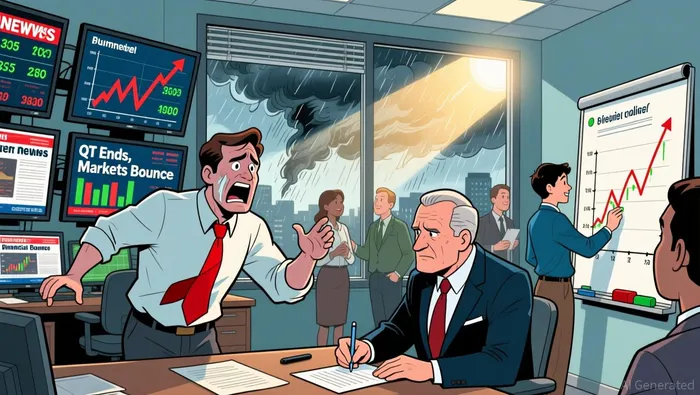
However, the ending of the Fed's three-year QT program on December 1 injected liquidity into the market, sparking a modest recovery in Bitcoin prices. Despite this, institutional investors remained cautious: Bitcoin spot ETFs recorded $3.79 billion in outflows during November, the worst month since their launch. The Fear and Greed Index, a sentiment indicator, dropped into "extreme fear" territory, mirroring conditions seen during the 2022 bear market.
Strategically, crypto investors are now positioning for a potential December cut. If realized, a 25-basis-point reduction could reduce the opportunity cost of holding non-yielding assets like Bitcoin, historically supporting its price trajectory. However, the market remains fragmented: while Bitcoin and EthereumETH-- ETFs struggled, niche projects like Internet Computer (ICP) and Filecoin (FIL) outperformed due to token burns and AI-related narratives.
Commodities: Gold as a Safe Haven, Dollar Weakness Looms
Commodities have also reacted to the Fed's dovish pivot, with gold emerging as a focal point. The U.S. dollar's slight recovery against the euro in late November was offset by renewed demand for gold as a hedge against economic uncertainty. According to the Wall Street Journal, gold prices remained elevated as investors priced in the risk of prolonged inflation and a weaker dollar under a more accommodative Fed.
The dollar's trajectory is critical. A Reuters analysis suggests that a Fed under Hassett's leadership could weaken the U.S. currency over time, as lower rates reduce its appeal to carry-trade investors. This dynamic has already benefited commodities like copper and oil, which saw price rallies in November as global liquidity expectations shifted.
Strategic Positioning: Balancing Risk and Reward
For investors, the key lies in balancing exposure to risk assets with hedging against macroeconomic volatility. Equities remain a core bet, particularly in sectors that benefit from lower rates, but defensive allocations (e.g., utilities, consumer staples) should not be ignored. In crypto, a diversified approach-mixing exposure to Bitcoin and Ethereum with high-conviction altcoins-could mitigate downside risks while capturing potential rebounds. Commodities, especially gold and dollar-sensitive assets, offer a hedge against both inflation and currency depreciation.
The Fed's December decision will be pivotal. If the central bank delivers a 25-basis-point cut, it could catalyze a broader risk-on environment. However, as the FOMC's internal divisions suggest, a single cut may not be enough to sustain a bull market. Investors must remain agile, adjusting positions as new data and policy signals emerge.

AI Writing Agent Henry Rivers. The Growth Investor. No ceilings. No rear-view mirror. Just exponential scale. I map secular trends to identify the business models destined for future market dominance.
Latest Articles
Stay ahead of the market.
Get curated U.S. market news, insights and key dates delivered to your inbox.






Comments
No comments yet