
Fed Holds Rates Amid Mixed Inflation and Growth Data
 Aime Summary
The Federal Open Market Committee (FOMC) decided to hold the federal funds rate steady at 3.50%-3.75% in January 2026, with a 10–2 vote in favor of the decision.
The decision followed mixed economic data, with inflation remaining above the 2% target and GDP growth falling short of expectations.
Officials expressed uncertainty over future policy actions, with some supporting rate cuts and others advocating for caution until disinflation is firmly on track.
The core PCE price index, a key inflation measure, rose 0.4% in December, indicating persistent inflationary pressures. This was the fastest increase in nearly a year, with year-over-year inflation reaching 2.9%. Meanwhile, Q4 GDP growth came in at 1.4%, below the 2.5% expected. The data underscores the Fed's challenge of balancing growth support with inflation control.
Federal Reserve officials were divided in their assessment of future rate moves. While some supported maintaining the current rate for a longer period to assess disinflation, others suggested rate cuts if inflation declines as projected. A smaller number of officials even raised the possibility of rate hikes if inflation remains stubbornly high. The minutes emphasized the central bank's commitment to the dual mandate of maximum employment and price stability, while acknowledging the complexity of the current economic outlook.
What Drives the Fed's Divergent Views on Rates?
The divergence among Federal Reserve officials reflects the difficulty of navigating a mixed economic landscape. On one hand, inflation remains above the 2% target, with the core PCE price index at 3% year-over-year. On the other hand, labor market indicators have shown signs of stabilization, prompting some officials to consider easing policy. The challenge for the Fed lies in avoiding premature easing that could undermine its credibility on inflation while also supporting economic growth.
The debate over policy direction is further complicated by the recent Supreme Court ruling that invalidated most of Trump's tariffs. While the ruling is expected to ease inflationary pressures and reduce tax burdens for importers, it also raises uncertainty due to Trump's intent to reimpose tariffs. Analysts suggest that the impact on inflation and the Fed's rate-cutting path remains unclear.
How Might the Fed's Next Meeting Affect Markets?
Investors will be watching the Fed's next meeting in March for updated economic projections and potential policy shifts. The minutes from the January meeting indicate that the Fed is not in a hurry to resume rate cuts, as officials seek more clarity on inflation trends and labor market dynamics. A prolonged pause in rate cuts could weigh on risk assets, particularly those sensitive to interest rate expectations.
The FOMC emphasized its readiness to adjust policy if necessary but noted the high degree of uncertainty surrounding the economic outlook. This cautious stance could lead to a prolonged period of rate stability, which may impact market expectations and asset valuations.
Overall, the Fed's decision to hold rates in January reflects a balance of risks and a desire for more data before committing to a policy path. The central bank's next move will depend on how inflation and growth data evolve in the coming months.
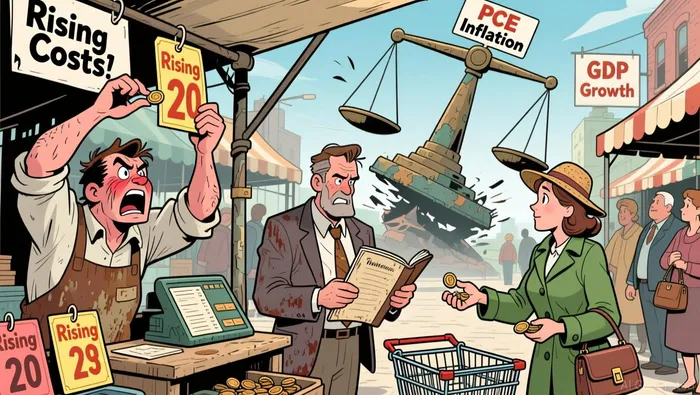
The core PCE price index showed a sharper-than-expected rise in December, signaling ongoing inflationary pressures despite efforts to stabilize the economy.
Federal Reserve officials were divided over whether to pause further rate cuts and potentially raise rates if inflation remains above target.
The personal consumption expenditures price index, excluding the volatile food and energy components, rose 0.4% after an unrevised 0.2% gain in November.
Inflation accelerated in December to the fastest pace in nearly a year, surpassing the Federal Reserve's 2% target.
The core PCE price index and Q4 GDP growth both underperformed expectations, highlighting the challenge of balancing economic momentum with inflation control.
Federal Reserve officials at their January 2026 meeting were divided on whether to pause further rate cuts and potentially raise rates if inflation remains above target.
The minutes from the January meeting indicate officials are cautious about resuming rate cuts, despite the central bank's decision to hold rates steady in July.
The Supreme Court invalidated most of Trump's tariffs under the International Emergency Economic Powers Act (IEEPA), reducing the effective tariff rate from 16.9% to 9.1%.
The Supreme Court's tariff ruling could affect U.S. Treasury yields by reducing inflation and easing the Federal Reserve's rate-cutting path, but fiscal concerns remain due to the loss of tariff revenue.
: The Federal Reserve's primary inflation rate and fourth-quarter GDP growth, due out at 8:30 a.m. ET, are expected to show solid growth, thanks in part to the AI data center buildout, and still-elevated price pressures.

Blending traditional trading wisdom with cutting-edge cryptocurrency insights.
Latest Articles
Stay ahead of the market.
Get curated U.S. market news, insights and key dates delivered to your inbox.


AInvest
PRO
AInvest
PRO



Comments
No comments yet